
Baroque & Rococo
Versailles' grandeur, the Dutch room, and the Rococo comfort revolution.
The age of the decorated interior. Baroque overwhelms — Versailles’ Hall of Mirrors, marble and ormolu, and the state bedchamber run as public ceremony; the restrained Dutch room of Vermeer is its counterpoint. Then Rococo brings intimacy, asymmetry and the great comfort revolution in seating — the fauteuil and the deep bergère — while England’s story is furniture-led and mahogany-based, from Palladian rooms to Chippendale’s Director.
Learning objectives
By the end of this lesson, you will be able to — mapped to the course outcomes for Evolution of Interiors I:
Describe the Baroque interior and Versailles, and the ceremony of the state bedchamber.
Contrast the restrained Dutch bourgeois interior with the court Baroque.
Explain Rococo intimacy, the rocaille and boiserie, and the seating comfort revolution.
Identify chinoiserie, the commode, and the English cabinetmakers led by Chippendale.
Baroque & the Dutch counterpoint
Versailles and the ceremony of the state bedchamber, Boulle marquetry, and the restrained bourgeois Dutch interior as deliberate contrast.[1, 2, 3]
Scale, drama, illusion — Versailles
The Baroque interior overwhelms with scale, movement, rich materials and trompe-l'œil ceilings that open to painted skies. VERSAILLES is the definitive secular example: under LOUIS XIV, the painter CHARLES LE BRUN directed a total decorative program; the GALERIE DES GLACES (Hall of Mirrors, 1678–1684) sets seventeen mirror-clad arches — mirrors then an extravagant luxury — against garden windows, with a glorifying painted ceiling, gilt bronze and marble. Light, reflection and gold as instruments of royal display.[1, 3]
Rococo & the English 18th century
The salon, the rocaille and boiserie, the comfort revolution of the fauteuil, bergère and commode, chinoiserie, and the mahogany world of Chippendale’s Director.[1, 3, 4]
The salon, rocaille and boiserie
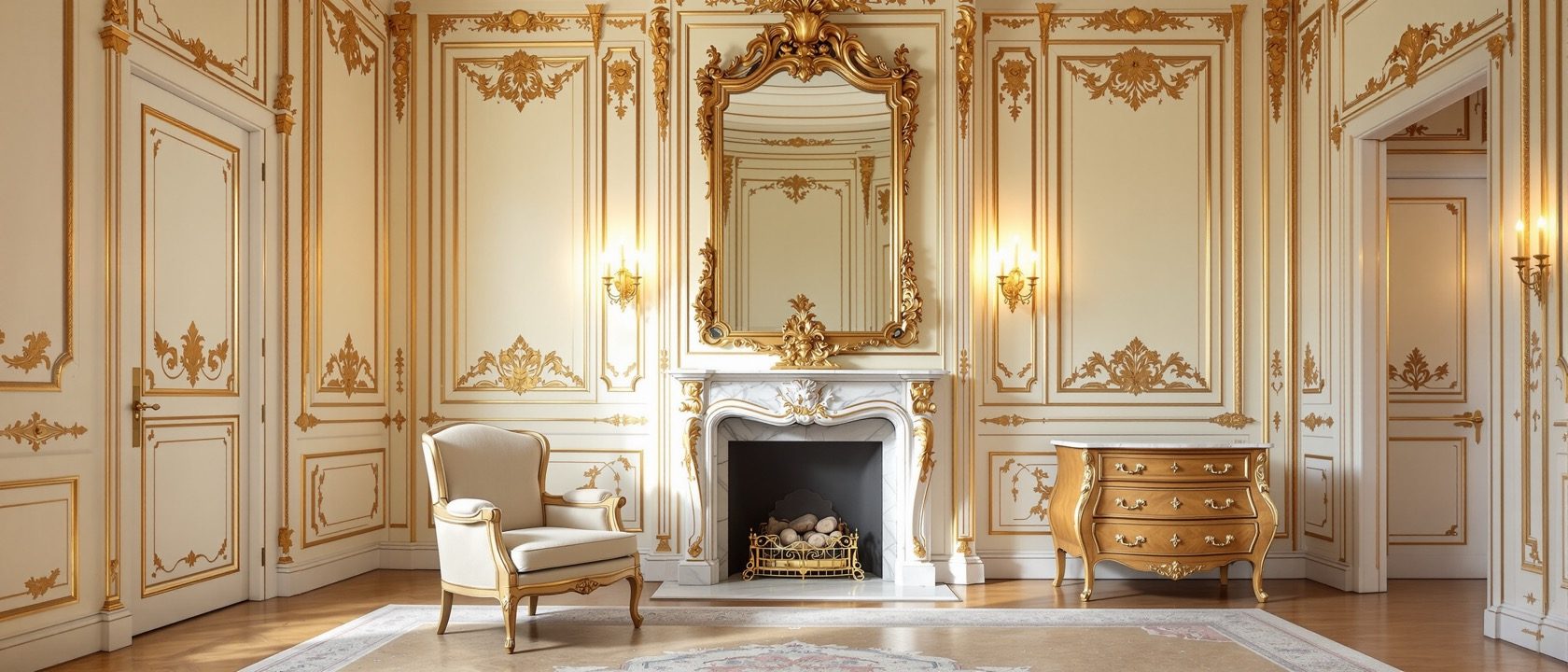
Rococo (c. 1715–1760, from the Régence into LOUIS XV) is a reaction WITHIN the French court toward smaller, more comfortable, intimate rooms — the age of the SALON and the hôtel particulier, sociable conversational life led substantially by women. The ROCAILLE is the defining ornament: ASYMMETRICAL, based on rock-work, shells and C- and S-scrolls (the word 'Rococo' comes from rocaille). BOISERIE — carved, painted wood panelling (white-and-gold or pastel) with curved gilt-edged panels — dissolves the room's corners; mirrors over chimneypieces multiply light.[1, 2]
At a glance
| Aspect | One side | The other |
|---|---|---|
| Baroque vs Rococo | Baroque: grand, heavy, symmetrical, awe | Rococo: intimate, light, asymmetrical, charm |
| The king's bedroom | Myth: private | Reality: a public ceremonial stage (the lever) |
| 'Chippendale' | Myth: all made by one man | Reality: a style spread by his printed Director |
| Chinoiserie | Myth: authentic Chinese design | Reality: a European fantasy of China |
| Rococo | Myth: just frivolous decoration | Reality: a real advance in comfort and sociability |
Key terms
Versailles' Galerie des Glaces (1678–84) — mirror-clad arches, a flaunting of costly glass.
André-Charles Boulle's inlay of tortoiseshell and brass in scrolling patterns.
The asymmetrical rock-and-shell ornament that gives Rococo its name.
Carved, painted wood wall panelling with curved gilt-edged panels.
A deep, enclosed upholstered armchair with a loose cushion — the Rococo comfort chair.
The low, often bombé chest of drawers — the signature Rococo case piece.
Study task
Put a Baroque Versailles room and a restrained Dutch bourgeois room side by side in two annotated sketches, listing three ways each expresses its culture (court display versus bourgeois order). Then sketch and label the Rococo comfort trio — the fauteuil, the bergère and the commode — and write two sentences arguing that Rococo was a genuine advance in how interiors serve living, not mere frivolity.
Self-assessment
1. The state bedchamber at Versailles teaches that —
2. The signature Rococo comfort chair, deep and enclosed with a loose cushion, is the —
3. 'Chippendale' furniture is best understood as —
Recap
References & further reading
- [1]John Pile & Judith Gura, A History of Interior Design, Laurence King / Wiley (Baroque, Rococo, English 18th-century chapters).
- [2]Mario Praz, An Illustrated History of Interior Decoration: From Pompeii to Art Nouveau, Thames & Hudson (Dutch and 18th-c. rooms via period paintings).
- [3]John Morley, The History of Furniture, Thames & Hudson / Bulfinch, 1999 (Boulle, the commode, French and English 18th-c. furniture).
- [4]Thomas Chippendale, The Gentleman and Cabinet-Maker's Director, 1754 (a primary source; Dover reprint); Peter Thornton, Authentic Decor 1620–1920.
Further reading
- Peter Thornton — Authentic Decor: The Domestic Interior 1620–1920.
- Mario Praz — An Illustrated History of Interior Decoration.
- John Morley — The History of Furniture.
Sources gathered and fact-checked June 2026. Published values vary by source, sample and method — treat as indicative and confirm against the cited standard before structural use.
The author
Amogh N P
Architect, interior designer, and creative polymath. Studio Matrx began in his notebooks — his vision of design made honest, useful, and open to everyone. Its Academy is written and taught in his memory, and free, forever.
More about Amogh →