
The Ancient World
Egypt, the Indus, Greece and Rome — the first interiors we can read.
The earliest interiors we can reconstruct in real detail are Egyptian — because a funerary culture buried furniture for the afterlife and a dry climate preserved it. Meet the Indus Valley courtyard house (whose furniture did not survive), the Greek symposium and the beautiful klismos chair, and the Roman domus with its wall-painting and underfloor heating. A lesson runs through the whole course: interiors survive far worse than facades.
Learning objectives
By the end of this lesson, you will be able to — mapped to the course outcomes for Evolution of Interiors I:
Describe Egyptian interiors and furniture, and why they survive so well.
Explain the Indus Valley courtyard house and why its furnishing is inferred.
Describe Greek interiors and the klismos, and Roman domus, insula and dining.
Explain the Four Pompeian styles, mosaic and the hypocaust.
A map of the whole journey
Before we begin, scan the periods you will meet — and notice the Mughal and Rajput track running in parallel with Europe.
Style-period explorer · the interior through time
Ancient
c. 3000 BCE – 400 CE
Egypt · Greece · Rome
- The interior
- Inward-looking courtyard and atrium houses; elite dining done reclining on couches; painted-plaster walls and mosaic floors.
- Furniture
- Animal-leg chairs and stools, chests and headrests (Egypt); the klismos chair and klinē couch (Greece); couches, folding stools and cupboards (Rome).
- Ornament
- The Four Pompeian wall-painting styles, floor mosaic, and the hypocaust — Rome's underfloor heating.
The Mughal & Rajput interior runs in PARALLEL with Europe’s Renaissance–Neoclassical span — a distinct, floor-based tradition.
Egypt, the Indus & Greece
Egyptian furniture preserved by a funerary culture, the Harappan courtyard house whose furnishing is inferred, and the Greek symposium and klismos.[1, 2, 4]
Buried for the afterlife
Egyptian interiors are the earliest we can reconstruct in furniture detail, precisely BECAUSE objects were buried for use in the afterlife and the dry climate preserved wood and textiles. The house of the living was cool mud-brick with high clerestory openings; the furniture was a mature craft — STOOLS (including the folding stool) as the common seat, CHAIRS with animal-paw legs signalling rank, BEDS with a curved neck-rest instead of a pillow, and CHESTS as primary storage. Luxury meant ebony, ivory inlay and gilding, with true mortise-and-tenon and dovetail joints. Tutankhamun's tomb is the complete New-Kingdom interior kit.[1, 2]
The Roman interior
The domus and insula, the Four Pompeian wall-painting styles, mosaic floors and the hypocaust — the first richly documented interior decoration.[1, 3]
Atrium, peristyle, triclinium
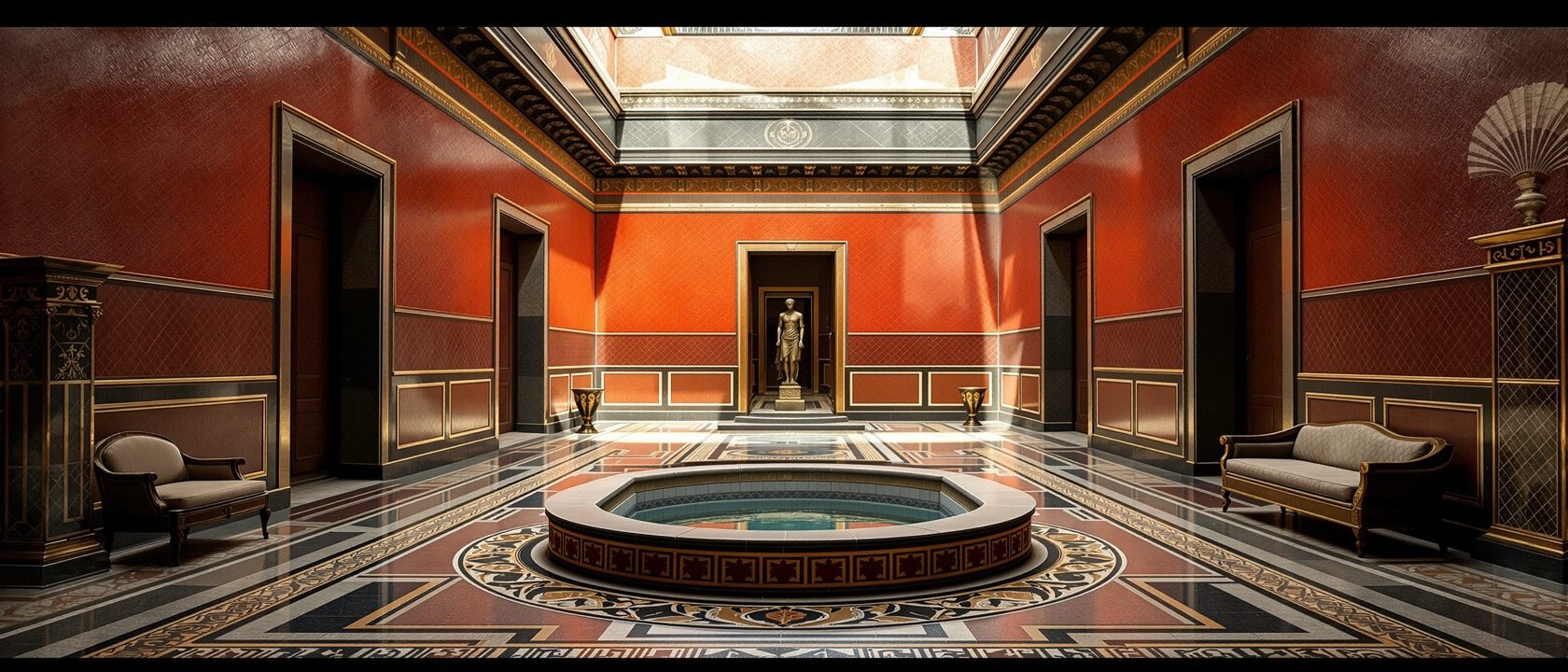
The Roman elite DOMUS was entered through a passage into the ATRIUM — a hall with a roof opening (compluvium) over a catch-basin (impluvium) — flanked by small bedrooms (CUBICULA), opening at the rear onto a colonnaded garden PERISTYLE. The dining room was the TRICLINIUM, named for its three couches set in a U for nine reclining diners. Ordinary Romans lived in the INSULA, the cramped multi-storey apartment block — the counterpoint to elite comfort. Interior life was organised around light-wells and the axial vista through the house.[1]
At a glance
| Aspect | One side | The other |
|---|---|---|
| Egyptian sleeping | Myth: on a pillow | Reality: a rigid curved neck-rest |
| Harappan furniture | Myth: we know how they furnished homes | Reality: inferred — furniture didn't survive |
| Greek & Roman dining | Myth: seated at a table | Reality: reclining on couches |
| The klismos | Myth: a Roman chair | Reality: Greek — Rome preferred heavier forms |
| Classical interiors | Myth: pure white marble | Reality: painted, polychrome |
Key terms
The Greek chair with sabre-curved legs and a curved back — known from images, revived in Neoclassicism.
The Greek male drinking party, and the dining room where men reclined on klinē couches.
The Roman domus's central hall with a roof opening over a water basin (impluvium).
The Roman dining room — three couches in a U for nine reclining diners.
Mau's classification of Roman wall painting — masonry, architectural, ornate, intricate.
Roman underfloor heating — floors on brick pillars with hot air circulating beneath.
Study task
Draw an annotated plan of a Roman domus, labelling the fauces, atrium, impluvium, cubicula, tablinum, peristyle and triclinium, and mark the axial vista. Then write a short paragraph on the Indus Valley courtyard house explaining honestly what we know (brick, drainage, plan) and what we infer (floor-based living) — and note one way the Harappan court anticipates the later Indian haveli.
Self-assessment
1. We can reconstruct Egyptian furniture in detail mainly because —
2. For the Indus Valley interior, a designer should say we —
3. The Four Pompeian styles are fundamentally about —
Recap
References & further reading
- [1]John Pile & Judith Gura, A History of Interior Design, Laurence King / Wiley (Egypt, Greece, Rome chapters — the course spine).
- [2]Gisela M.A. Richter, The Furniture of the Greeks, Etruscans and Romans, Phaidon, 1966 (the klismos, klinē — the scholarly furniture source).
- [3]Roger Ling, Roman Painting, Cambridge University Press, 1991 (authoritative on the Four Pompeian styles).
- [4]Jonathan Mark Kenoyer, Ancient Cities of the Indus Valley Civilization, Oxford University Press, 1998 (Harappan domestic life and infrastructure).
Further reading
- John Pile & Judith Gura — A History of Interior Design.
- Gisela M.A. Richter — The Furniture of the Greeks, Etruscans and Romans.
- Jonathan Mark Kenoyer — Ancient Cities of the Indus Valley Civilization.
Sources gathered and fact-checked June 2026. Published values vary by source, sample and method — treat as indicative and confirm against the cited standard before structural use.
The author
Amogh N P
Architect, interior designer, and creative polymath. Studio Matrx began in his notebooks — his vision of design made honest, useful, and open to everyone. Its Academy is written and taught in his memory, and free, forever.
More about Amogh →