
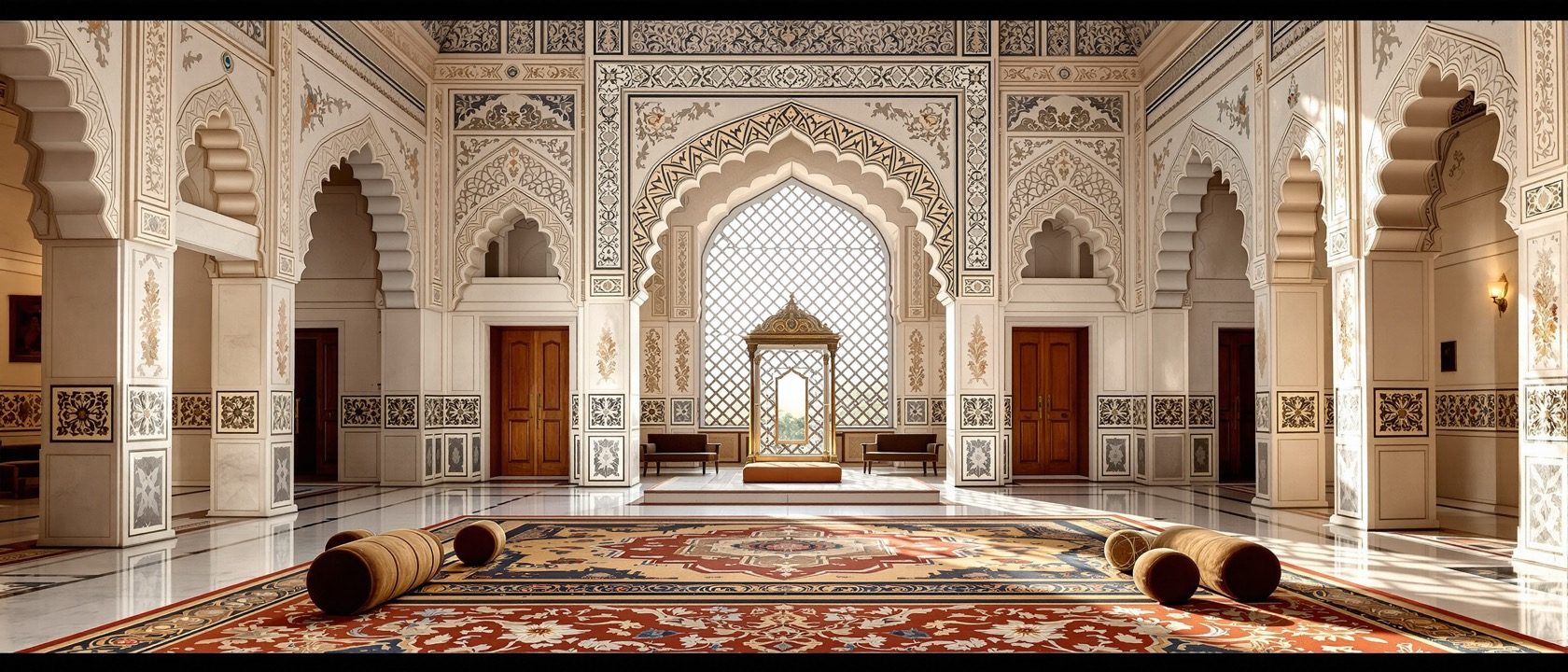
Neoclassical & Mughal India
Adam's antique restraint — and the parallel Indian interior tradition.
Neoclassicism is the disciplined reaction to Rococo — antique order fired by the excavation of Pompeii, and Robert Adam’s total, integrated interior. Set beside it is the magnificent, wholly distinct Indian interior — Mughal garden-connected pavilions and the diwan, floor seating on carpets and masnad bolsters, parchin kari and the jali, and the courtyard haveli that closes the circle back to the Harappan court and bridges to Part II.
Learning objectives
By the end of this lesson, you will be able to — mapped to the course outcomes for Evolution of Interiors I:
Explain Neoclassicism, Robert Adam's integrated interior and the klismos revival.
Describe the Mughal interior — the diwan, floor seating, jharokha and jali.
Explain parchin kari, shish mahal and the Rajput palace interior.
Evaluate the courtyard haveli as a domestic system and the bridge to Part II.
Neoclassicism
The reaction to Rococo fired by Pompeii, Robert Adam’s room-as-one-scheme, and the Greek klismos returning to close the Western circle.[3]
Antique order, fired by Pompeii
By mid-century, Rococo asymmetry provoked a return to ANTIQUE order, straight lines, symmetry and restraint — powered by the excavation of HERCULANEUM (from 1738) and POMPEII (from 1748), which supplied an authentic vocabulary of ancient ornament, and by writers like Winckelmann (who idealised a 'noble white' antiquity — itself a misreading, since ancient interiors were polychrome). Ornament now draws on the antique: urns, swags, paterae, husks, the anthemion and Greek key, all flat, delicate and symmetrical.[3]
The parallel Indian interior
The Mughal diwan and floor seating, the precise decorative techniques (parchin kari, jali, shish mahal), and the courtyard haveli as a whole domestic system — the bridge to Part II.[1, 2]
Garden, diwan, floor seating
Running through the same centuries, Mughal India (c. 1556–1750) developed a wholly distinct interior. Space is organised around the CHAR-BAGH (fourfold garden) and water — the interior OPENS TO the garden through arcades and pavilions, the inside/garden boundary deliberately porous. The DIWAN audience halls (Diwan-i-Am and Diwan-i-Khas) are furnished not with rows of chairs but with the throne, CARPETS and MASNAD bolsters: the emperor raised on a platform, the court on carpets — floor-based ceremonial seating, continuous with the older Indian tradition. The JHAROKHA (projecting balcony) is an interior-threshold device of great ceremonial importance (jharokha darshan).[1]
Retrospective — the seat as status
Trace a single idea from the Egyptian animal-leg chair to the Mughal masnad — who sits, how high, and on what.
The seat as status · one idea across 3,000 years
Egyptian chair
New Kingdom Egypt · c. 1550–1070 BCE
A chair with a back and arms signalled rank; legs were carved as lion or bull paws, in ebony with ivory inlay and gilding. Egypt bequeathed the animal-leg convention to the whole later Western tradition.
Who sits, how high, and on what — from the Egyptian animal-leg chair to the Mughal masnad, the seat has always encoded status.
At a glance
| Aspect | One side | The other |
|---|---|---|
| Neoclassical 'white' | Myth: it copied antiquity's real colours | Reality: it copied a mistaken pale image |
| Robert Adam | Myth: only an architect | Reality: the founder of the total integrated interior |
| Parchin kari (pietra dura) | Myth: it is Italian | Reality: a distinctively Mughal art; origin debated |
| Indian interiors | Myth: 'empty' / lacking furniture | Reality: a rich floor-based system (a colonial misreading) |
| The jharokha | Myth: just a window | Reality: a ceremonial interior-threshold device |
Key terms
Robert Adam's total integrated interior — walls, ceilings, carpets and furniture as one delicate scheme.
The Greek chair returning as high fashion in Neoclassicism — a full circle to antiquity.
The Mughal audience hall — throne, carpets and masnad bolsters, not rows of chairs.
A projecting balcony/oriel — a ceremonial interior-threshold device (jharokha darshan).
Mughal hardstone inlay in marble (the Italian term is 'pietra dura'); foreign origin debated.
The traditional Indian courtyard mansion — a whole domestic interior system.
Study task
Draw and annotate a Mughal diwan interior, labelling the scalloped arches, the garden connection, the throne platform with carpet and masnad bolsters, the jharokha and a jali screen — and mark one panel of parchin kari, noting honestly that its Florentine origin is debated, not fact. Then write a short reflection: pick one European period and one Indian feature from this course and explain what each teaches about how an interior expresses its culture — the theme Part II will carry forward.
Self-assessment
1. Robert Adam's key contribution to interior design was —
2. Mughal hardstone inlay in marble is properly called —
3. The Mughal diwan was furnished with —
Recap
References & further reading
- [1]Catherine B. Asher, Architecture of Mughal India, Cambridge University Press, 1992 (Mughal palace interiors, diwan, jharokha, parchin kari).
- [2]George Michell, The Royal Palaces of India / Indian architecture surveys (Rajput and regional palace interiors and the haveli).
- [3]Peter Thornton, Authentic Decor: The Domestic Interior 1620–1920, and Mario Praz, An Illustrated History of Interior Decoration (Adam-period and Louis XVI interiors).
- [4]Robert & James Adam, The Works in Architecture, 1773–1822 (primary source); Sunand Prasad, scholarship on the Indian house and the haveli courtyard system.
Further reading
- Catherine B. Asher — Architecture of Mughal India.
- George Michell — Indian architecture and palace surveys.
- Peter Thornton — Authentic Decor: The Domestic Interior 1620–1920.
Sources gathered and fact-checked June 2026. Published values vary by source, sample and method — treat as indicative and confirm against the cited standard before structural use.
The author
Amogh N P
Architect, interior designer, and creative polymath. Studio Matrx began in his notebooks — his vision of design made honest, useful, and open to everyone. Its Academy is written and taught in his memory, and free, forever.
More about Amogh →