
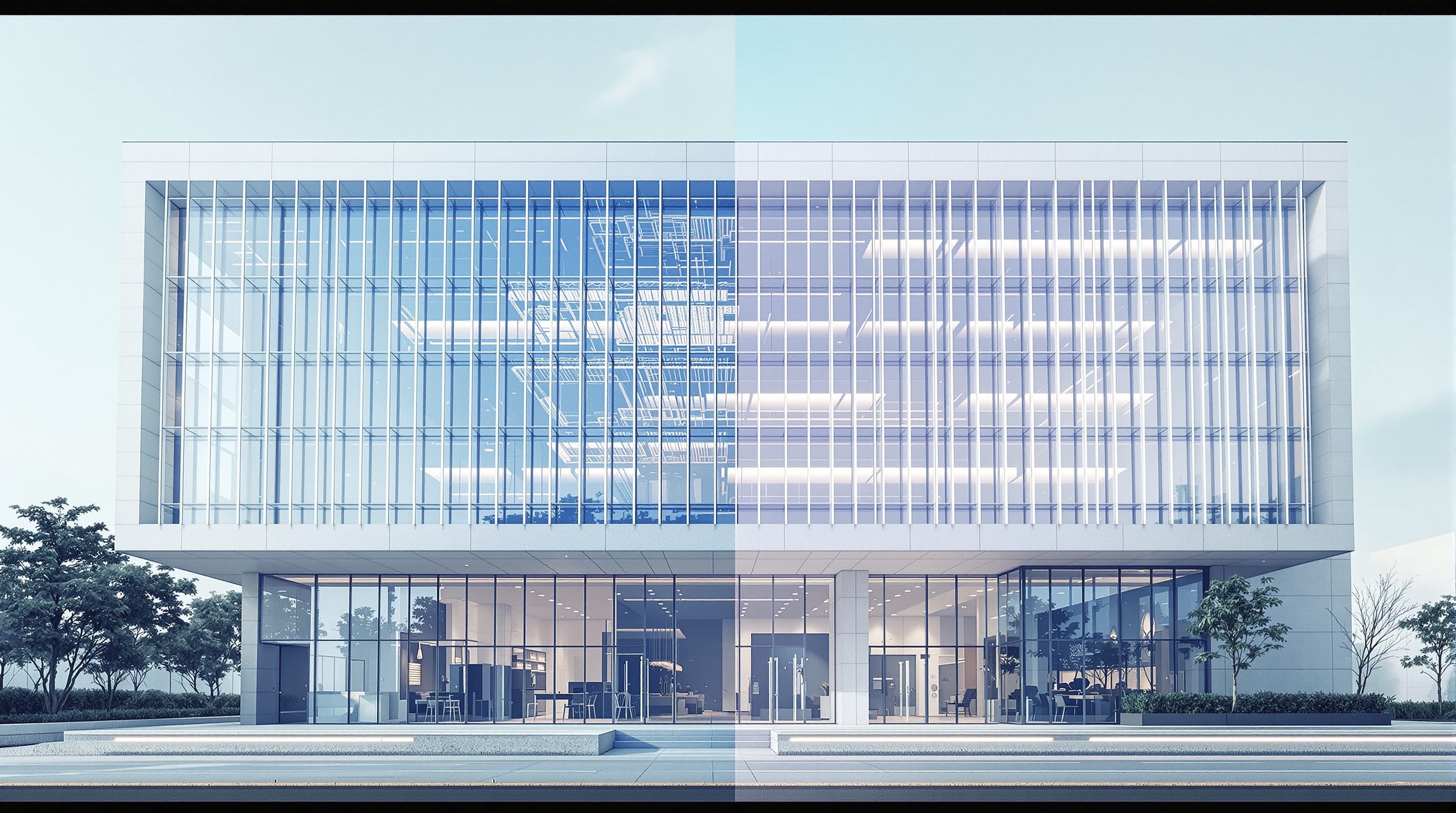
 Lesson 0.4
Lesson 0.4 · Foundations of Digital Twins & Smart Buildings
Hype versus Reality
Cutting through vendor marketing - the performance gap, the common failure modes, and how to judge real value
The demo always works. The building always argues. Real value lives in the gap between them.
Few fields are as oversold as digital twins and smart buildings. Every vendor has a spinning 3D model, a dashboard glowing green, and a slide promising thirty percent savings. Some of it is real. A lot of it is a demo that has never survived contact with an actual building.
This lesson is the sceptical counterweight the whole course needs. We name what these technologies are oversold as, look honestly at the performance gap between a demo and daily operation, walk the failure modes that quietly kill projects, and hand you a short, blunt test for telling genuine value from marketing. Scepticism here is not cynicism - it is how you protect a client's money and your own credibility.
Discount the demo. Ask year two. Purpose / data / owner / proof. Sceptic, not cynic.
What they are oversold as
Start by naming the marketing, because you will hear it constantly. Digital twin gets oversold as any 3D model of a building - a spinning BIM viewer relabelled, with no live data behind it. It is sold as autonomous - implying the building runs itself - when the product is really a read-only dashboard. It is sold as plug-and-play - connect it and savings appear - when the real work is months of integrating silos and cleaning data. And it is sold with a single headline number, 30% energy savings, lifted from a best-case pilot and quietly presented as a guarantee.
Smart building is oversold the same way: a building called smart because it has an app and some connected gadgets, with none of the integration that lesson 0.2 showed is where smartness actually lives. The industry even has nicknames for the practice - twin-washing and smart-washing - slapping the label on a thin product to ride the trend.
None of this means the technology is fake. Genuine twins cut real energy, catch real faults, and inform real retrofits. The problem is that the marketing collapses a hard, systems-level, multi-year effort into a screenshot - and a buyer who believes the screenshot pays for a capability the product does not have. Your first defence is simply knowing the difference between what is shown and what is delivered.
Twin-washing: a BIM viewer with no live data, sold as autonomous. Know the tell.
The performance gap: demo versus daily operation
The heart of the hype problem is the performance gap - the distance between how a system behaves in a demo and how it behaves after a year of real operation. In the demo everything is fresh: sensors are calibrated, data is complete, the model was tuned last week, and an expert is driving. In operation, entropy sets in. Sensors drift or die and nobody notices. A subsystem is replaced and its data stops flowing. The people who understood the model move on. Alarms pile up until operators ignore them all - alarm fatigue - and the green dashboard quietly stops meaning anything.
This gap is not the technology failing; it is the operating model around it decaying. A twin is not a product you install once - it is a living system that needs data quality, upkeep and someone whose job is to act on it. Buildings themselves keep changing - tenants, uses, plant, seasons - so a model calibrated at handover drifts away from reality unless it is re-tuned.
The practical lesson is to discount the demo and ask about operation. What did this system deliver in year two, not week one, on a building like mine? Who kept the data clean and acted on the insight? What decayed, and how was it caught? Vendors who can answer those questions honestly are the ones worth trusting; a demo that cannot speak to sustained, measured performance is telling you only that the technology can work under ideal conditions - which was never in doubt.
The failure modes that quietly kill projects
Smart-building and twin projects rarely fail with a bang; they fade. A handful of failure modes recur so reliably that knowing them is half the defence.
Data silos. Subsystems that will not share data - closed protocols, no common schema - so the twin never sees the whole building and analytics starve. This is the number-one killer, and it is why lesson 0.2 stressed integration.
No purpose. A twin built because twins are fashionable, serving no named decision. It looks impressive, changes nothing, and is quietly switched off when budgets tighten. A twin with no decision to serve is an expensive screen-saver.
Unmaintained data and models. Sensors drift, points break, models go stale, and no one owns the upkeep - so the twin slowly fills with wrong data and loses trust. Once operators stop believing it, it is dead even if it still runs.
No owner. Nobody whose job is to act on the output. Insight that lands on no desk is not acted on, and value never materialises. Over-scoping compounds all of these: reaching for autonomous, whole-portfolio optimisation before proving a single read-only use case, so the project collapses under its own ambition. And under all of them sits security and privacy debt - connected buildings widen the cyber-attack surface and collect data about real people, and a project that treats those as afterthoughts is one incident away from failure. Spot any of these early and you can usually save the project - or decline it.
Silos. No purpose. Unmaintained. No owner. Over-scoped. Any one quietly kills the twin.
How to judge real value: a four-question test
Cut through all of it with four blunt questions - the same instinct from lesson 0.1, sharpened into a checklist. Ask them of any smart-building or twin proposal before a rupee or dollar is spent.
1. Purpose - what decision does it serve? Make the vendor name the specific decision or outcome: which energy cost, which fault, which retrofit. If the answer is vague - visibility, insight, a single pane of glass - with no decision attached, you are being sold a screen-saver.
2. Data - is it live, trusted and complete? A twin is only as good as its feed. Ask where the data comes from, how fresh it is, how gaps and drift are caught, and whether the building is instrumented enough to answer the question being asked. Stale or sparse data yields confident, wrong answers.
3. Owner - who acts on it and maintains it? Name the human who will read the output, act on it, and keep the data and models healthy. No owner means the system rots within a year, however good it was on day one.
4. Proof - measured savings, not a slide? Ask for results from a real building in sustained operation, ideally comparable to yours, with numbers you can check. A demo and a best-case pilot are not proof; they are marketing.
Four honest yeses is genuine value worth buying. Any no is not a reason to walk away outright - it is the precise question to resolve first. Used steadily, this test protects your client's budget, keeps vendors honest, and - the real payoff - makes you the person in the room who can tell a working twin from a beautiful lie.
Sceptical, not cynical: the mature stance
There is a trap on the far side of the hype, and it is just as costly: deciding the whole field is smoke and dismissing it. That is cynicism, and it loses real money. The buildings that quietly run twenty or thirty percent cheaper, that catch a failing chiller a fortnight before it dies, that plan a retrofit on measured evidence instead of a hunch - those are not fantasies, they are the payoff for buyers who resisted both the hype and the cynicism. The mature stance is discernment: assume every claim is inflated until it is tested, then test it properly and back what survives.
That balance also shapes how you build. Prefer the boring, high-value moves before the glamorous ones: get to trustworthy monitoring, clean the data model, fix the faults it finds, and only then reach for prediction and control. Scope to a single named decision and prove it before scaling to a portfolio. Treat security and privacy as first-class requirements, not afterthoughts, and defer statutory and safety sign-off to qualified professionals - a connected building is a bigger attack surface and a bigger data-protection duty than the brochure admits.
Held this way, scepticism is not negativity - it is the discipline that lets genuine value through while keeping the marketing out. It makes you the person a client trusts precisely because you neither gush nor sneer: you ask the four questions, weigh the evidence, and say buy, probe or pass. That judgement, more than any protocol or platform, is what this whole course has been quietly building toward.
The performance gap
Demo behaviour versus sustained operation
The distance a twin drifts once sensors, data and attention decay; judge systems on year two, not week one.
Data silos
Subsystems that will not share data
The number-one killer of twin projects; open protocols and a common schema are the antidote.
ENERGY STAR Portfolio Manager
Independent building energy benchmarking
A neutral yardstick to check claimed savings against measured performance rather than a vendor slide.
Return on investment (ROI)
Value delivered against total cost of ownership
Include integration, upkeep and an owner's time - not just the licence - or the business case is fiction.
NIST Cybersecurity Framework
Managing cyber risk in connected systems
Connected buildings widen the attack surface; security is a project requirement, not an afterthought.
Workshop - run the four-question test on a real product
Put the sceptical toolkit to work. Take a real digital-twin or smart-building product - a vendor website, a case study, a conference pitch - and audit its claims against the performance gap, the failure modes and the four-question value test. The goal is a decision you could defend to a client.
None required - a real product page or case study and a notebook. Optionally, a benchmarking reference like ENERGY STAR Portfolio Manager to sanity-check claimed savings.
Goal: turn one vendor claim into an evidence-based buy / probe / pass judgement
Inputs: a real smart-building or digital-twin product page or case study, and a notebook
Time: ~30 minutes
- 1Collect the claims: pull out the headline promises - savings figures, autonomy, plug-and-play, single-pane-of-glass - exactly as marketed.
- 2Separate demo from operation: for each claim, ask whether the evidence is a demo/best-case pilot or sustained performance on a real building like your client's. Flag the gap.
- 3Run the four-question test: purpose (what decision?), data (live, trusted, complete?), owner (who acts and maintains?), proof (measured savings you can check?). Score each yes / no / unclear.
- 4Scan for failure modes: does the offer risk data silos, no named purpose, unmaintained data, no owner, over-scoping, or ignored security/privacy? Note which apply.
- 5Write a verdict: buy, probe further, or pass - with the two or three specific questions you would put to the vendor before committing money.
You’ll walk away with
A one-page vendor audit: the marketed claims, a demo-versus-operation flag on each, a four-question scorecard, the failure modes at risk, and a defensible buy/probe/pass verdict with the exact questions to ask next.
Three altitudes on the same idea
Read the band that fits you — or all three.
You are often the one advising the client on what to buy. That makes the four-question test part of your professional duty of care: press vendors on purpose, data, owner and proof before smart-building spend is committed, and design foundations - open protocols, clean data, room for integration - that let a real twin succeed later. Protecting a client from an expensive screen-saver is as much design judgement as any drawing.
Beware the smart-washed interior. A responsive-lighting or comfort system is only smart if it is integrated and actually serves the occupant - not if it merely adds an app. Ask what decision each smart feature serves and who maintains it, so you specify systems that keep working in year two rather than gadgets that impress at handover and frustrate users soon after.
Informed scepticism is a rare, hireable skill. Anyone can repeat vendor claims; the valuable person separates real value from twin-washing. Practise the four-question test on every case study and product page you meet, and learn the failure modes cold - it is the judgement that makes a smart-building professional worth hiring over a brochure.
“Digital twins and smart buildings are overhyped, so it is all just marketing with no real substance.”
Do it yourself
Reason it through - stay sceptical, not cynical.
- 1Name three things a digital twin is commonly oversold as.
- 2What is the performance gap, and why does it open over time?
- 3List the failure modes that quietly kill twin projects.
- 4State the four-question value test from memory.
- 5Why is dismissing the whole field as hype as costly as believing it?
The one line to carry out
Peer-reviewed journals & authoritative standards
- 01Digital twin — Wikipedia, 2026.
- 02Property technology (proptech) — Wikipedia, 2026.
- 03Return on investment — Wikipedia, 2026.
- 04ENERGY STAR Portfolio Manager (benchmarking) — US EPA, 2026.
- 05NIST Cybersecurity Framework — NIST, 2026.
That completes the foundations: what a twin is, what makes a building smart, how the two relate, and how to stay honest about both. From here the course descends into the stack itself, starting with the building's senses - the sensors and what they actually measure.
The author
Amogh N P
Architect, interior designer, and creative polymath. Studio Matrx began in his notebooks — his vision of design made honest, useful, and open to everyone. Its Academy is written and taught in his memory, and free, forever.
More about Amogh →