
Techniques by Stage
The working methods of each mode — from user interviews to testing.
Each mode has its own toolkit. Empathize is research, not guessing; Define turns it into a point-of-view and “How Might We” questions; Ideate generates widely under rules; Prototype builds to learn — low-fidelity first; and Test puts the prototype in front of real users. Learn the techniques that make each mode actually work.
Learning objectives
By the end of this lesson, you will be able to — mapped to the course outcomes for Design Thinking:
Use interviews and observation to empathise — research rather than assume.
Write a point-of-view statement and How-Might-We questions.
Run divergent ideation under brainstorming rules.
Choose an appropriate interior prototype and test it with users.
Empathize & Define
Ask the right questions and observe; then synthesise into a point-of-view statement and open it with How-Might-We questions.[1]
Research, not guessing
Ask open, 'why'-driven questions and use the '5 Whys' to reach real motivations; avoid leading questions. Interview people in context and ask for STORIES and specifics ('tell me about the last time…'), not opinions or hypotheticals. Crucial correction: Empathize does NOT mean guessing what users want — it means researching and observing them, and setting your own assumptions aside.[1, 2]
Ideate, Prototype & Test
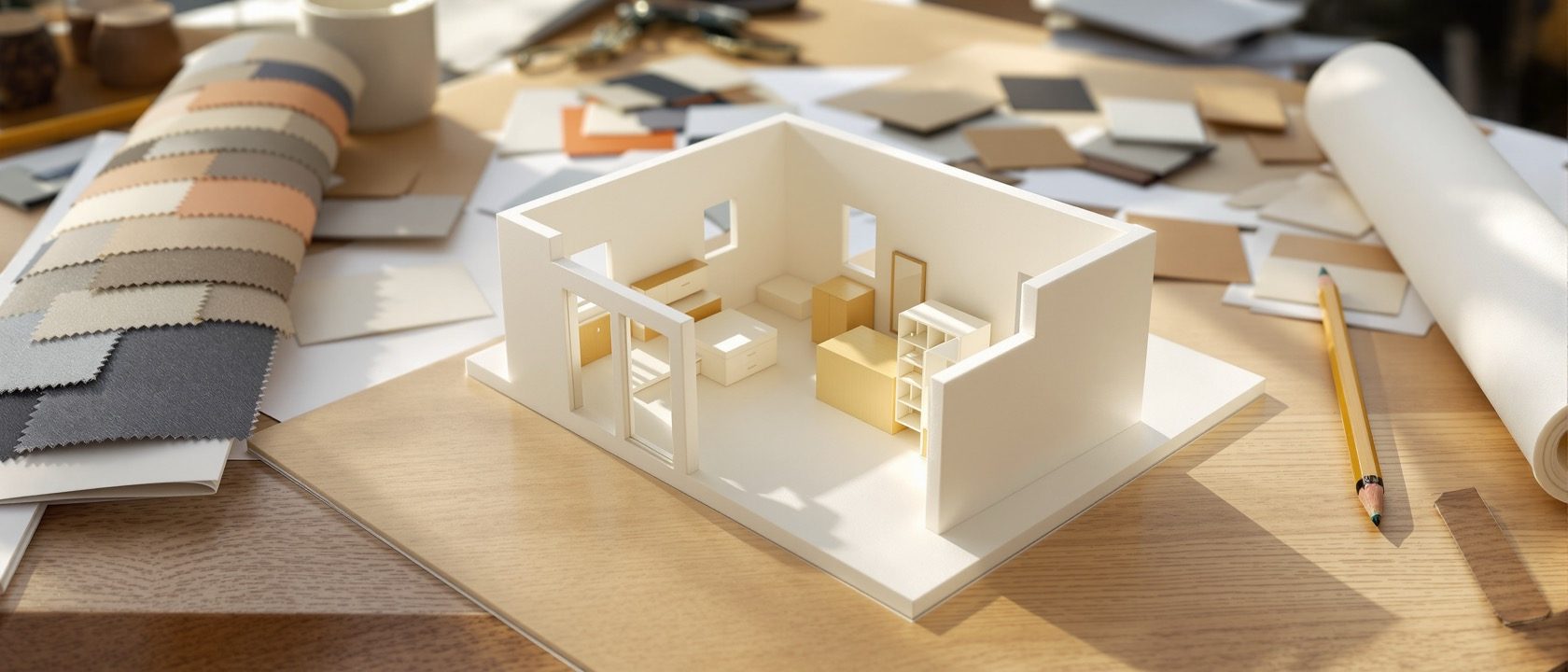
Brainstorm under rules, prototype at the right fidelity (for interiors: sketches, boards, models, mock-ups, 3D), and test with real users.[1, 4]
Rules make it work
Divergent generation aims for VOLUME — quantity breeds quality. Run it under Osborn's rules: defer judgment, go for quantity, welcome wild ideas, build on others ('yes-and'); plus stay on topic, one conversation at a time, be visual. Deferring judgment is the key — evaluating too early kills the ideas that lead to breakthroughs. Then converge (dot-voting, bundling) to 2-3 concepts.[1, 4]
At a glance
| Aspect | One side | The other |
|---|---|---|
| Empathize | Myth: guess what users want | Reality: research and observe them |
| Fidelity | Low-fi: cheap, fast, invites honesty | High-fi: detailed, for validated concepts |
| Ideation | Defer judgment, go for quantity | Then converge to 2-3 concepts |
| Prototype purpose | Myth: a mini-final product | Reality: a question built to learn from |
| Testing | Myth: ask if they like it | Reality: observe behaviour + capture structured feedback |
Key terms
Asking 'why' repeatedly to reach the root motivation behind a need.
[user] needs [need] because [insight] — the framed problem.
An open, optimistic design prompt from the POV (Basadur; popularised by IDEO).
A prototype is a question made tangible — its purpose is learning, not polish.
Rough/quick to test big questions vs detailed to test specifics.
Likes / criticisms / questions / ideas — a structured way to capture test feedback.
Studio task
Interview one person about how they use a room, then write a point-of-view statement ([user] needs [need] because [insight]) and three How-Might-We questions. Sketch two quick low-fidelity prototypes for one HMW, and note what each is built to learn.
Self-assessment
1. In the Empathize mode you should mainly —
2. A point-of-view statement follows the template —
3. Early prototypes should usually be —
Recap
References & further reading
- [1]Stanford d.school, Bootcamp Bootleg (method cards for empathy, define, ideate, prototype, test).
- [2]Eli Woolery, Design Thinking Handbook, InVision (interviews, prototyping, testing).
- [3]Jeanne Liedtka, Andrew King & Kevin Bennett, Solving Problems with Design Thinking, Columbia, 2013.
- [4]Alex F. Osborn, Applied Imagination, Scribner's, 1953 (brainstorming rules).
Further reading
- Stanford d.school — Bootcamp Bootleg.
- Eli Woolery — Design Thinking Handbook.
- Liedtka, King & Bennett — Solving Problems with Design Thinking.
Sources gathered and fact-checked June 2026. Published values vary by source, sample and method — treat as indicative and confirm against the cited standard before structural use.
The author
Amogh N P
Architect, interior designer, and creative polymath. Studio Matrx began in his notebooks — his vision of design made honest, useful, and open to everyone. Its Academy is written and taught in his memory, and free, forever.
More about Amogh →