
The Five-Stage Framework
Empathize, Define, Ideate, Prototype, Test — and the Double Diamond.
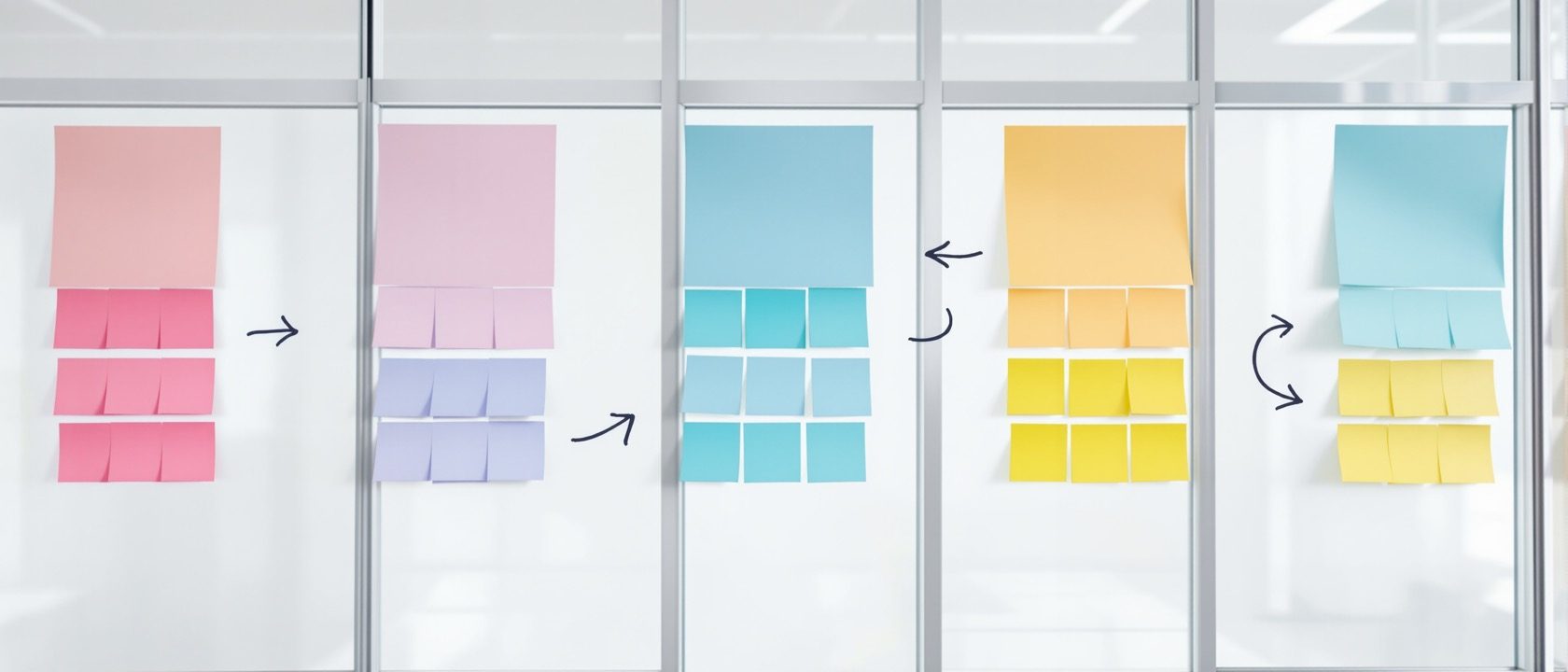
The most-taught model is the d.school’s five modes — Empathize, Define, Ideate, Prototype, Test. Learn each through one interior case, and the single most important point: the process is iterative and non-linear — you loop back, and the tidy diagram is a teaching aid, not a waterfall.
Learning objectives
By the end of this lesson, you will be able to — mapped to the course outcomes for Design Thinking:
Describe the goal and activities of each of the five modes.
Walk an interior problem through Empathize, Define, Ideate, Prototype and Test.
Explain why the process is iterative and non-linear, not a waterfall.
Map the Double Diamond onto the five modes as a companion model.
The five modes
Each mode’s goal and activities, walked through the cramped Pune living-dining room for a joint family.[1]
Understand, without assuming
Deeply understand the users and their context. Interview the people, observe what they actually do (not only what they say), immerse in their routine. For the Pune 2BHK: interview the joint family; watch how the living-dining room is really used at dinner, during study time, at festivals and when guests come — and note the daily conflicts.[1]
Walk the five modes
Step through each mode and see how it plays out on the Pune 2BHK case.
The five modes · the Pune 2BHK case
1. Empathize
mode 1 of 5Goal: Understand the users and their context deeply — without assuming.
Interviews · observation · immersion · shadowing
Remember: the modes loop — Test can send you back to Empathize.
The Double Diamond
A companion view of the same diverge-converge rhythm — and the difference between designing the right thing and the thing right.[2]
The most important point
The five modes are a shared VOCABULARY, not a fixed sequence. Teams loop back constantly: a Test finding sends you back to Empathize or Ideate; a Prototype can reframe your Define. The d.school explicitly warns against treating the modes as a waterfall — the straight-line diagram is a simplification for teaching.[3]
At a glance
| Aspect | One side | The other |
|---|---|---|
| Nature | Myth: a linear five-step recipe | Reality: iterative and non-linear — you loop back |
| First diamond | Discover + Define | Design the RIGHT thing (frame the problem) |
| Second diamond | Develop + Deliver | Design the thing RIGHT (build it well) |
| Mapping | Discover ≈ Empathize; Define ≈ Define | Develop ≈ Ideate+Prototype; Deliver ≈ Test |
| Stage count | Myth: one official number | Reality: 3/4/5/6/7 — the rhythm is what matters |
Key terms
Understand users and context deeply, without assuming.
Synthesise research into one sharp, actionable problem (a POV).
A question made tangible cheaply — built to learn, not to impress.
You loop back between modes; the straight-line diagram is a teaching aid.
Discover, Define, Develop, Deliver — diverge and converge, twice (Design Council, 2005).
First diamond frames the problem; second builds the solution well.
Studio task
Take a room you would like to improve and write one line for each of the five modes — what you would do at each. Then mark one place where a Test result might send you back to an earlier mode, and one place where you risk designing the wrong thing beautifully (skipping the first diamond).
Self-assessment
1. The single most important structural point about the five modes is that they are —
2. The Double Diamond's four phases are —
3. 'Designing the right thing' happens in —
Recap
References & further reading
- [1]Stanford d.school, Bootcamp Bootleg / Process Guide (the five modes and their method cards).
- [2]UK Design Council, The Double Diamond (2005; 'History of the Double Diamond').
- [3]Tim Brown, Change by Design, HarperBusiness, 2009 (Inspiration-Ideation-Implementation; iteration).
- [4]Hasso Plattner, Christoph Meinel & Larry Leifer (eds.), Design Thinking: Understand – Improve – Apply, Springer, 2011.
Further reading
- Stanford d.school — Bootcamp Bootleg.
- Tim Brown — Change by Design.
- Plattner, Meinel & Leifer — Design Thinking: Understand – Improve – Apply.
Sources gathered and fact-checked June 2026. Published values vary by source, sample and method — treat as indicative and confirm against the cited standard before structural use.
The author
Amogh N P
Architect, interior designer, and creative polymath. Studio Matrx began in his notebooks — his vision of design made honest, useful, and open to everyone. Its Academy is written and taught in his memory, and free, forever.
More about Amogh →