
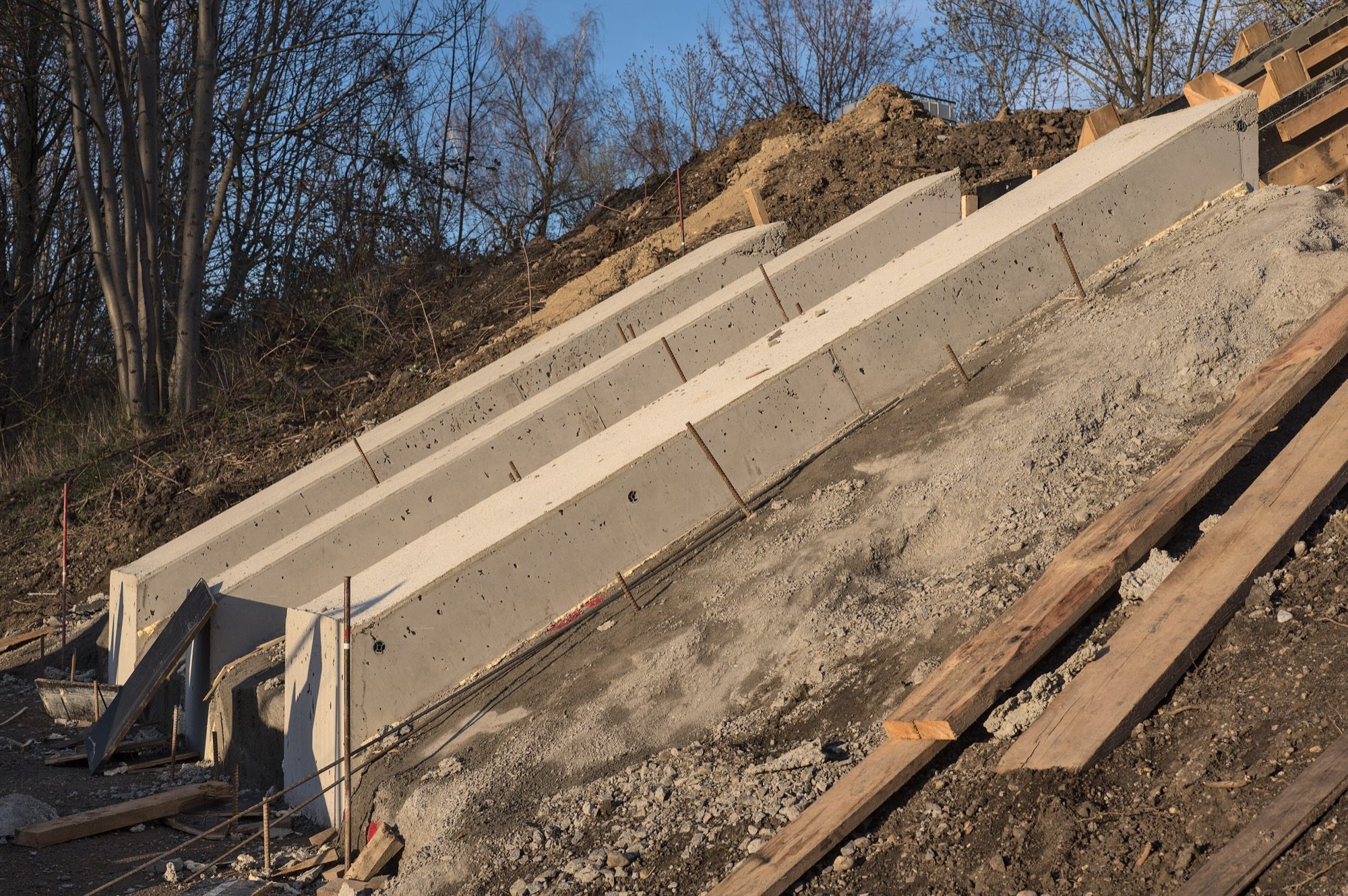
Design of Staircases
The dog-legged stair — comfort geometry, then the waist slab.
A staircase is the one structural element a building's users touch with their feet — so it must be both comfortable and strong. First the geometry: risers and treads set to the comfort rule 2R + T ≈ 600–630 mm. Then the structure: the inclined waist slab spanning going-plus-landings, with a self-weight that must include the slope factor everyone forgets.
Learning objectives
By the end of this lesson, you will be able to — mapped to the course outcomes for Design of Structures I:
Name the common stair types and pick the dog-legged stair for a 180° turn.
Set out a dog-legged stair — risers, treads, going — to the comfort rules.
Build up the loads on an inclined waist slab, including the slope factor.
Design the waist slab — effective span, thickness and steel.
Stair types and comfort
Stairs come straight, dog-legged, open-well, spiral or helical; the dog-legged is the compact default. Set the riser and tread to 2R + T ≈ 600–630 mm for a comfortable climb.[4, 5]
Straight stair
Rises in one direction in one or two in-line flights — simple, but it needs a long, narrow space.[4]
Designing the waist slab
The inclined waist self-weight is increased by the slope factor √(R²+T²)/T; add the steps, finishes and live load. With the effective span (going + landings), take a waist of about span/20 and design it like a slab.[1, 3]
Setting out the flight
Number of risers = floor height ÷ riser. A dog-legged stair splits these into two equal flights; each flight has one fewer tread than risers, and the going = (treads) × tread. Check 2R + T falls in the comfort band.[4]
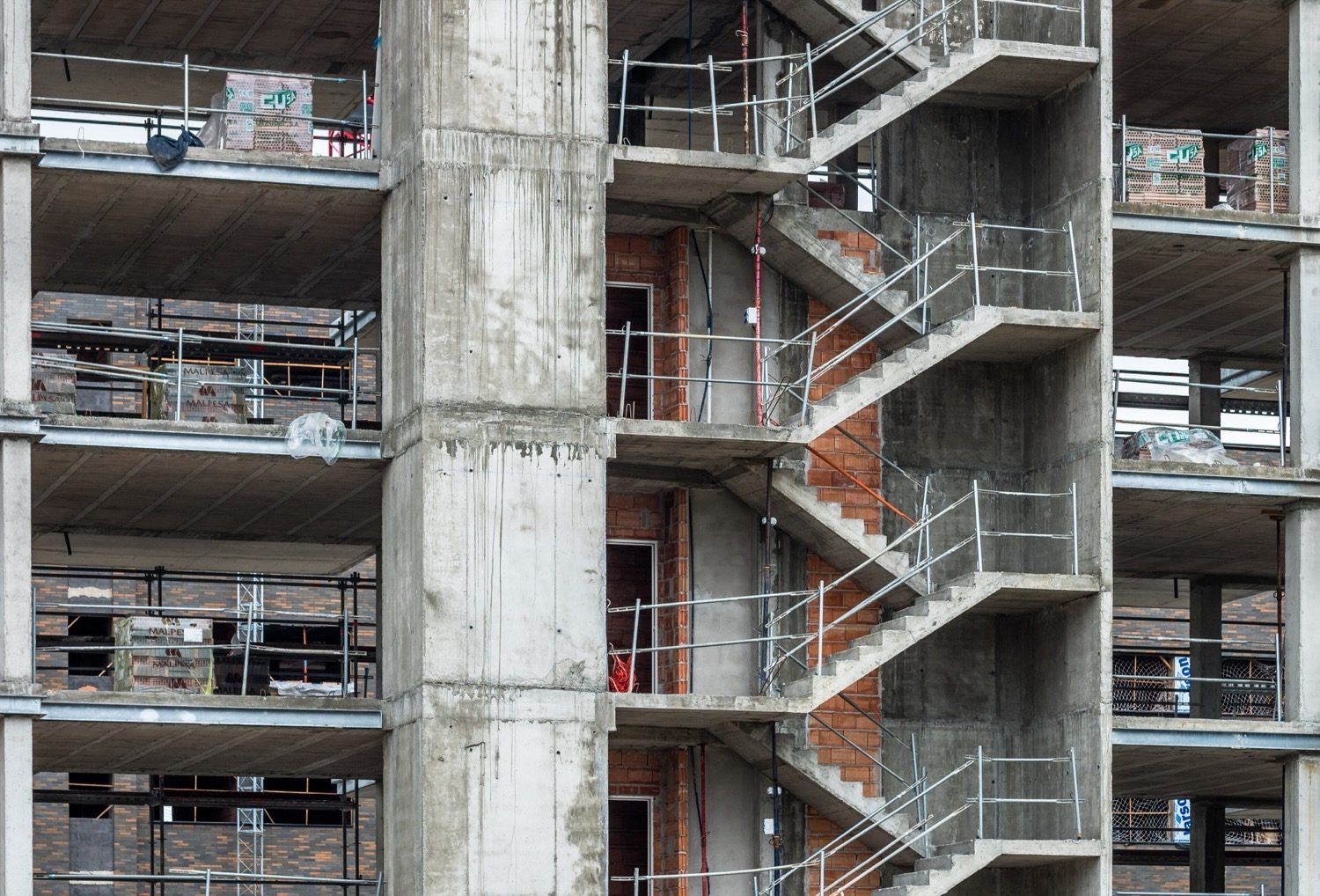
Set out a dog-legged stair
A 3.2 m floor height at 160 mm risers gives 20 risers — two flights of 10, nine treads each, a 2.43 m going. Adjust the riser and tread and watch the comfort check and the slope factor respond.
Dog-legged staircase designer
Risers = H / R (split into two flights); treads = risers/flight − 1; going = treads × T. Comfort: 2R + T ≈ 600–630 mm.
0
Total risers
0
Treads / flight
0.00 m
Going / flight
0.00 m
Effective span
0 mm
Waist ≈ span/20
The numbers that matter
| Aspect | One | The other |
|---|---|---|
| Step parts | Riser: vertical height | Tread: horizontal depth; Going = treads × T |
| Comfort | 2R + T ≈ 600–630 mm | R + T ≈ 400–450 mm |
| Typical sizes | Riser 150–190 mm | Tread 250–300 mm |
| Treads per flight | = risers − 1 | Going = (risers − 1) × tread |
| Waist self-weight | × slope factor √(R²+T²)/T | Steps ≈ R/2 smeared on plan |
Key terms
Vertical height of one step.
Horizontal depth of one step's walking surface.
Total horizontal length of a flight = (number of treads) × tread.
The inclined RC slab beneath the steps that carries the flight in bending.
A flight is an unbroken run of steps; a landing is the level platform between flights.
Two parallel flights with a half-landing turning 180°, no central well.
Comfortable steps satisfy 2R + T ≈ 600–630 mm (and R + T ≈ 400–450 mm).
√(R²+T²)/T — converts the inclined waist self-weight to weight per plan area.
Worked example
Floor-to-floor 3.2 m, riser 160 mm → 20 risers, split into two flights of 10; treads = 9; going = 9 × 270 = 2.43 m. With 1.2 m landings the effective span ≈ 2.43 + 2.4 = 4.83 m, so the waist ≈ span/20 ≈ 240 mm. The self-weight uses the slope factor √(160²+270²)/270 ≈ 1.16 — leave it out and you under-count the dead load.
Self-assessment
1. A dog-legged stair with 20 risers of 160 mm serves a floor-to-floor height of —
2. The slope factor used for the waist-slab self-weight is —
3. The comfort rule 2R + T should be about —
Recap
References & further reading
- [1]IS 456:2000 — Plain and Reinforced Concrete, Code of Practice. Bureau of Indian Standards. (cl. 33 stairs; cl. 36 limit states.)
- [2]SP 16:1980 — Design Aids for Reinforced Concrete to IS 456. Bureau of Indian Standards.
- [3]S.U. Pillai & Devdas Menon, Reinforced Concrete Design (3rd ed.). McGraw-Hill Education, 2009.
- [4]National Building Code of India 2016, Part 4 (Fire & Life Safety) — stair geometry. Bureau of Indian Standards.
- [5]IS 875 (Part 2):1987 — Code of Practice for Design Loads (Imposed Loads). Bureau of Indian Standards.
Further reading
- N. Krishna Raju, Reinforced Concrete Design (Limit State Method). CBS Publishers.
- B.C. Punmia, A.K. Jain & A.K. Jain, Reinforced Concrete Structures. Laxmi Publications.
- S. Unnikrishna Pillai & Devdas Menon, Reinforced Concrete Design. McGraw-Hill.
Sources gathered and fact-checked June 2026. Published values vary by source, sample and method — treat as indicative and confirm against the cited standard before structural use.
The author
Amogh N P
Architect, interior designer, and creative polymath. Studio Matrx began in his notebooks — his vision of design made honest, useful, and open to everyone. Its Academy is written and taught in his memory, and free, forever.
More about Amogh →