
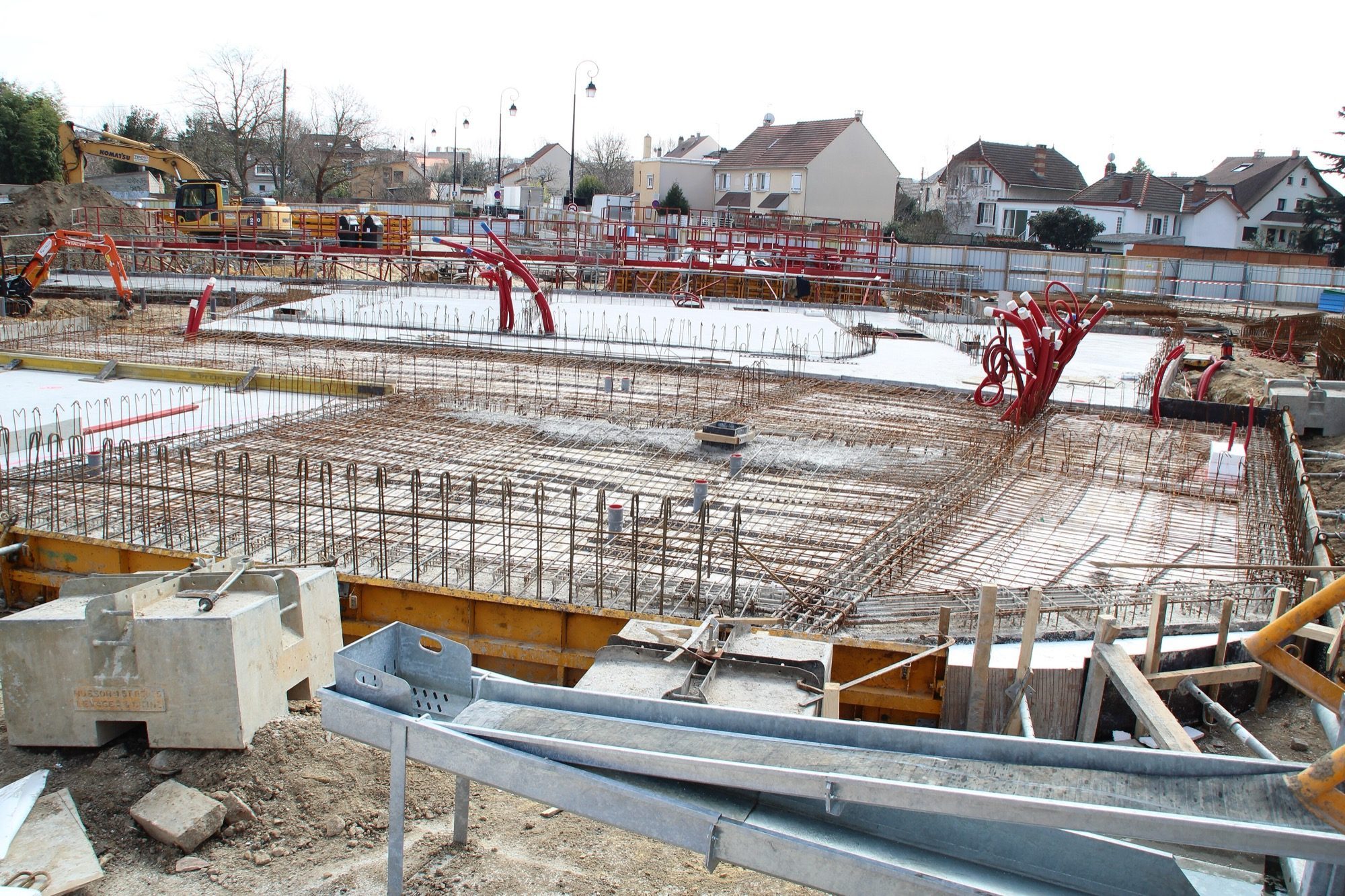
Design of Slabs
One-way and two-way — reading the load path before you reach for steel.
A slab is just a wide, shallow beam — but which way does it span? Compare the two spans: if the long is more than twice the short, the slab is one-way and carries load to the short-span supports; if not, it is two-way and shares the load both ways. Get that right and the rest is the beam flexure you already know, run on a one-metre strip.
Learning objectives
By the end of this lesson, you will be able to — mapped to the course outcomes for Design of Structures I:
Classify a slab as one-way or two-way from the span ratio and read its load path.
Use span/depth ratios to fix a slab's thickness.
Design a one-way slab strip for flexure and provide distribution steel.
Explain why two-way action needs the long/short ratio ≤ 2.
One-way or two-way?
With ly the longer span and lx the shorter, a ratio ly/lx greater than 2 makes the slab one-way; otherwise it is two-way. The classification decides where the main steel goes.[1, 3]
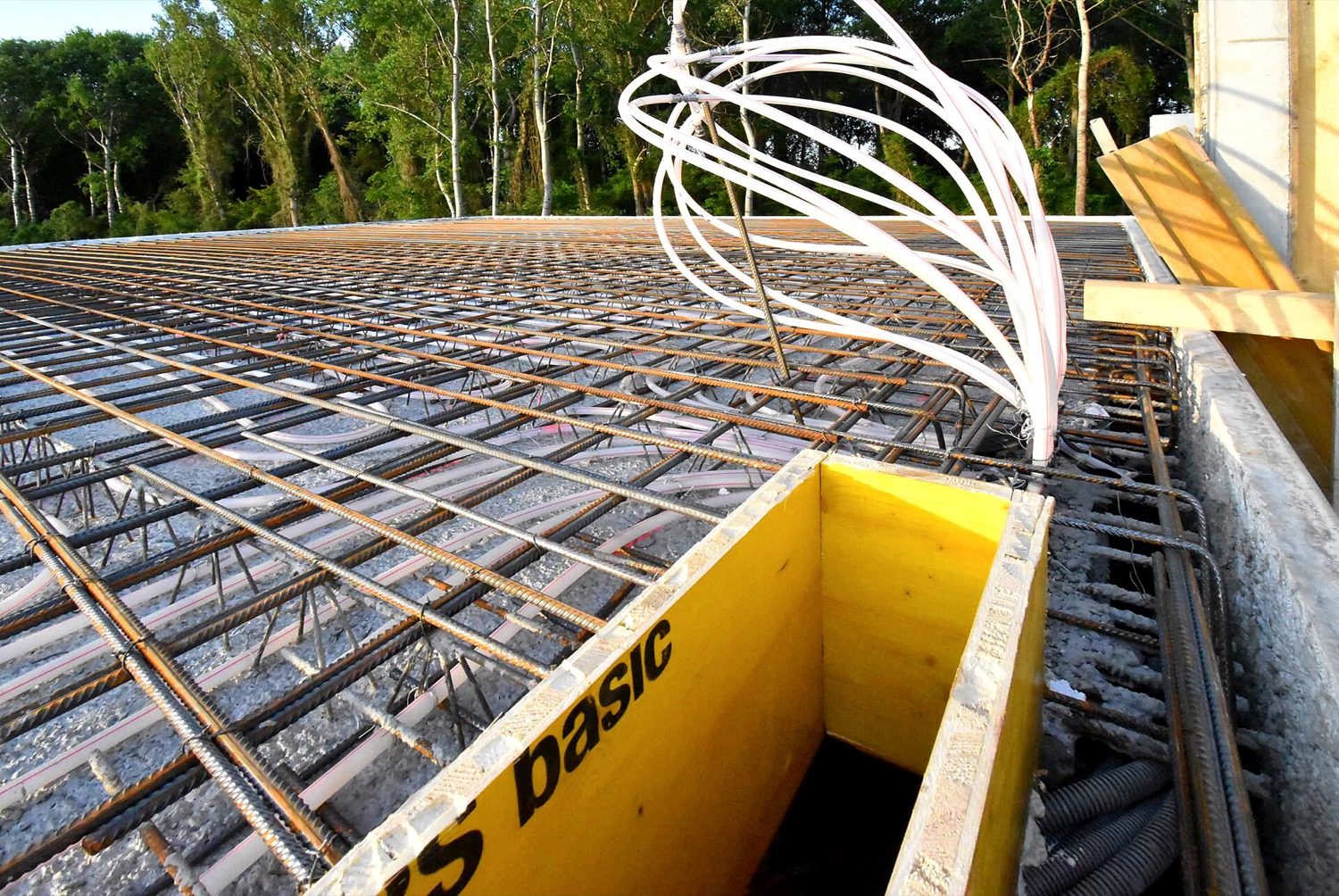
Thickness, then steel
Thickness is set by the span/effective-depth ratio (about 20 for a simply-supported slab, times a tension modification factor), so slabs come out thin. Then the one-metre strip is designed for Mu = wu·leff²/8.[1]
Design a one-way slab
A 3 m span, 150 mm slab with 3 kN/m² live load needs about 333 mm²/m of main steel — 8 mm bars at 150 mm. Change the spans and watch the slab flip between one-way and two-way.
One-way slab designer
M20 / Fe415, finishes 1 kN/m². wu = 1.5(self-wt + finishes + LL), Mu = wu·leff²/8 on a 1 m strip.
0.0 kN·m/m
Design moment Mu
0 mm²/m
Main steel Ast
0 mm
Effective depth d
0 mm c/c
8 mm bars @
Min steel 0.12% = 180 mm²/m; spacing capped at 3d or 300 mm.
One-way vs two-way
| Aspect | One-way | Two-way |
|---|---|---|
| Span ratio | One-way: ly/lx > 2 | Two-way: ly/lx ≤ 2 |
| Bending | Single curvature, short span | Double curvature, both spans |
| Main steel | Along the short span only | Along both spans |
| Moments from | wu·leff²/8 (strip) | Coefficients αx, αy (IS 456 Annex D) |
| Distribution steel | Yes — along the long span (≥0.12%) | Both directions are main steel |
Key terms
ly/lx > 2 — bends mainly across the short span; main steel one way.
ly/lx ≤ 2 — bends both ways, sharing load; main steel both ways.
Ratio of longer to shorter effective span — decides one-way vs two-way.
Deflection control on thickness: basic 7 (cantilever), 20 (SS), 26 (continuous).
Clear span + effective depth (or centre-to-centre), whichever is less — not the clear span.
Flexural bars along the span that carries the load (short span in a one-way slab).
Transverse bars (≥ 0.12% HYSD) for shrinkage, temperature and load spread.
Main bars ≤ 3d or 300 mm; distribution bars ≤ 5d or 450 mm (IS 456 cl. 26.3.3).
Worked example
A 3 m one-way slab, 150 mm thick (d = 125 mm): loads = self-weight 3.75 + finishes 1 + live 3 = 7.75 kN/m², so wu = 11.6 kN/m². With leff ≈ 3.125 m, Mu = 11.6 × 3.125²/8 ≈ 14.2 kN·m/m and the main steel works out at about 333 mm²/m — 8 mm bars at 150 mm centres, with distribution steel across.
Self-assessment
1. A slab is designed as one-way when the long-to-short span ratio is —
2. The basic span/effective-depth ratio for a simply-supported slab is —
3. The maximum spacing of main reinforcement in a slab is —
Recap
References & further reading
- [1]IS 456:2000 — Plain and Reinforced Concrete, Code of Practice. Bureau of Indian Standards. (cl. 22.2, 23.2.1, 24, 26.3.3, 26.5.2; Annex D.)
- [2]SP 16:1980 — Design Aids for Reinforced Concrete to IS 456. Bureau of Indian Standards.
- [3]S.U. Pillai & Devdas Menon, Reinforced Concrete Design (3rd ed.). McGraw-Hill Education, 2009.
Further reading
- N. Krishna Raju, Reinforced Concrete Design (Limit State Method). CBS Publishers.
- B.C. Punmia, A.K. Jain & A.K. Jain, Reinforced Concrete Structures. Laxmi Publications.
- S. Unnikrishna Pillai & Devdas Menon, Reinforced Concrete Design. McGraw-Hill.
Sources gathered and fact-checked June 2026. Published values vary by source, sample and method — treat as indicative and confirm against the cited standard before structural use.
The author
Amogh N P
Architect, interior designer, and creative polymath. Studio Matrx began in his notebooks — his vision of design made honest, useful, and open to everyone. Its Academy is written and taught in his memory, and free, forever.
More about Amogh →