
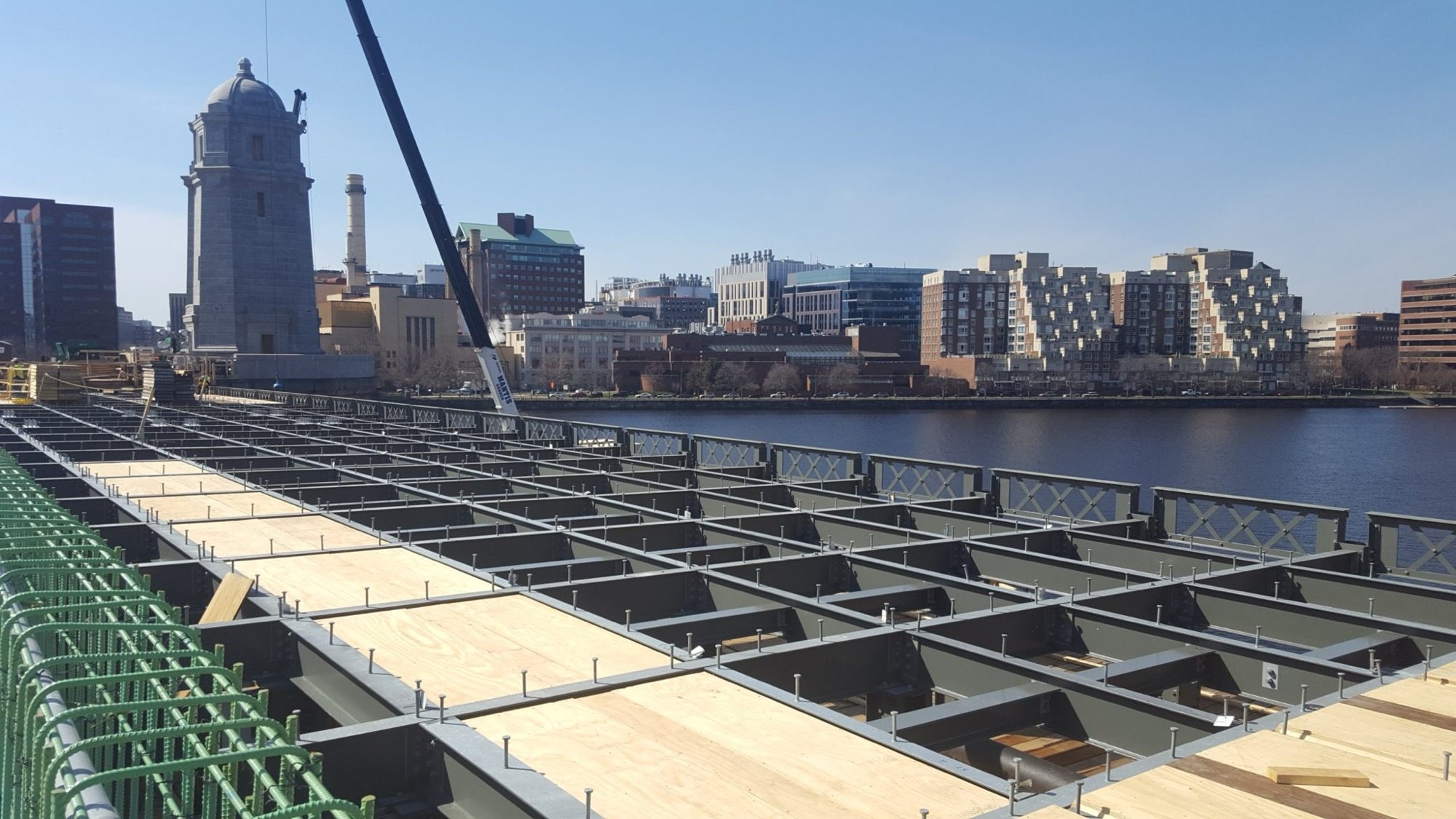
Design of Beams
The flexural member — the stress block, Mu,lim and the tension steel.
A beam resists bending: concrete takes the compression at the top, steel takes the tension at the bottom. The whole of limit-state flexure follows from one picture — the stress block — and one threshold, the limiting moment Mu,lim, that decides whether the section needs steel in tension only, or in compression too.
Learning objectives
By the end of this lesson, you will be able to — mapped to the course outcomes for Design of Structures I:
Describe the limit-state stress block and its 0.36 (force) and 0.42 (lever-arm) constants.
Compute the limiting moment Mu,lim = K fck b d² for Fe250/415/500.
Decide singly vs doubly reinforced by comparing Mu with Mu,lim.
Find the tension steel Ast for a rectangular beam.
The stress block and Mu,lim
At collapse the compressive resultant is C = 0.36 fck b xu at 0.42 xu from the top; the tension is T = 0.87 fy Ast. Capping the neutral axis for ductility fixes the limiting moment Mu,lim = K fck b d².[1, 3]
Simple and continuous beams
A simply-supported beam under a uniform load has a sagging parabola of moment wL²/8; a continuous beam adds hogging moments over the interior supports — both designed by the same flexure rules.
Design a beam section
A 300 × 500 mm M20 beam with Fe415 has Mu,lim ≈ 207 kN·m. Apply 150 kN·m and it is singly reinforced with about 958 mm² of steel; push past 207 and the calculator flags that you need compression steel.
Beam design · rectangular, flexure
Mu,lim = K·fck·b·d² (K = 0.138 Fe415); if Mu ≤ Mu,lim design singly, with Ast = 0.5(fck/fy)[1 − √(1 − 4.6 Mu/fck b d²)] b d.
0.0 kN·m
Limiting moment Mu,lim
0 mm²
Tension steel Ast
Applied moment is within the singly-reinforced limit.
Singly vs doubly reinforced
| Aspect | Singly | Doubly / grade |
|---|---|---|
| Decision | Mu ≤ Mu,lim: singly reinforced | Mu > Mu,lim: doubly reinforced |
| Failure mode | Under-reinforced: ductile (steel yields) | Over-reinforced: brittle (concrete crushes) — disallowed |
| K in Mu,lim | Fe415: K = 0.138 | Fe500: K = 0.133 · Fe250: K = 0.149 |
| xu,max / d | Fe415: 0.48 | Fe500: 0.46 · Fe250: 0.53 |
| Steel added | Singly: tension only | Doubly: tension + compression |
Key terms
Depth where bending stress is zero; concrete above in compression, steel below in tension.
Compressive force C = 0.36 fck b xu, acting at 0.42 xu from the top fibre.
Ductility limit on the neutral axis: 0.53 (Fe250), 0.48 (Fe415), 0.46 (Fe500).
Limiting moment of a singly-reinforced section; K = 0.149 / 0.138 / 0.133.
Under-reinforced (steel yields first) is ductile and required; over-reinforced (concrete crushes first) is brittle and disallowed.
Singly = tension steel only (Mu ≤ Mu,lim); doubly adds compression steel (Mu > Mu,lim).
Distance between the compressive and tensile resultants, z = d − 0.42 xu.
Ast/bd = 0.85/fy (IS 456 cl. 26.5.1).
Worked example
For b = 300 mm, d = 500 mm, M20, Fe415: Mu,lim = 0.138 × 20 × 300 × 500² = 207 kN·m. An applied moment of 150 kN·m is below this, so the section is singly reinforced, with Ast = 0.5(20/415)[1 − √(1 − 4.6 × 150×10⁶ /(20 × 300 × 500²))] × 300 × 500 ≈ 958 mm². Verify in the calculator, then raise Mu above 207 to see it call for compression steel.
Self-assessment
1. In the IS 456 stress block, the compressive resultant acts at what depth from the top fibre?
2. For an M20–Fe415 beam, Mu,lim is approximately —
3. When the applied moment exceeds Mu,lim, the correct action is to —
Recap
References & further reading
- [1]IS 456:2000 — Plain and Reinforced Concrete, Code of Practice. Bureau of Indian Standards. (cl. 38, Annex G; cl. 26.5.1.)
- [2]SP 16:1980 — Design Aids for Reinforced Concrete to IS 456. Bureau of Indian Standards.
- [3]S.U. Pillai & Devdas Menon, Reinforced Concrete Design (3rd ed.). McGraw-Hill Education, 2009.
Further reading
- N. Krishna Raju, Reinforced Concrete Design (Limit State Method). CBS Publishers.
- B.C. Punmia, A.K. Jain & A.K. Jain, Reinforced Concrete Structures. Laxmi Publications.
- S. Unnikrishna Pillai & Devdas Menon, Reinforced Concrete Design. McGraw-Hill.
Sources gathered and fact-checked June 2026. Published values vary by source, sample and method — treat as indicative and confirm against the cited standard before structural use.
The author
Amogh N P
Architect, interior designer, and creative polymath. Studio Matrx began in his notebooks — his vision of design made honest, useful, and open to everyone. Its Academy is written and taught in his memory, and free, forever.
More about Amogh →