
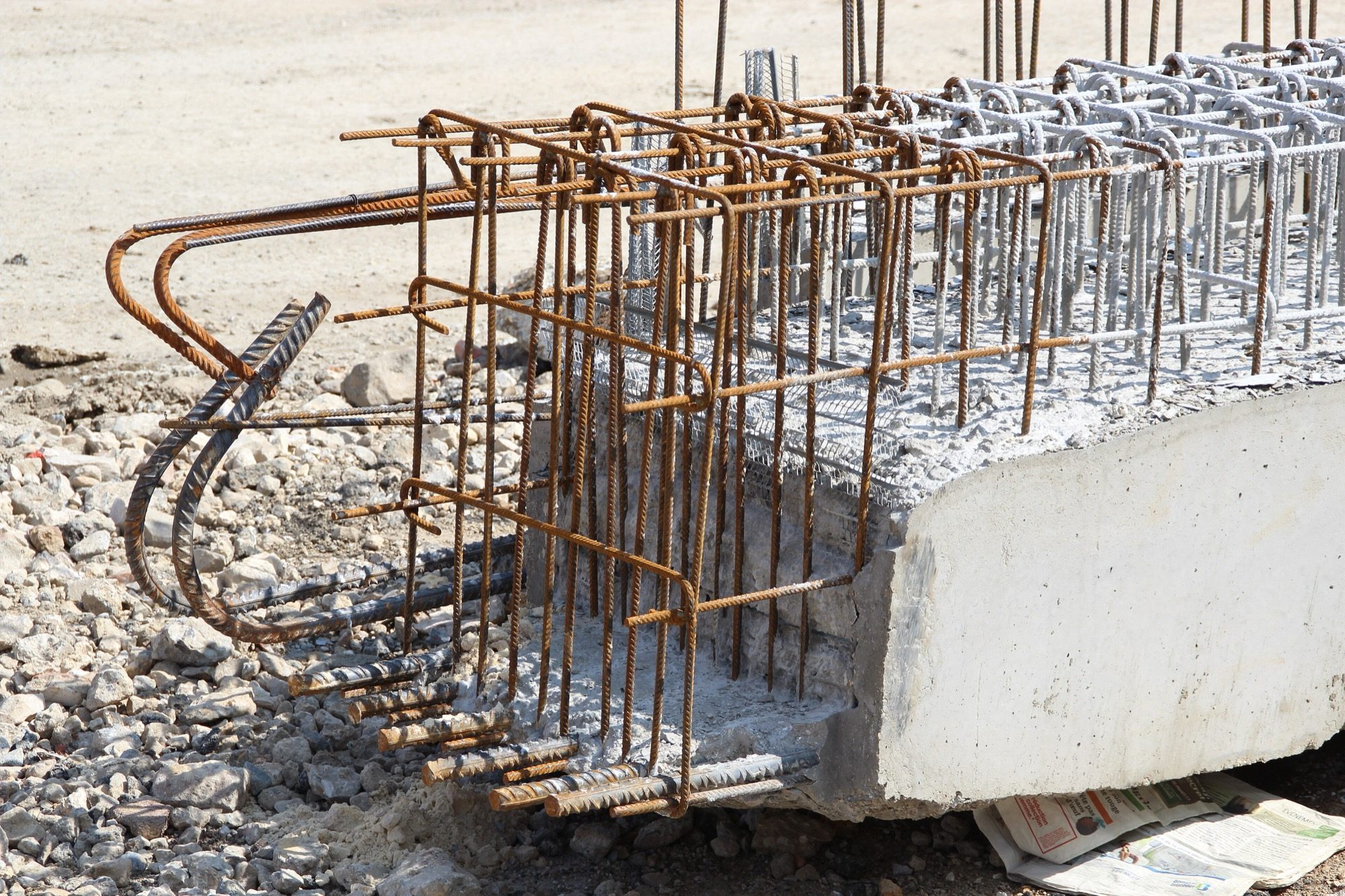
Design of Footings
Sizing the foundation — from safe bearing capacity to shear and steel.
Every load in a building ends up in the ground. A footing is the device that spreads a column's concentrated load over enough soil that the pressure stays within the soil's safe bearing capacity. The design has a neat split that trips up beginners: you size the area with the service (unfactored) load, because the bearing capacity is itself a working-level value — then you switch to factored loads for the depth and the steel.
Learning objectives
By the end of this lesson, you will be able to — mapped to the course outcomes for Design of Structures I:
Distinguish shallow and deep foundations and say when each is used.
Size an isolated footing's plan area from the column's service load and the soil's safe bearing capacity.
Locate and check the one-way and two-way (punching) shear sections.
Explain why area uses service loads while depth and steel use factored loads.
Foundation types
Foundations are shallow — isolated, combined, strip and raft — or deep, where piles carry the load down to firm strata. This lesson designs the isolated footing.[1, 3]
Isolated footing
A single footing under one column — the default for an ordinary framed building on good soil. This unit designs it in detail.[1]
Designing an isolated footing
Size the plan area from the safe bearing capacity; find the net upward pressure; set the depth from one-way and two-way shear; then provide the bending steel. The shear sections are the part to get right.[1]
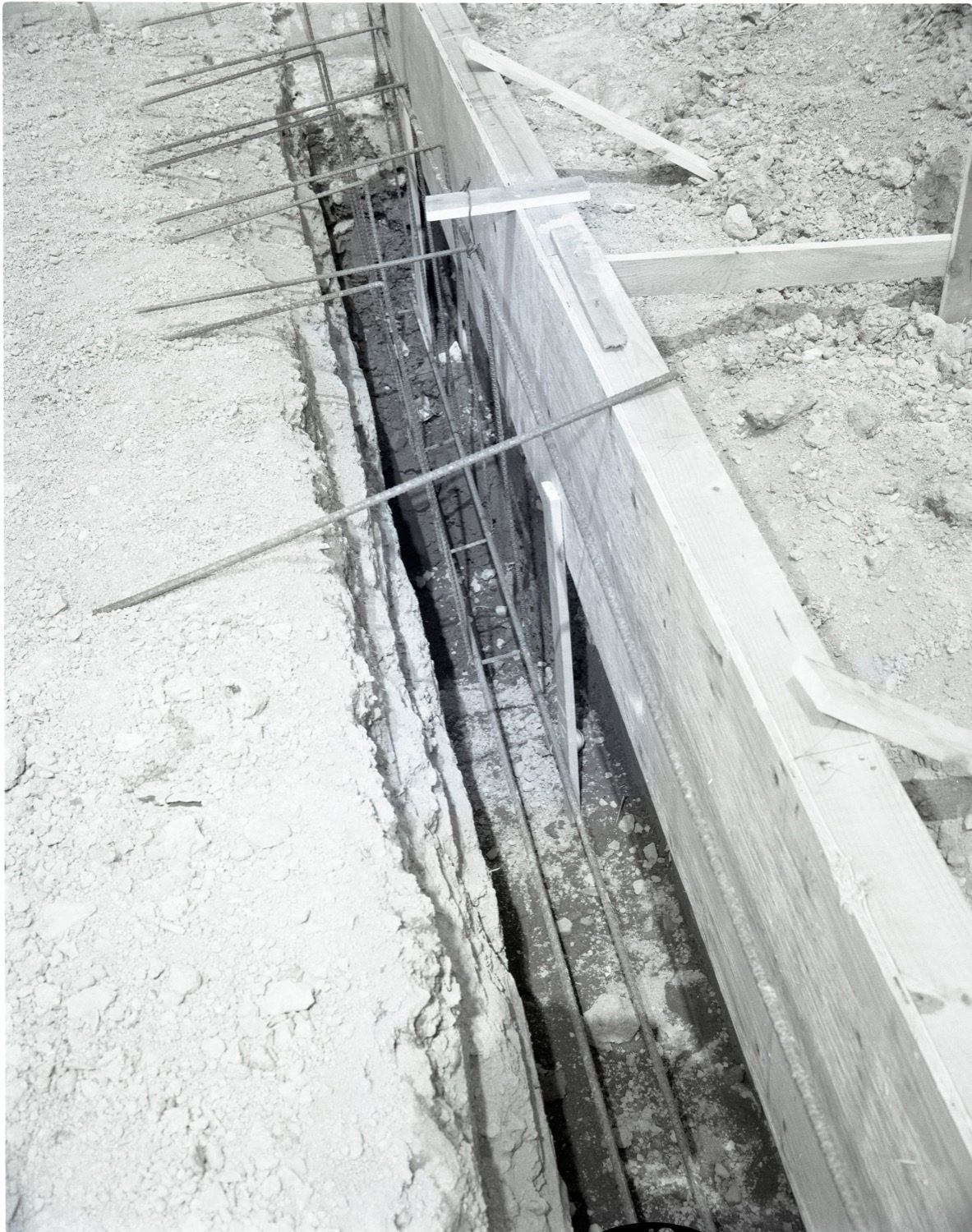
Size a footing
Drive the sizing yourself. A 1000 kN column on soil of 200 kN/m² needs about 5.5 m² — a 2.35 m square — and then carries a net factored pressure for the structural design.
Footing sizer · isolated square footing
Area A = 1.1·P / SBC (service load); side rounded up to 0.05 m. Then the factored pressure qu = 1.5·P / A drives the depth and steel.
0.00 m²
Required area
0.00 m
Square side (≥)
0.0 kN/m²
Net factored upward pressure qu
Area uses the service load + SBC; switch to the factored load only for depth and steel.
Service vs factored, one-way vs two-way
| Aspect | First | Then |
|---|---|---|
| Use this load | Sizing the AREA: service load + SBC | Designing depth & steel: factored load (1.5×) |
| Critical shear section | One-way: at d from column face | Two-way (punching): at d/2 around column |
| Where it acts | Bending moment: at the column face | Punching: on the perimeter near the column |
| Foundation depth | Shallow: isolated, strip, raft | Deep: piles, piers/wells |
| Governs the depth | Usually shear (no shear steel in footings) | Then checked for bending steel |
Key terms
The allowable (working-level) soil pressure used to size the footing area.
Service = unfactored (DL+LL) for sizing area; factored = 1.5× for strength design of depth/steel.
Shear across a full plane at distance d from the column face.
Shear on a perimeter at d/2 around the column, which it tends to punch through.
ks·τc with τc = 0.25√fck; ks = 0.5 + βc ≤ 1 (so 0.25√fck for a square column).
50 mm clear cover to steel for surfaces cast against earth (IS 456 cl. 26.4.2.2).
The soil reaction that actually bends the footing — the footing's self-weight is balanced directly by the soil beneath.
0.12% of gross area for HYSD steel (Fe415/500).
Worked example
For a 1000 kN service load on soil of SBC 200 kN/m²: required area = 1.1 × 1000 ÷ 200 = 5.5 m², so a square of side √5.5 = 2.35 m. The provided area gives a net factored upward pressure qu = 1.5 × 1000 ÷ 5.52 ≈ 272 kN/m² to design the depth and steel. Try changing the SBC in the calculator and watch the footing grow.
Self-assessment
1. The plan area of an isolated footing is sized using —
2. The critical section for two-way (punching) shear is located —
3. For an isolated footing, the depth is usually governed by —
Recap
References & further reading
- [1]IS 456:2000 — Plain and Reinforced Concrete, Code of Practice (4th rev.). Bureau of Indian Standards, New Delhi. (cl. 26.4.2.2, 31.6, 34.)
- [2]SP 16:1980 — Design Aids for Reinforced Concrete to IS 456. Bureau of Indian Standards, New Delhi.
- [3]S.U. Pillai & Devdas Menon, Reinforced Concrete Design (3rd ed.). New Delhi: McGraw-Hill Education, 2009.
Further reading
- B.C. Punmia, A.K. Jain & A.K. Jain, Reinforced Concrete Structures. Laxmi Publications.
- N. Krishna Raju, Reinforced Concrete Design (Limit State Method). CBS Publishers.
- S.U. Pillai & Devdas Menon, Reinforced Concrete Design. McGraw-Hill.
Sources gathered and fact-checked June 2026. Published values vary by source, sample and method — treat as indicative and confirm against the cited standard before structural use.
The author
Amogh N P
Architect, interior designer, and creative polymath. Studio Matrx began in his notebooks — his vision of design made honest, useful, and open to everyone. Its Academy is written and taught in his memory, and free, forever.
More about Amogh →