
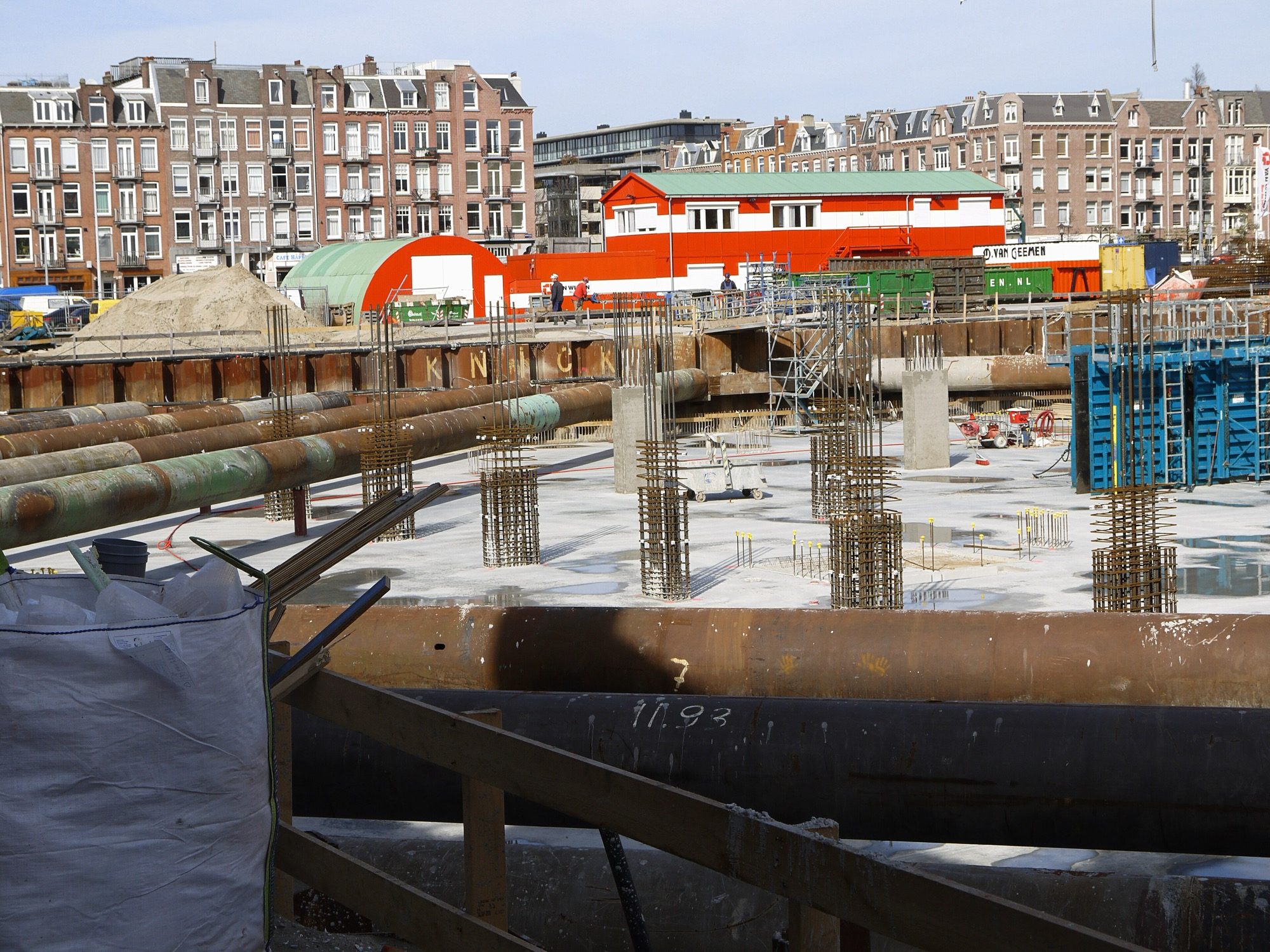
Design of Columns
The compression member — Pu = 0.4 fck Ac + 0.67 fy Asc.
A column carries the building down to the footing in pure compression — concrete and steel acting together. The design of a short, axially-loaded column reduces to one elegant formula, Pu = 0.4 fck Ac + 0.67 fy Asc, where the two reduced stresses already fold in the safety factors and the limited strain the concrete allows before it crushes.
Learning objectives
By the end of this lesson, you will be able to — mapped to the course outcomes for Design of Structures I:
Classify columns by shape, reinforcement, slenderness and loading.
Find the axial capacity of a short column from Pu = 0.4 fck Ac + 0.67 fy Asc.
State the minimum-eccentricity condition under which the simple formula is valid.
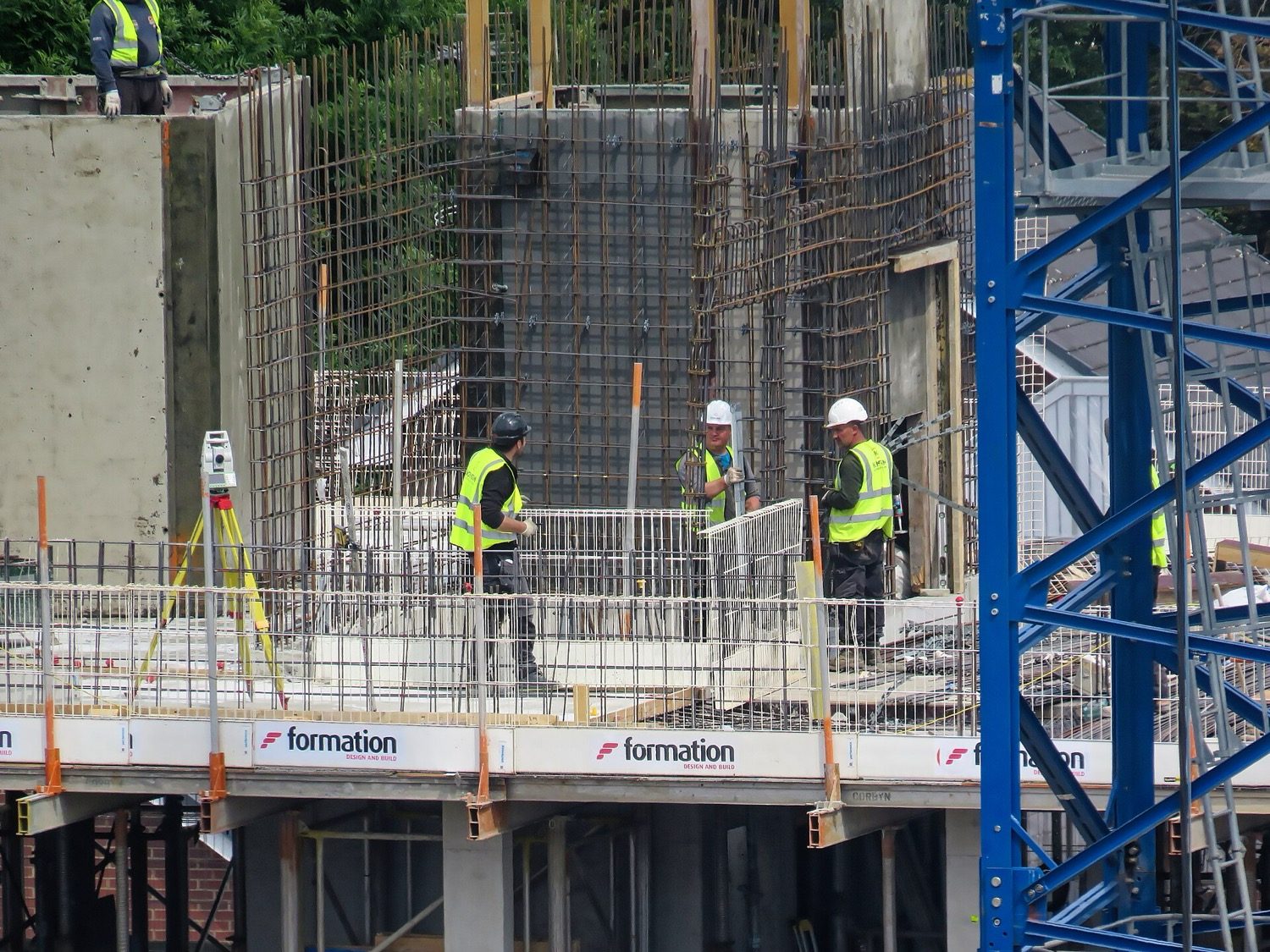
Apply the longitudinal-steel and lateral-tie limits of IS 456.
How columns are classified
By shape (rectangular, square, circular), by reinforcement (tied or spiral), by slenderness (short or long) and by loading (axial, or axial plus bending).[1]
Rectangular, square, circular
Columns are most often rectangular or square; circular columns (often spirally bound) are used for piers, stilts and architectural columns.[1]
The capacity of a short column
The concrete carries 0.4 fck over its net area and the steel 0.67 fy over its area — but only while the minimum eccentricity stays within 0.05D, and only within the 0.8–6% steel limits.[1]
Pu = 0.4 fck Ac + 0.67 fy Asc
For a short axially-loaded column (IS 456 cl. 39.3): the concrete carries 0.4 fck over its net area Ac, and the longitudinal steel 0.67 fy over Asc. The 0.4 and 0.67 are reduced design stresses allowing for the accidental eccentricity and the limited strain at crushing.[1]
Find a column's capacity
A 300 × 400 mm M20 column with Fe415 steel at 1% carries about 1284 kN. Change the section, the grade and the steel and watch how the concrete and steel share the load.
Column capacity · short axially-loaded
Pu = 0.4 fck·Ac + 0.67 fy·Asc (IS 456 cl. 39.3), with Ac = gross − steel.
0.0 kN
Axial capacity Pu
0 mm²
Steel area Asc
0.0 %
Steel of gross
How the concrete and steel share the axial load.
Tied vs spiral, short vs long
| Aspect | One | The other |
|---|---|---|
| Lateral reinforcement | Tied: discrete ties | Spiral: continuous helix (~5% stronger) |
| Slenderness | Short: lₑ/D and lₑ/b ≤ 12 | Long: > 12 — design for buckling |
| Loading | Axial (simple formula) | Axial + bending (P–M interaction) |
| Min longitudinal steel | 0.8% of gross area | Max 6% (≈ 4% practical) |
| Min number of bars | 4 (rectangular) | 6 (circular) |
Key terms
Both slenderness ratios lₑ/D and lₑ/b ≤ 12 (IS 456 cl. 25.1.2).
Longitudinal bars held by discrete lateral ties — the common type.
Longitudinal bars confined by a continuous helix; ~5% extra strength.
Axial capacity of a short column (IS 456 cl. 39.3).
Gross area minus the area of longitudinal steel (Ag − Asc).
emin = l/500 + D/30 ≥ 20 mm; simple formula valid while emin ≤ 0.05D.
0.8% min, 6% max of gross area; 4 bars (rect.) / 6 (circular) minimum.
Restrain bar buckling; pitch ≤ least of least dimension, 16× bar dia, 300 mm.
Worked example
A 300 × 400 mm column (Ag = 120 000 mm²) with 1% steel has Asc = 1200 mm² and Ac = 118 800 mm². Then Pu = 0.4 × 20 × 118 800 + 0.67 × 415 × 1200 = 950 400 + 333 660 ≈ 1284 kN. Confirm it in the calculator, then push the steel toward the 6% cap and see the diminishing return.
Self-assessment
1. A column is treated as 'short' when both slenderness ratios are —
2. In Pu = 0.4 fck Ac + 0.67 fy Asc, the 0.67 on the steel is used because —
3. The longitudinal-steel limits for a column are —
Recap
References & further reading
- [1]IS 456:2000 — Plain and Reinforced Concrete, Code of Practice. Bureau of Indian Standards. (cl. 25.1.2, 25.4, 26.5.3, 39.3.)
- [2]SP 16:1980 — Design Aids for Reinforced Concrete to IS 456. Bureau of Indian Standards.
- [3]S.U. Pillai & Devdas Menon, Reinforced Concrete Design (3rd ed.). McGraw-Hill Education, 2009.
Further reading
- B.C. Punmia, A.K. Jain & A.K. Jain, Reinforced Concrete Structures. Laxmi Publications.
- N. Krishna Raju, Reinforced Concrete Design (Limit State Method). CBS Publishers.
- S. Unnikrishna Pillai & Devdas Menon, Reinforced Concrete Design. McGraw-Hill.
Sources gathered and fact-checked June 2026. Published values vary by source, sample and method — treat as indicative and confirm against the cited standard before structural use.
The author
Amogh N P
Architect, interior designer, and creative polymath. Studio Matrx began in his notebooks — his vision of design made honest, useful, and open to everyone. Its Academy is written and taught in his memory, and free, forever.
More about Amogh →