
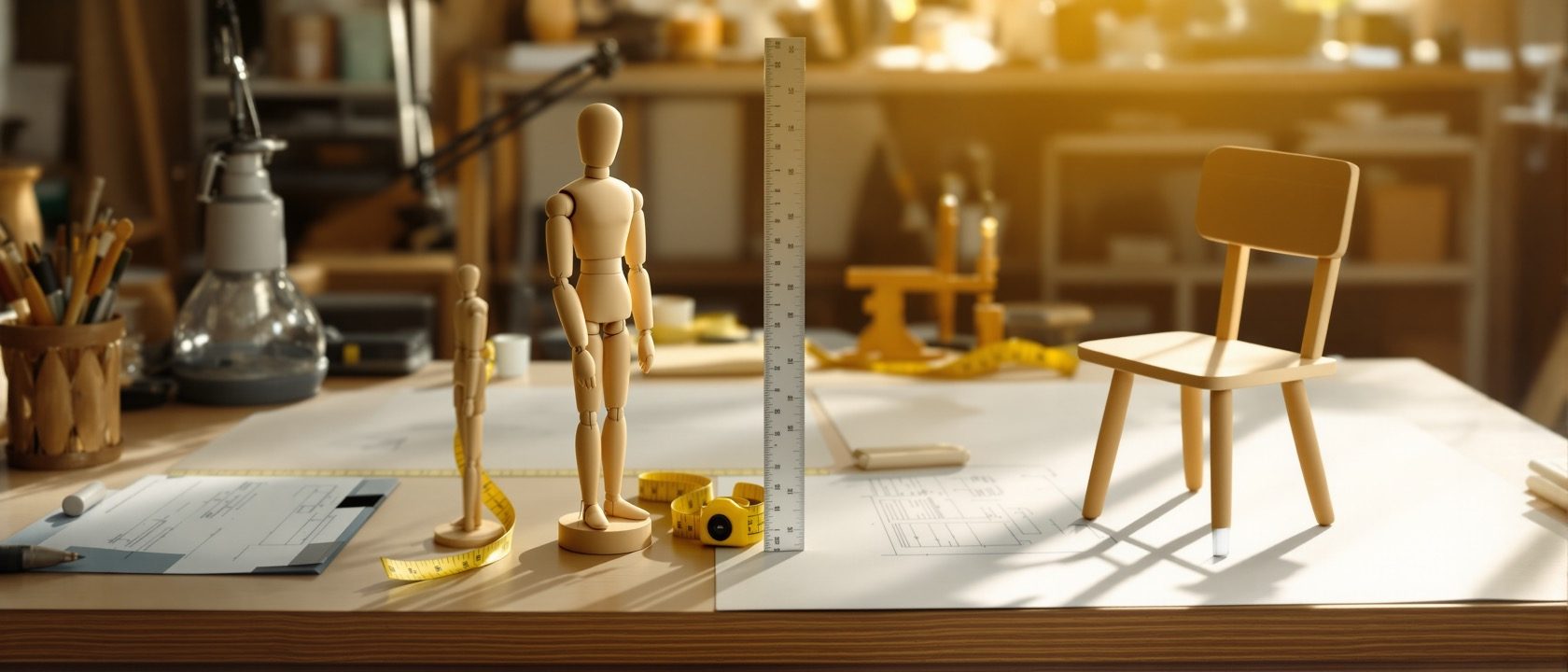
Anthropometrics
Measuring the body — and the percentile rules that size everything to it.
Anthropometry is the measurement of the human body — the data foundation every interior sizes itself to. Master three rules and one caution: size clearance to the large user, reach to the small, make it adjustable across the range — and remember that Western datasets overstate Indian bodies, so use Indian data (Chakrabarti, NID).
Learning objectives
By the end of this lesson, you will be able to — mapped to the course outcomes for Design Fundamentals:
Define anthropometry and distinguish static (structural) from dynamic (functional) measurement.
Apply the percentile rules — clearance to the 95th, reach to the 5th, adjustability across the range.
Treat standard dimensions as conventions or code-governed ranges, not fixed rules.
Explain why Indian-specific data is needed and Western datasets overstate Indian dimensions.
Measuring the body
Static measures still postures; dynamic measures reaches in motion; and designers work in percentiles — the 5th, 50th and 95th.[1, 2]
Measuring the human body
Anthropometry (Greek anthropos 'human' + metron 'measure') is the systematic measurement of the body's size, shape and capabilities — heights, breadths, reaches, ranges of motion. It is the DATA foundation that design (and ergonomics) applies: it answers 'how big is the user?', so that furniture, fittings and spaces can be sized to fit real bodies rather than an imagined one.[1]
The three rules — and the Indian caution
Clearance to the 95th, reach to the 5th, adjustability across the range — and Indian percentiles, not imported Western figures.[1, 4, 5]
Fit the biggest body
CLEARANCE — anything a body must pass through or fit into (doorway, legroom, seat width, corridor, escape route) — is sized to the 95th percentile, the LARGE user. The logic: if the biggest user fits, the smaller users fit too. Sizing clearance to the average leaves the largest 50% cramped.[1, 4]
Which percentile governs?
Pick a design decision and see whether it is a clearance, reach or adjustability problem — and where its governing percentile falls.
Anthropometric-fit explorer · which percentile governs?
Doorway width & height
clearanceClearance → 95th percentile (the large user)
Illustrative dimension: ~800–900 mm wide · ~2000–2100 mm high
If the biggest user passes, everyone passes. [code-varies]
Every millimetre here is a convention or a code-governed range, never a fixed rule — in India, check the NBC 2016 and use Indian (Chakrabarti/NID) percentiles, which Western datasets overstate.
At a glance
| Aspect | Design to | Example |
|---|---|---|
| Clearance | Design to: 95th percentile (large user) | e.g. doorway, legroom, corridor |
| Reach | Design to: 5th percentile (small user) | e.g. shelf, switch, grab bar |
| Adjustability | Design to: 5th–95th range | e.g. office chair, worktop, monitor |
| Static vs dynamic | Static: still postures | Dynamic: reaches in motion (usually governs) |
| Which dataset? | Myth: one universal dataset fits all | Reality: Indian ≠ Western — use Chakrabarti/NID data |
Key terms
The measurement of the body's sizes, shapes and reaches — the data design applies.
Dimensions taken in fixed, still, standardised postures.
Dimensions taken while the body is moving or working (reach envelopes).
The % of a population below a given dimension — 5th (small), 50th (median), 95th (large).
Clearance sizes to the 95th (large); reach sizes to the 5th (small).
The height behind the knee — governs a chair's seat height.
Studio task
For a small study desk, list six dimensions you must fix (desk height, knee clearance, shelf height, chair seat height, legroom, monitor height). For each, state whether it is clearance, reach or adjustability, and which percentile governs. Note where you would reach for Indian (Chakrabarti/NID) data rather than a Western table.
Self-assessment
1. A doorway (clearance) should be sized to the —
2. A wall switch's height (reach) should be sized to the —
3. Using Panero & Zelnik's Western data unchanged in India tends to —
Recap
References & further reading
- [1]R. S. Bridger, Introduction to Ergonomics, 2nd ed., Taylor & Francis, 2003 (percentiles, static/dynamic, design rules).
- [2]Julius Panero & Martin Zelnik, Human Dimension & Interior Space, Whitney Library of Design, 1979.
- [3]Ernst Neufert, Architects' Data (Bauentwurfslehre), current Wiley-Blackwell ed.
- [4]Henry Dreyfuss Associates, The Measure of Man and Woman: Human Factors in Design, rev. ed., 1993 (a Western dataset).
- [5]Debkumar Chakrabarti, Indian Anthropometric Dimensions for Ergonomic Design Practice, NID, Ahmedabad, 1997 (ISBN 81-86199-15-0).
Further reading
- Julius Panero & Martin Zelnik — Human Dimension & Interior Space.
- Ernst Neufert — Architects' Data.
- Debkumar Chakrabarti — Indian Anthropometric Dimensions (NID, 1997).
Sources gathered and fact-checked June 2026. Published values vary by source, sample and method — treat as indicative and confirm against the cited standard before structural use.
The author
Amogh N P
Architect, interior designer, and creative polymath. Studio Matrx began in his notebooks — his vision of design made honest, useful, and open to everyone. Its Academy is written and taught in his memory, and free, forever.
More about Amogh →