

Lesson 07Module 2 · The language of design drawing
Pictorial Systems: An Overview of Projection
Multiview, paraline, and perspective compared
2.5 hours (seminar + studio)ByAmogh N P· Architect & interior designer
Learning objectives
By the end of this lesson, students will be able to:
- Classify the three families of projection — orthographic/multiview, paraline, and perspective — by how projectors meet the picture plane.
- Match each system to its communicative strength: measurable accuracy, volumetric clarity, or experiential realism.
- Read one simple building presented in all three systems and explain what each view reveals and conceals.

Key concepts
- Projection as the geometric bridge between a 3D object and a 2D drawing: parallel vs. converging projectors, perpendicular vs. oblique to the picture plane.
- Multiview drawings preserve true measurements but fragment the object; paraline drawings keep the whole volume but distort experience; perspective matches experience but sacrifices measurability.
- Drawing conventions as a shared language: why a plan in Bengaluru is readable in Berlin.
- Choosing a system is a rhetorical decision — what do you need the viewer to understand?
In-class activities & exercises
Projection demonstration (30 min)Instructor uses a cardboard model, a lamp, and a glass sheet to physically cast orthographic and perspective projections.
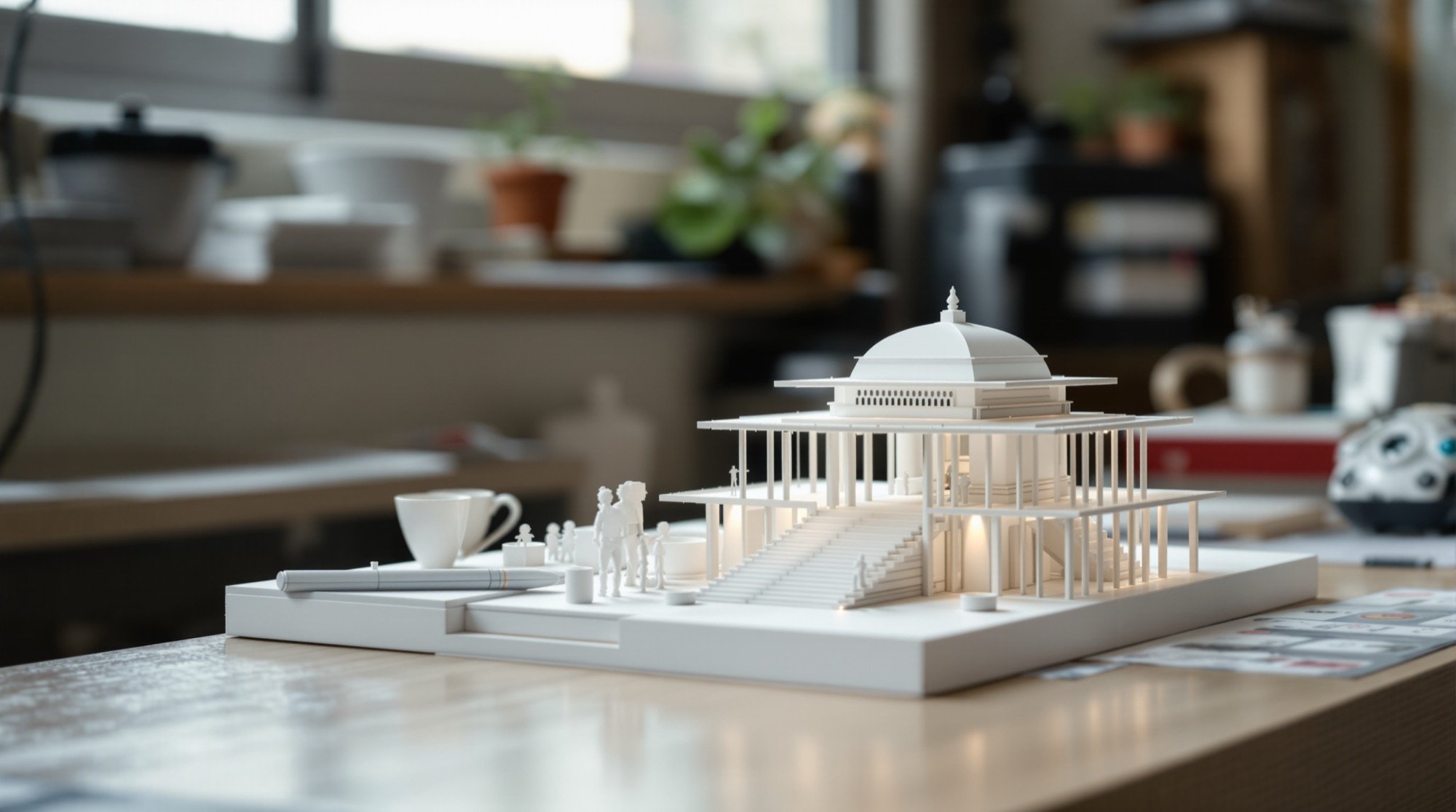
System safari (40 min)Students receive one small pavilion design shown as plan, section, isometric, and perspective, and annotate what each view tells them.
First translations (50 min)From a dimensioned isometric of a simple stepped form, students produce its plan and front view freehand.
Discussion (20 min)Which system would you choose to explain this pavilion to a builder? To a client? To yourself?
Worked example sketches
How the technique looks in practice — loose, hand-drawn examples. Scroll to watch each one draw in; click to zoom.
Homework / studio assignment
Find any building product brochure or instruction sheet; identify and label every projection type used and write three sentences on why each was chosen.
Assessment
Annotation quality in the system safari; correctness of the translation exercise.
A
The author
Amogh N P
Architect, interior designer, and creative polymath. Studio Matrx began in his notebooks — his vision of design made honest, useful, and open to everyone. Its Academy is written and taught in his memory, and free, forever.
More about Amogh →