Amogh N P
 In loving memory of Amogh N P — Architect · Designer · Visionary 
Multiview Drawings I: Orthographic Views and Floor Plans — The plan as a horizontal cut
Lesson 08Module 2 · The language of design drawing

Multiview Drawings I: Orthographic Views and Floor Plans

The plan as a horizontal cut

3 hours studio

Learning objectives

By the end of this lesson, students will be able to:

  • Set up related orthographic views with correct alignment and shared dimensions.
  • Construct a floor plan as a horizontal cut at roughly window height, applying cut/seen line-weight conventions.
  • Use standard plan conventions: wall poché, door swings, window indications, stairs with direction arrows, and dashed lines for elements above the cut.
  • Draw to scale using an architect's scale, working at 1:100 and 1:50.

The Plan Cut: a horizontal slice through the building An imaginary plane cuts at roughly window height; we look straight down on what remains. cutting plane ≈ window height everything above the cut is removed look straight down Resulting floor plan LIVING BED HALL poché — cut walls drawn heaviest / solid opening = gap in poché
DiagramThe horizontal cutting plane slicing a house, with the resulting plan below.
Plan conventions — a quick legend Standard symbols every floor plan uses. Cut elements heaviest; swings and annotation lightest. Door (swing) leaf swing arc Window in wall glazing lines in the cut Stair (single flight) UP Fixtures (WC & sink) WC basin Kitchen sink + counter counter run with double-bowl sink Line-weight key cut (poché) — heaviest seen — medium fixtures / thin — light above-cut / swing — dashed
DiagramPlan conventions: doors, windows, stairs, fixtures, and line weights.
How a floor plan is built up — six stages 1 Setup lines 2 Walls 3 Openings 4 Fixtures 5 Poché 6 Annotation 3600 KIT BATH HALL Work light-to-heavy: faint construction first, then build weight as decisions become final. Poché and labels come last.
DiagramA plan developing: setup lines → walls → openings → fixtures → poché → annotation.
Students measuring a room beside the resulting dimensioned sketch.
PhotoStudents measuring a room beside the resulting dimensioned sketch.
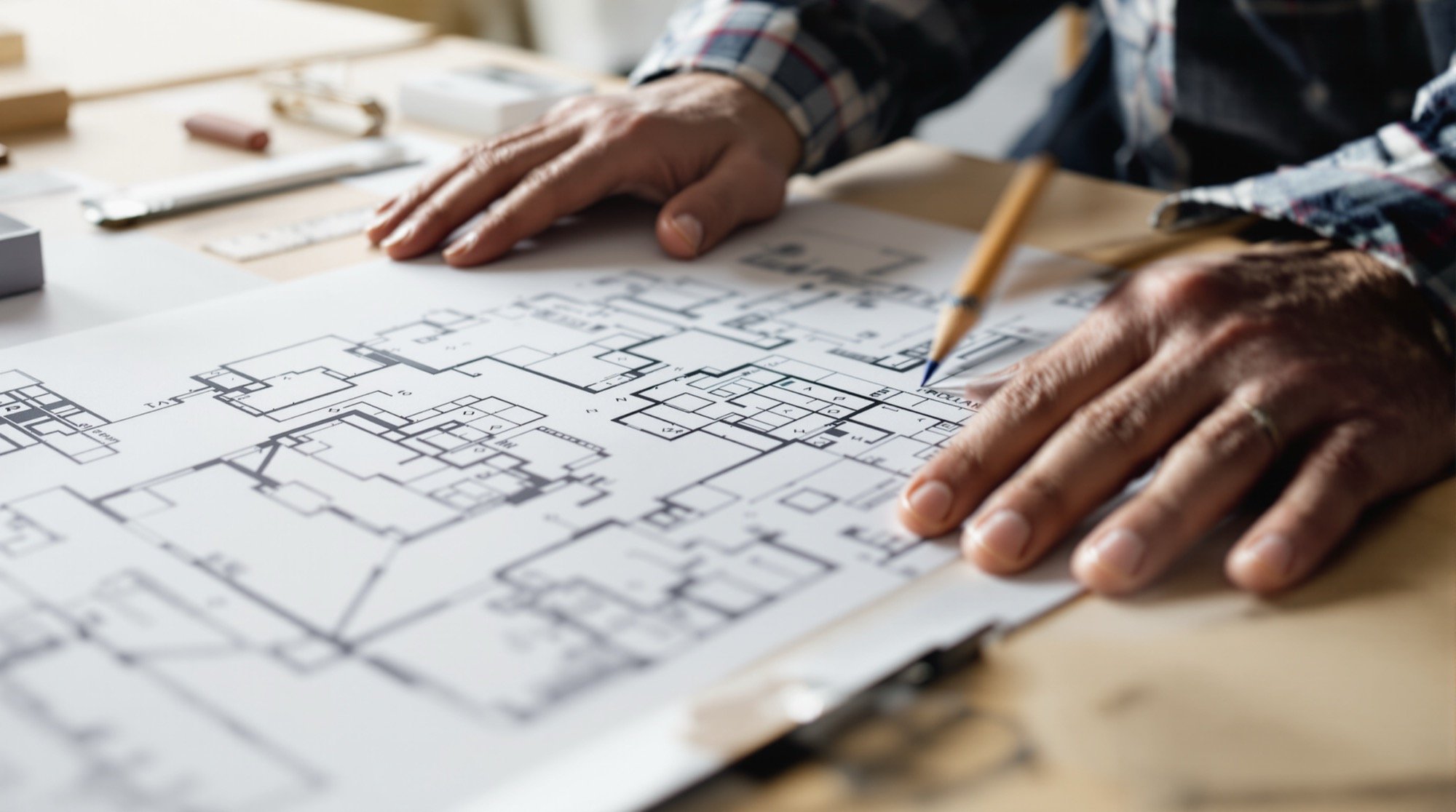
Drafting a plan by hand.
ReferenceDrafting a plan by hand.
Interactive · step through it

Draw the plan, stage by stage

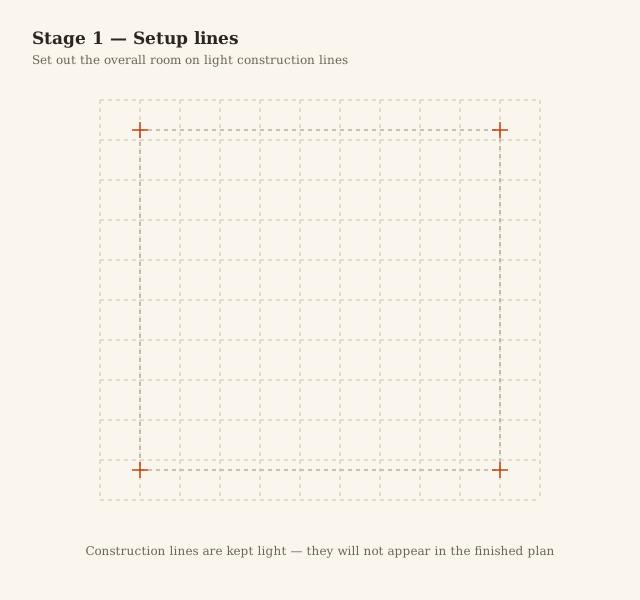
A floor plan is a horizontal cut. Step through setup → walls → openings → fixtures → poché → annotation.
1 / 6
Setup lines

Stage 1Setup lines

Key concepts

  • The plan as a horizontal section: everything cut is heaviest, everything seen below is lighter, everything above is dashed.
  • View alignment: plan, elevations, and sections must correspond — features line up across views.
  • Scale as a contract: what level of detail belongs at 1:100 vs. 1:50.
  • Poché and the figure of space: how filling walls reveals rooms as shapes.

In-class activities & exercises

Convention bootcamp (40 min)A worksheet of doors, windows, stairs, and fixtures to draw in correct plan notation.
Measure and draw (80 min)In pairs, students measure a small real room with tape measures and produce a 1:50 plan on site.
Line-weight pass (30 min)Inking the plan with three weights — cut, seen, and annotation.
Cross-check (30 min)Pairs swap plans and attempt to locate three features in the real room using only the drawing.

Worked example sketches

How the technique looks in practice — loose, hand-drawn examples. Scroll to watch each one draw in; click to zoom.

Single room — plan 1:50 0 1 2 m
DiagramA hand-drafted single-room plan at 1:50, fully conventioned.
Kitchen plan 0 1 2 m
DiagramA small kitchen plan with fittings and door swing.
Studio room — plan 4.60 3.40
DiagramA studio-room plan with furniture and dimension lines.
Bathroom plan — 1:50 0 1 2 m
DiagramA bathroom plan at 1:50 with WC, basin and shower.

Homework / studio assignment

Measure and draw a 1:50 plan of one room of your home, fully conventioned, with furniture.

Assessment

Rubric on dimensional accuracy (spot-checked against the real room), convention correctness, and line-weight discipline.