By the end of this lesson, students will be able to:
Define and place the elements of linear perspective: horizon line, station point, picture plane, vanishing points, and cone of vision.
Construct a one-point interior perspective from a plan and section.
Set up a two-point exterior perspective of a simple block building.
Manipulate perspective variables — eye level, distance, and view angle — to change the drawing's effect.
DiagramThe perspective apparatus: observer, picture plane, station point, horizon, cone of vision.
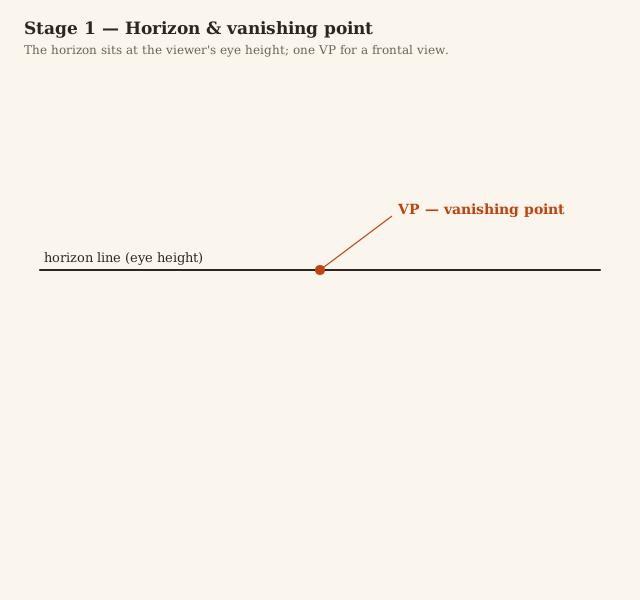
DiagramA one-point interior constructed in six stages.
DiagramThe same building at low, normal, and high eye levels.
PhotoA street arcade with traced convergence overlays.
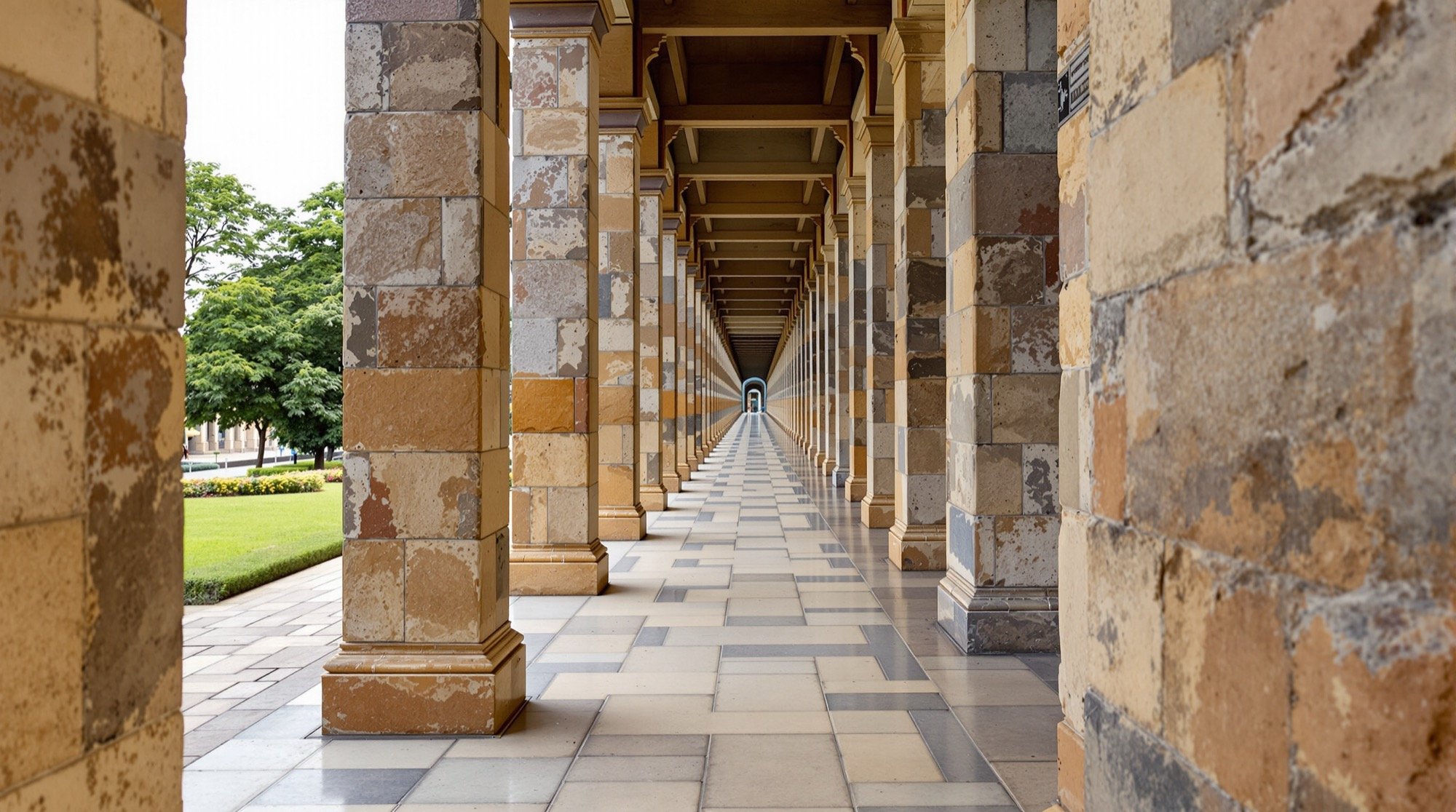
ReferenceA colonnade receding — one-point in the world.
Interactive · drag it
Perspective Playground
Drag the orange handles — the horizon (eye level) and the vanishing points. Watch the building re-converge. Notice how every standing figure's head stays on the horizon, no matter how far away.
Drag the orange dots. Try dropping the horizon low for a monumental worm's-eye view, or high for an aerial one.
Interactive · step through it
Construct a one-point interior, stage by stage
From a single vanishing point on the horizon to a furnished room.
1 / 6
Stage 1 — Horizon & vanishing point
Key concepts
Convergence as the defining cue: parallel lines meet at vanishing points on the horizon at the observer's eye height.
One-point for axial interiors and streets; two-point for objects and corners; the cone of vision as a distortion guard.
Eye level as storytelling: worm's-eye monumentality vs. aerial overview vs. standing-height normalcy.
Estimating depth in freehand perspective: the diagonal method for halving and repeating equal bays.
In-class activities & exercises
Horizon hunts (20 min)On five photographs, students find the horizon and vanishing points with ruler overlays.
One-point interior (70 min)Constructing the studio room in one-point from its measured plan, gridding the floor with diagonals.
Two-point block (70 min)A simple two-storey block building in two-point, with bays repeated by the diagonal method.
Variable play (40 min)Three rapid thumbnails of the same block at low, normal, and high eye levels.
Worked example sketches
How the technique looks in practice — loose, hand-drawn examples. Scroll to watch each one draw in; click to zoom.
DiagramA one-point corridor sketch with a lightly held vanishing point.
DiagramA street corner in two-point — bays repeated by the diagonal method.
DiagramA daily-walk street in one-point, horizon retained.
DiagramA worm's-eye two-point view of a tall building.
Homework / studio assignment
A freehand one-point perspective of a corridor or street you walk daily, with horizon and vanishing point lightly retained.
Assessment
Rubric on geometric correctness (convergence, eye level consistency), depth estimation, and freehand confidence.
A
The author
Amogh N P
Architect, interior designer, and creative polymath. Studio Matrx began in his notebooks — his vision of design made honest, useful, and open to everyone. Its Academy is written and taught in his memory, and free, forever.