By the end of this lesson, students will be able to:
Construct a measured two-point perspective using the office/common method (plan projection through the picture plane).
Use measuring lines and the diagonal-point technique to transfer true dimensions into perspective depth.
Build and reuse a two-point perspective grid for rapid sketching.
Produce a section perspective and recognize when three-point perspective is warranted.
DiagramThe common method in eight numbered steps.
DiagramThe diagonal-point technique with equal columns receding in depth.
DiagramA flat section vs. the same section deepened into a section perspective.
DiagramA reusable two-point grid with an example sketch over it.
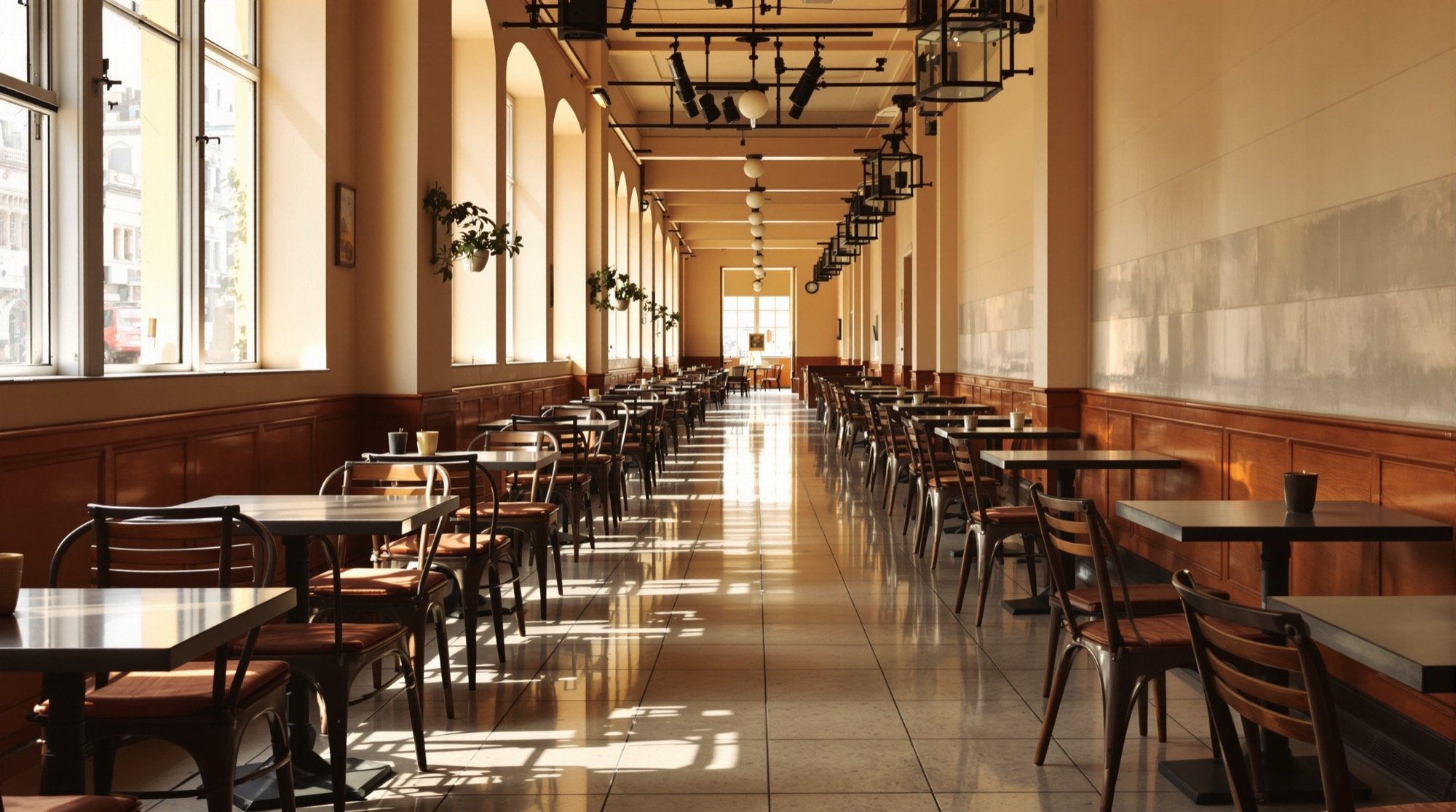
ReferenceA café interior — a two-point subject.
Interactive · drag it
Perspective Playground
Drag the orange handles — the horizon (eye level) and the vanishing points. Watch the building re-converge. Notice how every standing figure's head stays on the horizon, no matter how far away.
Drag the orange dots. Try dropping the horizon low for a monumental worm's-eye view, or high for an aerial one.
Key concepts
The common method: plotting where sight lines from plan corners cross the picture plane, then projecting heights from a true-height line.
Diagonal points as measuring tools: converting real distances along the ground line into receding depth.
Perspective grids as reusable scaffolding: one careful setup, many fast sketches.
Section perspective as the hybrid workhorse: measurable cut plus experiential depth; three-point for towers and dramatic views.
In-class activities & exercises
Common-method construction (90 min)A fully measured two-point perspective of the Lesson 10 pavilion from its plan and elevation.
Grid building (40 min)Constructing a reusable A3 two-point grid; students then sketch two massing variations over it on trace.
Section perspective (50 min)Extending the Lesson 9 section into depth with a single vanishing point.
Demonstration (15 min)Instructor sets up a three-point view of a tall building and discusses when the third point earns its complexity.
Worked example sketches
How the technique looks in practice — loose, hand-drawn examples. Scroll to watch each one draw in; click to zoom.
DiagramA measured two-point setup — plan above, true-height line, projected box.
DiagramA café interior sketched quickly over a reusable perspective grid.
DiagramA section extended into a section perspective.
DiagramA reusable two-point grid with a quick massing over it.
Homework / studio assignment
Using your grid, produce two quick perspective studies of an imagined small café interior; submit grid and overlays together.
Assessment
Rubric on measured accuracy of the common-method drawing, plus fluency of the grid sketches.
A
The author
Amogh N P
Architect, interior designer, and creative polymath. Studio Matrx began in his notebooks — his vision of design made honest, useful, and open to everyone. Its Academy is written and taught in his memory, and free, forever.