By the end of this lesson, students will be able to:
Use contour and modified-contour techniques to capture edges accurately.
Control line weight deliberately to signal hierarchy: heavy for nearer/cut edges, light for distant or soft edges.
Apply sighting techniques (pencil-at-arm's-length, comparative measurement) to check proportions.
Identify positive and negative shapes and use negative space to correct a drawing.
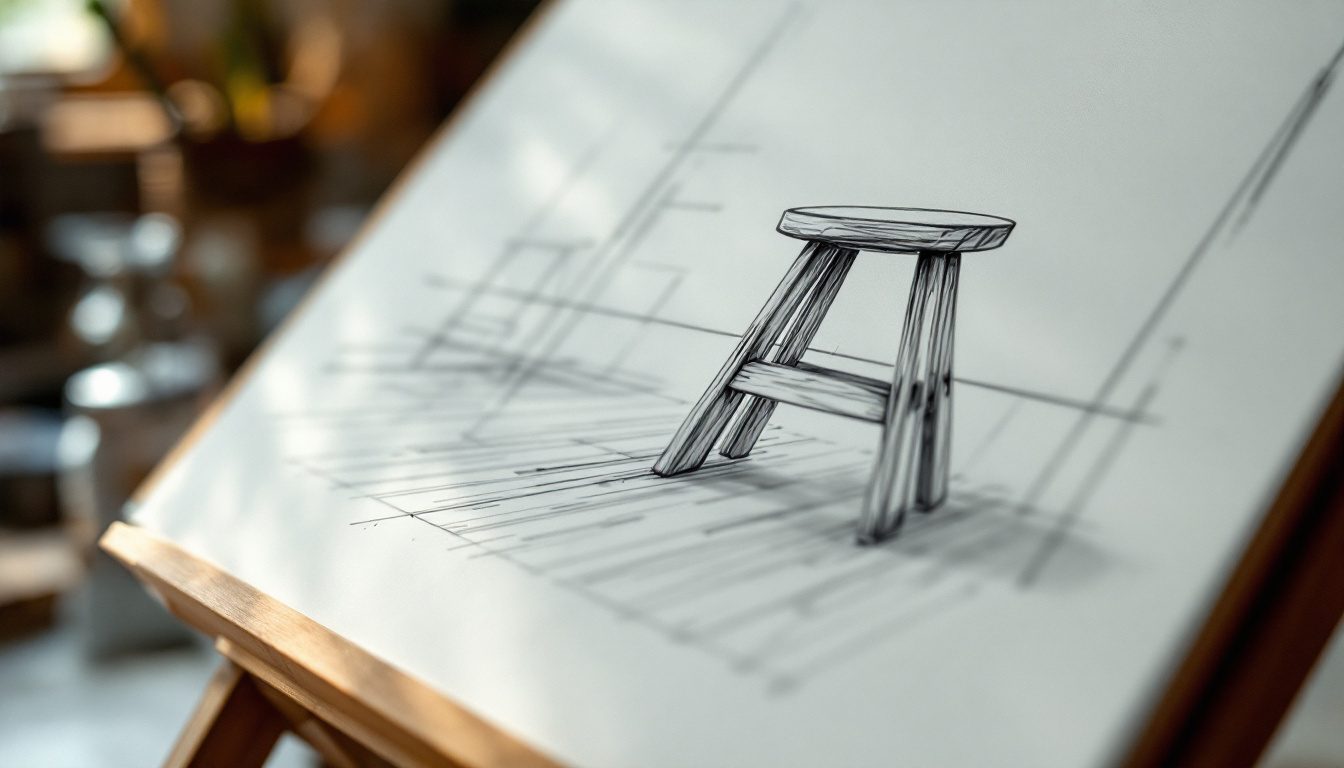
DiagramThe same stool in uniform vs. hierarchical line weight — how hierarchy creates depth.
DiagramFigure–ground pair: black-on-white and white-on-black of one composition.
DiagramPencil-sighting technique for checking proportion.
PhotoA contour drawing of a paper bag at four stages.
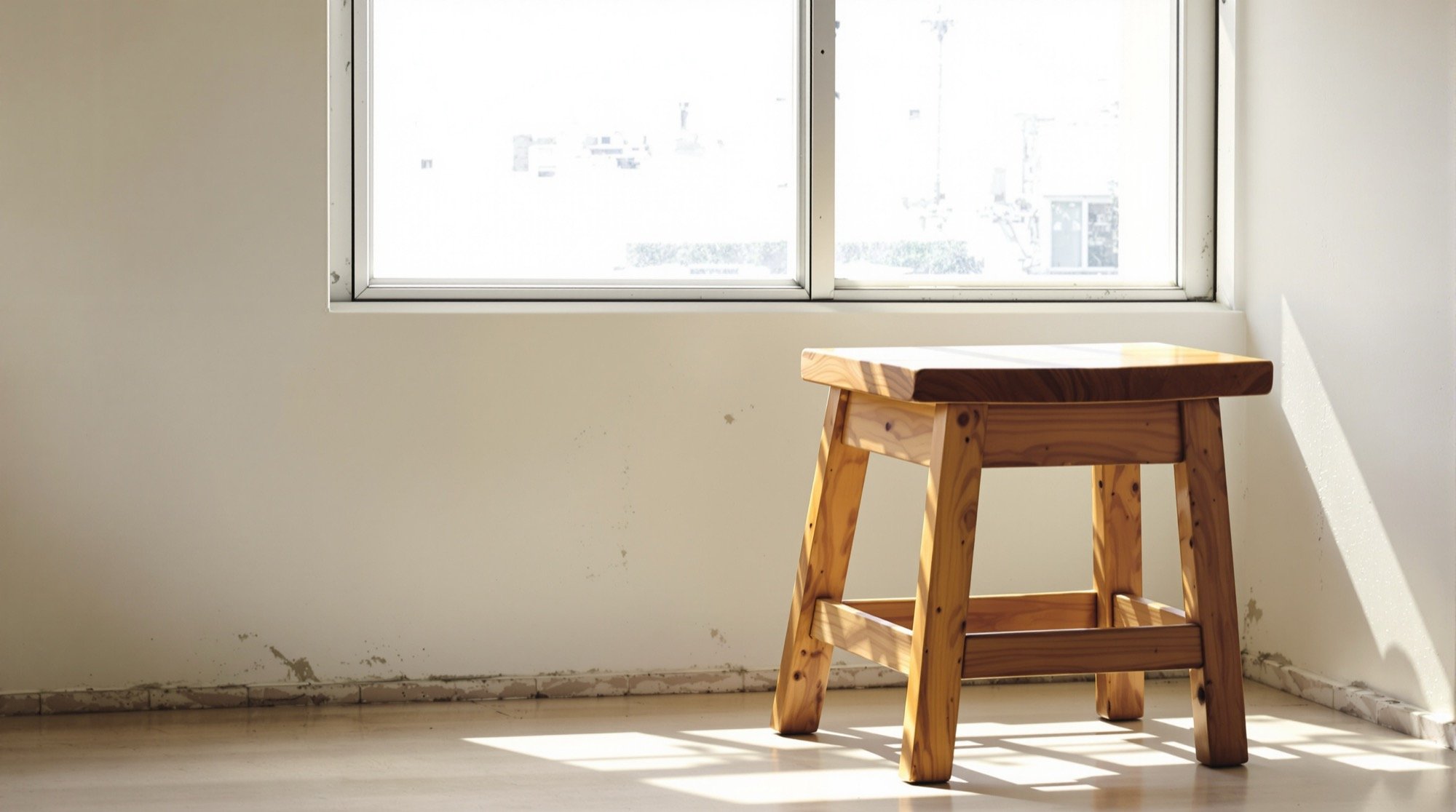
ReferenceA wooden stool in raking side light — a contour subject.
Interactive · toggle it
Line weight makes depth
The same stool, the same lines — only the line weights change. Heavy for near and cut edges, light for far and soft ones. Flip it and watch the flat drawing gain depth.
Hierarchical — the front edge and near legs read as closer.
Key concepts
Line as the most abstract yet most fundamental graphic element — edges do not exist in nature, only changes of surface.
Contour vs. outline: following the form across its surface rather than tracing a silhouette.
Proportion and sighting: using a pencil as a measuring stick, finding the midpoint of any subject first.
Figure–ground reversal: drawing the air around a chair instead of the chair.
In-class activities & exercises
Contour studies (30 min)Blind and modified contour studies: crumpled paper bag, then a stack of books.
Negative-space study (40 min)A wooden stool drawn entirely by shading the spaces between its legs and rails.
Sighting workshop (40 min)Full-height drawing of the studio doorway and wall, with measured checkpoints marked.
Line-weight pass (30 min)Students re-trace one earlier drawing on tracing paper using three pen weights with explicit rules for each.
Pin-up critique (20 min)Drawings reviewed together as a group.
Worked example sketches
How the technique looks in practice — loose, hand-drawn examples. Scroll to watch each one draw in; click to zoom.
DiagramContour study of a bicycle — confident, hierarchical line weight.
DiagramA chair drawn through its negative spaces.
DiagramA potted plant in pure line, leaf edges followed across the form.
DiagramA building entrance in modified contour, line-weight hierarchy applied.
Homework / studio assignment
Two A4 studies: (1) negative-space drawing of a bicycle or plant; (2) modified contour of a building entrance near your home, with line-weight hierarchy applied.
Assessment
Rubric (1–5) on accuracy of proportion, line confidence, and deliberate use of line weight.
A
The author
Amogh N P
Architect, interior designer, and creative polymath. Studio Matrx began in his notebooks — his vision of design made honest, useful, and open to everyone. Its Academy is written and taught in his memory, and free, forever.