
The Revolt & the Pluralism
Postmodernism, Memphis, High-Tech, Deconstructivism and Minimalism
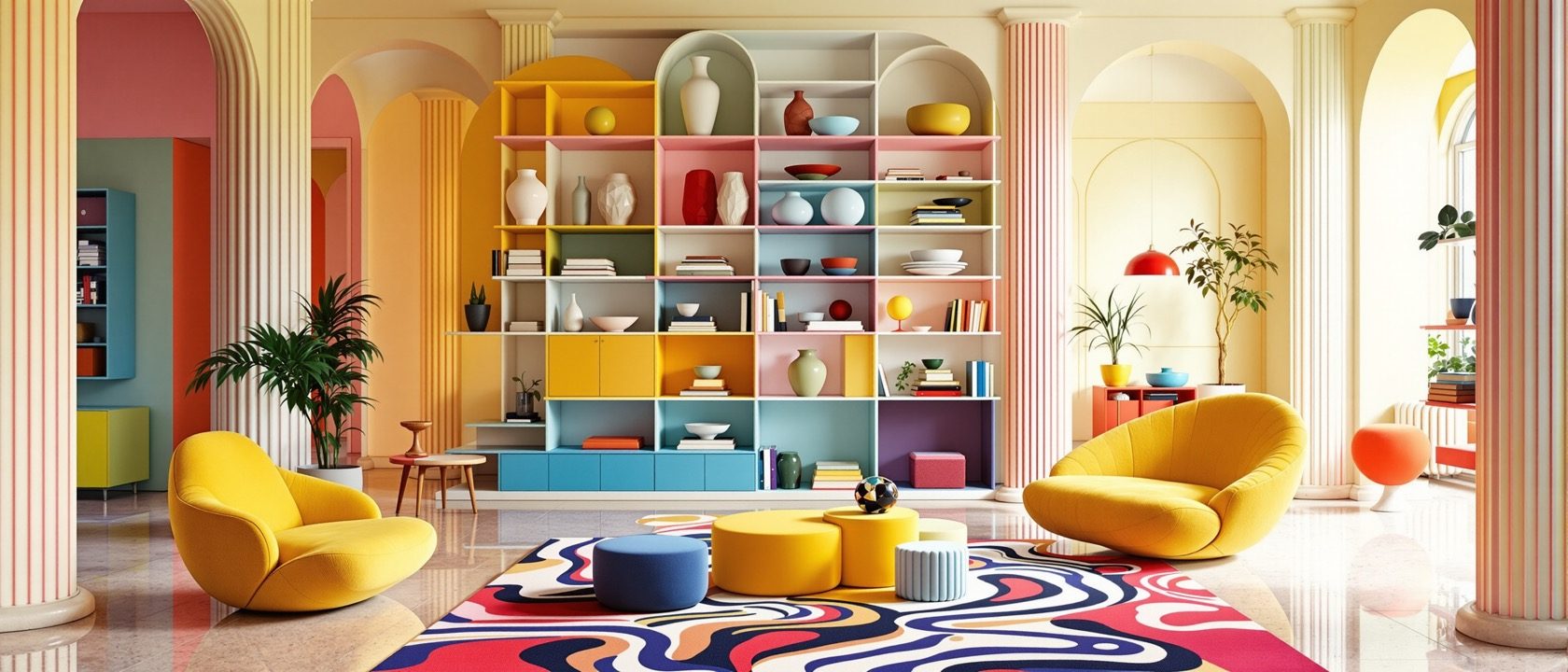
By the mid-1960s the single modernist narrative shattered. This unit follows the revolt and the plural field that followed: Venturi’s ‘less is a bore’ and the writing-out of Denise Scott Brown, Postmodern irony, the Memphis provocation, High-Tech’s services worn on the outside, Deconstructivism as a visual tendency rather than built philosophy, and minimalism as expensive high-craft — not empty rooms. Each one is a chance to separate what actually happened from the folklore that grew over it.
Learning objectives
By the end of this lesson, you will be able to — mapped to the course outcomes for Contemporary Interiors:
Identify Postmodernism, Memphis, High-Tech, Deconstructivism and Minimalism, with their landmark works and dates.
Explain the revolt against 'less is more' and the writing-out of Denise Scott Brown from the 1991 Pritzker.
Show that postmodernism was disciplined (not chaos), Memphis was a deliberate provocation, and Deconstructivism is a visual tendency, not built philosophy.
Correct the biggest myth of the unit — that minimalism is empty, cheap or easy — with the evidence of hidden craft.
The revolt
Venturi’s ‘less is a bore’ (1966) opened the revolt against ‘less is more’; postmodernism is disciplined irony, not chaos. And ‘Learning from Las Vegas’ was co-authored with Denise Scott Brown, whom the 1991 Pritzker left out.[1, 2, 3]
Venturi's riposte to Mies, 1966
Robert Venturi's 'Complexity and Contradiction in Architecture' (MoMA, 1966) is the founding manifesto of architectural postmodernism, arguing for 'both-and' over 'either-or'. Its most famous line is a deliberate riposte to Mies's 'less is more': “I like elements which are hybrid rather than ‘pure’ … Less is a bore.” Vincent Scully's introduction called it 'probably the most important writing on the making of architecture since Le Corbusier's Vers une Architecture, of 1923'.[1]
The plural field
Memphis was a calculated 1981 provocation, not random tackiness; High-Tech wears its services on the outside (the Pompidou, 1977); and Deconstructivism is a shared visual tendency, not built Derrida.[4, 5, 6]
A calculated provocation, not tackiness
The Memphis Group debuted in Milan in September 1981, led by the veteran Ettore Sottsass with a young circle. Its clashing plastic laminate, kitsch pattern and 'wrong' colour — the totem-like Carlton room divider (1981) is emblematic — were a CALCULATED critique of modernist 'good taste' and function-worship, not random tackiness. It was polarising by design, deliberately short-lived (Sottsass stepped back around 1985; the group ended in 1988), and famously collected by Karl Lagerfeld.[4]
Minimalism
The unit’s biggest correction: minimalism is not empty, cheap or easy. With ‘nowhere to hide’, every junction must be perfect — concealed joinery, tight tolerances, hidden storage. The calm plane is expensive, exacting work.[7, 8, 9]
Not cheap, not easy — the big correction
The centrepiece myth of the unit: minimalism is empty, cheap and easy. In truth, serious minimalism is expensive and craft-intensive. Because there is 'nowhere to hide', every junction must be perfect — concealed joinery, flush details, shadow gaps, seamless surfaces, hidden lighting and services, and large amounts of concealed storage to keep the visible plane clear. The empty room is the RESULT of a great deal of hidden, costly work.[7]
At a glance
| Aspect | The fact | The folklore |
|---|---|---|
| 'Less is a bore' | Robert Venturi, 1966 — a deliberate riposte to Mies | An anonymous internet slogan |
| Learning from Las Vegas / the 1991 Pritzker | Co-authored with Denise Scott Brown; the prize went to Venturi alone | Venturi's solo work, fairly awarded |
| Postmodernism | Disciplined irony, quotation and 'double coding' | Anything-goes chaos with no rules |
| Memphis | A calculated 1981 critique of 'good taste', short-lived by design | Random, tacky 1980s plastic |
| Deconstructivism | A shared visual tendency named at MoMA (1988) | The built application of Derrida's philosophy |
| Minimalism | Expensive, high-craft, storage-heavy; essence not emptiness | Empty, cheap and easy — just decluttering |
Key terms
Charles Jencks's term (1977) for postmodern architecture that speaks on two levels at once — to the architectural elite and to the public/street.
Venturi & Scott Brown's distinction: a 'duck' is a building whose form is its sign; a 'decorated shed' is a plain box carrying applied signage.
A style (named by Kron & Slesin, 1978) that celebrates exposed structure and services and industrial off-the-shelf components — the Centre Pompidou its icon.
A visual tendency (MoMA, 1988) of fragmentation, distortion and skewed geometry — a shared look, not a doctrine or 'built philosophy'.
A rigorous aesthetic of reduction to essence — proportion, light, seamless surface and concealed everything. Expensive and exacting, distinct from decluttering.
The post-1966 condition in which a single dominant narrative (modernism) fragments into many coexisting tendencies at once.
Study task
Take one work from the plural field — Graves’s Portland Building or Alessi kettle, a Memphis piece, the Centre Pompidou, a Gehry or Hadid building, a Pawson interior — and write a one-page honest reading. Name its movement and date; describe the specific way it argues against modernism (irony, exposed services, fragmentation, radical reduction); and correct one myth commonly attached to it (that postmodernism is chaos, that Memphis is just tacky, that Deconstructivism is ‘built Derrida’, that minimalism is empty and cheap). Finish with a sentence on what the work was for — the point it was making. Reading a building as an argument, not just a look, is the habit this unit builds.
Self-assessment
1. 'Less is a bore' — whose line is it, and what is it answering?
2. What happened with Denise Scott Brown and the 1991 Pritzker?
3. What is the honest description of the Memphis Group?
4. The Centre Pompidou (1977) is a High-Tech icon because…
5. What is the biggest myth this unit corrects about minimalism?
Recap
References & further reading
- [1]Robert Venturi, Complexity and Contradiction in Architecture (Museum of Modern Art, 1966; intro by Vincent Scully) — 'Less is a bore'.
- [2]The Pritzker Architecture Prize (1991 laureate; 2013 jury statement); Denise Scott Brown, 'Room at the Top? Sexism and the Star System in Architecture' (1975/1989). https://www.pritzkerprize.com/laureates/1991
- [3]Charles Jencks, The Language of Post-Modern Architecture (1977) — double coding; Michael Graves, Portland Building (1982) and Alessi 9093 (1985).
- [4]Victoria & Albert Museum — the Memphis Group and Ettore Sottsass's 'Carlton' (1981). https://www.vam.ac.uk/articles/memphis-design
- [5]Joan Kron & Suzanne Slesin, High-Tech: The Industrial Style and Source Book for the Home (Clarkson N. Potter, 1978); Centre Pompidou (Piano + Rogers, 1977). https://www.centrepompidou.fr/en/the-centre-pompidou/the-building
- [6]Philip Johnson & Mark Wigley, Deconstructivist Architecture (MoMA exhibition catalogue, 1988). https://www.moma.org/calendar/exhibitions/1813
- [7]John Pawson, Minimum (Phaidon, 1996); the Calvin Klein flagship, New York (1995–96).
- [8]Antoine de Saint-Exupéry, Terre des Hommes / Wind, Sand and Stars (1939) — 'nothing left to take away'.
- [9]Charles Jencks, The Language of Post-Modern Architecture (1977) — the '3.32 pm' Pruitt-Igoe line.
Further reading
- Robert Venturi, Complexity and Contradiction in Architecture (MoMA, 1966).
- Venturi, Scott Brown & Izenour, Learning from Las Vegas (MIT Press, 1972; rev. 1977).
- John Pawson, Minimum (Phaidon, 1996).
Sources gathered and fact-checked June 2026. Published values vary by source, sample and method — treat as indicative and confirm against the cited standard before structural use.
The author
Amogh N P
Architect, interior designer, and creative polymath. Studio Matrx began in his notebooks — his vision of design made honest, useful, and open to everyone. Its Academy is written and taught in his memory, and free, forever.
More about Amogh →