
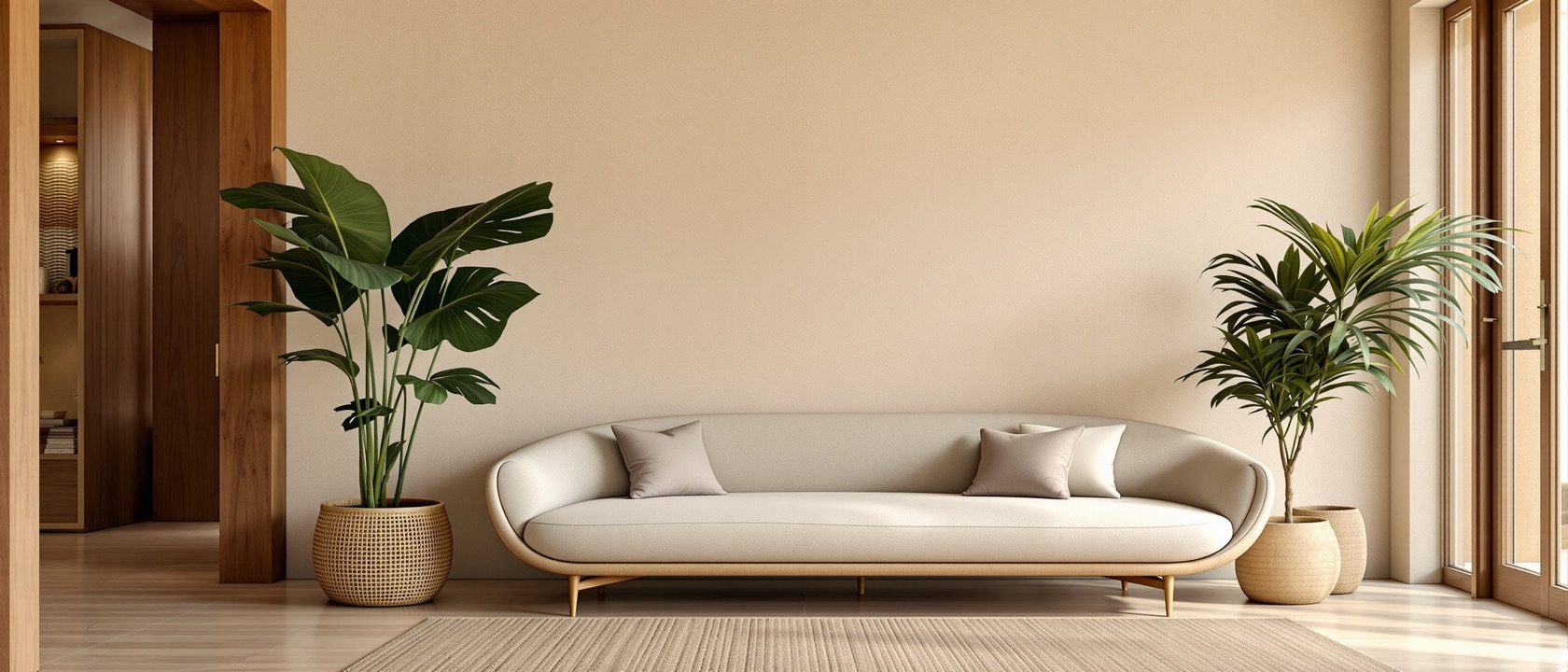
The Contemporary Interior Today
Trends, sustainability, technology — and contemporary India, honestly
Now for the interior being designed today — and the honest caveats that come with it. This unit states the spine precisely (‘contemporary’ is not ‘modern’), then tests the claims of the present: that trends are not timelessness, that ‘natural’ is not automatically sustainable, that the greenest interior is usually the one you don’t rip out, that ‘smart’ is not the same as better, and that contemporary-Indian design done well is modern form answering local craft and climate — not an imported Western look.
Learning objectives
By the end of this lesson, you will be able to — mapped to the course outcomes for Contemporary Interiors:
State precisely why 'modern' and 'contemporary' are not synonyms, and how the words are misused in the market.
Separate genuine contemporary shifts from passing trend cycles, and trends from timelessness.
Weigh sustainability and 'smart' technology claims against the honest evidence — embodied carbon, reuse, greenwashing, over-marketed tech.
Describe the genuine contemporary-Indian synthesis of modern form with local craft, material and climate.
The spine, in practice
A 1930s Bauhaus chair is permanently modern; a newly made one is contemporary production of a modern design. The market blurs the two into sales adjectives — and any list of ‘contemporary characteristics’ is a snapshot with an expiry date.[1, 2]
The spine, stated precisely
'Modern' is a proper noun — a specific, dated, rule-bound movement of roughly the 1910s–1960s. 'Contemporary' is a common adjective — literally 'belonging to the present moment', a target that never stops moving. A 1930s Bauhaus chair is permanently modern; it can never again be contemporary. A newly made one is contemporary PRODUCTION of a modern design. Modern is frozen; contemporary moves.[1]
The honest caveats
On-trend is the opposite of timeless; ‘fast’ furniture is wasteful by design; the greenest interior is usually the one you keep; and ‘smart’ tech is real in mechanism but often over-marketed and under-used.[3, 4, 5, 6, 7]
Near-opposites, not the same thing
The core myth: 'on-trend equals timeless'. They are near-opposites. A trend is defined by mass adoption and therefore mass fatigue; 'timeless' means resistant to exactly that cycle. 'Millennial grey' is the textbook case — a safe, everywhere choice the design press was declaring 'over' by around 2021–2023. Fashion is designed to expire so the next thing can sell; good design tries to outlive fashion.[2]
See the spine
Here is the whole distinction in one picture: the Modern movement occupies a bounded, shaded stretch of the twentieth century, while ‘contemporary’ is the open right edge that never stops moving. Tap an era to read it.
Modern ↔ contemporary · a period, and a moving moment
Tap an era · amber = the Modern movement, green = the contemporary now
The golden age
1945–1969Mid-Century Modern: the Eameses, Saarinen, Jacobsen, Wegner, Florence Knoll, Scandinavian and organic design. The image most people mean by 'modern' — and the one labelled, retrospectively, in 1984.
The whole point in one picture: ‘modern’ is a bounded stretch of the past; ‘contemporary’ is the open edge that keeps moving. A new Bauhaus chair is contemporary production of a modern design.
Contemporary India
The myth to kill: that ‘contemporary’ means an imported, all-white look. The genuine synthesis is modern form plus local craft, material and climate — Studio Mumbai, RMA, Kundoo, Wallmakers — a continuation of Correa’s climate-responsive modernism.[8, 9]
Contemporary is not a Western look
The myth to kill: that 'contemporary' means an imported, all-white, imported-furniture look. The genuine contemporary-Indian synthesis is modern spatial form plus local craft, local materials, climate response and, where relevant, Vaastu sensibilities — a continuation of the climate-responsive modernism pioneered by Charles Correa. The all-white imported look is a fashion, not the definition of contemporary.[8]
At a glance
| Aspect | The fact | The folklore |
|---|---|---|
| 'Modern' vs 'contemporary' | A finished historical movement vs the ever-moving present | Two words for the same thing |
| On-trend | Defined by mass adoption and mass fatigue — the opposite of timeless | Proof that a choice is timeless |
| 'Natural' / 'eco' materials | Judged by embodied carbon, durability and churn — natural is not automatically low-impact | Automatically sustainable |
| The most sustainable interior | Usually the one you don't rip out (reuse/retrofit) | The one made of the most 'green' new products |
| 'Smart' technology | Real mechanism, often over-marketed and under-used; complexity is a cost | Automatically better and more livable |
| Contemporary-Indian design | Modern form answering local craft, material and climate | An imported, all-white Western look |
Key terms
Literally 'of the present moment' — the interior being designed now. It has no fixed rulebook and looks different in every decade; not a synonym for 'modern'.
The greenhouse emissions locked into a building's materials and construction — roughly 11% of global energy-related carbon (WorldGBC, 2019) — as distinct from operational energy.
A framework (E.O. Wilson, 1984; Stephen Kellert, 2008) connecting interiors to nature through daylight, natural pattern, materiality and prospect/refuge — more than a potted plant.
A media-driven label (c.2023) for understated, high-quality, logo-free richness — a fashion term that migrated into interiors, not a design theory.
The CIE's neutral term for lighting designed to support the body clock — preferred to the marketing phrase 'human-centric' or 'circadian' lighting.
Kyle Chayka's term (2016) for the global sameness of Instagram- and Airbnb-optimised interiors — photogenic, placeless and interchangeable.
Study task
Find one recent, real interior you admire — a magazine feature, a designer’s portfolio, a project near you — and interrogate it honestly on one page. Which of its features are genuine design values (material honesty, daylight, a real climate response) and which are simply this year’s trend? Where is it sustainable in substance versus in marketing — is anything reused or retrofitted, or is it a full rip-out of ‘eco’ new products? And if it is Indian, does it answer local craft and climate, or import a look? End with the honest one-line verdict: does it serve the people who use it, or does it just photograph well? Weighing the claim against the evidence is the whole point of the unit.
Self-assessment
1. Why are 'modern' and 'contemporary' not synonyms?
2. What is the honest relationship between 'on-trend' and 'timeless'?
3. What is the most sustainable interior, honestly?
4. What is the honest position on 'circadian' smart lighting?
5. What is the genuine contemporary-Indian synthesis?
Recap
References & further reading
- [1]Merriam-Webster / Tate & MoMA glossaries — the definitions of 'modern' (the movement) and 'contemporary' (the present). https://www.tate.org.uk/art/art-terms/c/contemporary-art
- [2]E.O. Wilson, Biophilia (Harvard University Press, 1984); Stephen R. Kellert et al., Biophilic Design (Wiley, 2008).
- [3]US Environmental Protection Agency — Advancing Sustainable Materials Management: Facts and Figures (furniture and furnishings in MSW). https://www.epa.gov/facts-and-figures-about-materials-waste-and-recycling
- [4]Carl Elefante, 'The Greenest Building Is… One That Is Already Built', Forum Journal (National Trust for Historic Preservation, 2007).
- [5]World Green Building Council, Bringing Embodied Carbon Upfront (2019). https://worldgbc.org/article/bringing-embodied-carbon-upfront/
- [6]Berson, Dunn & Takao, 'Phototransduction by Retinal Ganglion Cells That Set the Circadian Clock', Science 295 (2002). https://www.science.org/doi/10.1126/science.1067262
- [7]International Commission on Illumination (CIE) — position statement on integrative (non-visual) lighting. https://cie.co.at/
- [8]Studio Mumbai / RMA Architects / Atelier Ashiesh Shah / Wallmakers / Anupama Kundoo — practice sources and coverage (Dezeen, ArchDaily, AD India). https://www.dezeen.com/tag/studio-mumbai/
- [9]Fondation Cartier, Paris — Bijoy Jain, 'Breath of an Architect' (2024). https://www.fondationcartier.com/en
Further reading
- Kyle Chayka, Filterworld: How Algorithms Flattened Culture (Doubleday, 2024).
- Stephen R. Kellert, Judith Heerwagen & Martin Mador (eds.), Biophilic Design (Wiley, 2008).
- William J. R. Curtis, Modern Architecture Since 1900 (Phaidon) — for the Indian modernists.
Sources gathered and fact-checked June 2026. Published values vary by source, sample and method — treat as indicative and confirm against the cited standard before structural use.
The author
Amogh N P
Architect, interior designer, and creative polymath. Studio Matrx began in his notebooks — his vision of design made honest, useful, and open to everyone. Its Academy is written and taught in his memory, and free, forever.
More about Amogh →