
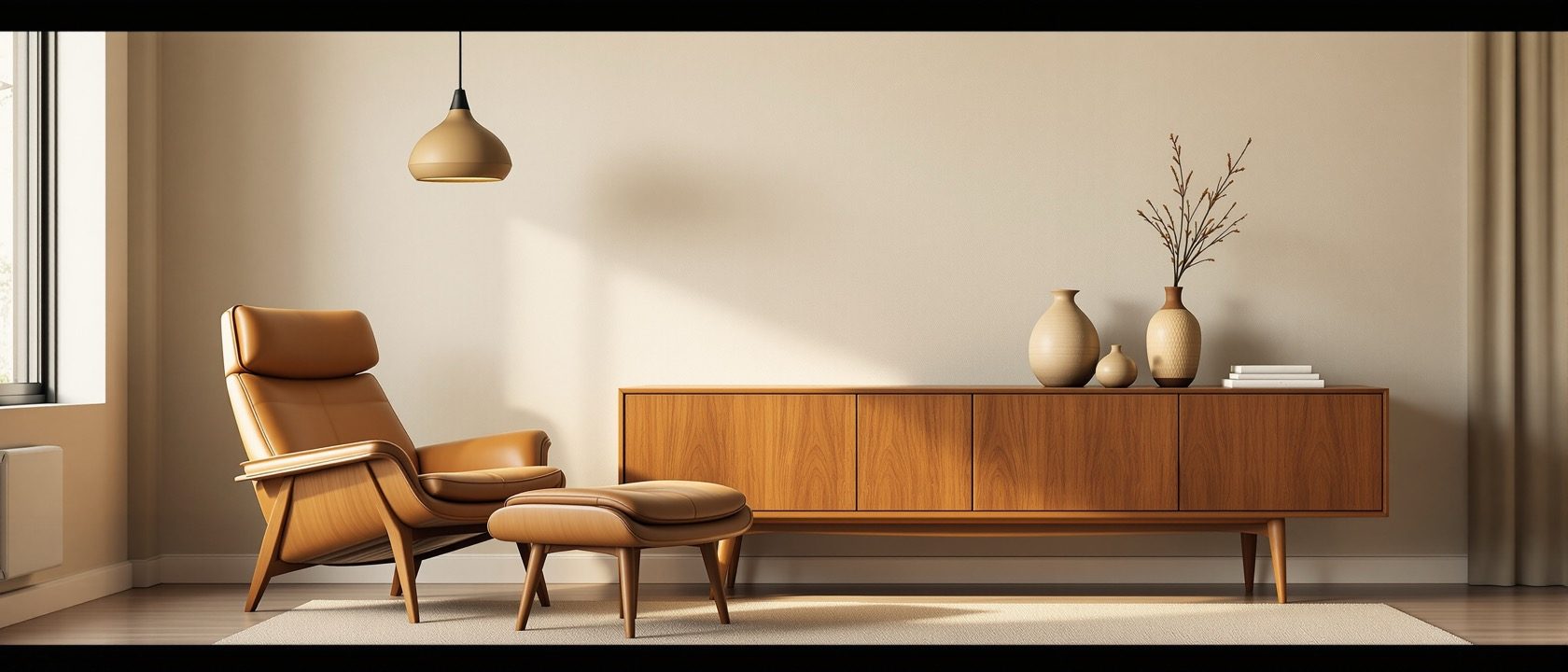
The Modern Movement Matures
International Style to Mid-Century — and the labels invented after the fact
Once modernism had its manifestos, it spread and diversified. This unit follows it into maturity: the International Style and how naming it a ‘style’ softened a social movement; Mid-Century Modern and the fact that the label was coined in 1984, not the 1950s; the real designers and pieces — Charles and Ray Eames, Saarinen, Florence Knoll who refused the word ‘decorator’; Scandinavian democratic design and the 2016 ‘hygge’ overlay; Wright’s open plan that predates its reinvention by fifty years; and Indian modernism at Chandigarh, with the uncomfortable story of the Jeanneret chairs.
Learning objectives
By the end of this lesson, you will be able to — mapped to the course outcomes for Contemporary Interiors:
Identify the International Style, Mid-Century Modern, Scandinavian and organic design, with their key figures and landmark pieces.
Explain how naming the 'International Style' recast a social/functional movement as a formal aesthetic.
Show that 'Mid-Century Modern' and 'hygge' are retrospective labels, and that the Eames work is Charles AND Ray Eames.
Describe Indian modernism at Chandigarh — including the honest story of the Jeanneret furniture — as co-produced, not merely imported.
How modernism spread
MoMA’s 1932 show recast a social and functional movement as a formal aesthetic — which made it exportable. And ‘Mid-Century Modern’ is a retrospective label: nobody in the 1950s used it.[1, 2, 3, 4]
A social movement renamed a 'style'
MoMA's 1932 exhibition 'Modern Architecture: International Exhibition' and Hitchcock & Johnson's companion book 'The International Style' distilled modernism into three formal principles: volume rather than mass, regularity rather than symmetry, and the avoidance of applied ornament. The nuance to teach: European modernism had been driven by program — mass housing, social reform, industrial production. Presenting it to America as a coherent AESTHETIC is what made it exportable, and what many pioneers, Gropius among them, disliked.[1]
The designers and the pieces
The ‘Eames’ work is Charles and Ray Eames; Saarinen wanted to ‘clear up the slum of legs’; Florence Knoll refused the word ‘decorator’; and ‘hygge’ is a 2016 marketing overlay, not a mid-century principle.[3, 4, 5, 6]
An equal creative partner, long half-erased
The chairs the world calls 'Charles Eames' were the work of Charles AND Ray Eames — Ray (born Bernice Alexandra Kaiser) was a woman and his equal creative partner, central to the office's form, colour and visual language. The persistent 'solo male designer' framing is a myth the discipline is still correcting. The Eames Lounge (670/671, 1956) debuted on American television that year.[3]
Organic and Indian modernism
Wright’s ‘destruction of the box’ opened the room fifty years before ‘open plan’ became a cliché; and Indian modernism at Chandigarh was co-produced and climatised — with the uncomfortable Jeanneret-chair auction story as a lesson in how value is made.[7, 8, 9]
Wright dissolves the walled room
Frank Lloyd Wright's 'organic architecture' fused building to site with natural materials and built-in furniture. His own phrase for freeing the interior was the 'destruction of the box' — opening corners, dissolving walls into screens and glass. Fallingwater (1935) and the affordable Usonian houses (from 1936, with radiant floors, carports and open living) carried it into the American home.[7]
At a glance
| Aspect | The fact | The folklore |
|---|---|---|
| 'International Style' | A name that recast a social/functional movement as a formal aesthetic (MoMA, 1932) | A neutral label that simply described the modern movement |
| 'Mid-Century Modern' | A retrospective label popularised by Cara Greenberg's 1984 book | A style designers consciously belonged to in the 1950s |
| The Eames work | Charles AND Ray Eames — a woman, an equal creative partner | 'Charles Eames', a solo male designer |
| Florence Knoll | Ran the Knoll Planning Unit; rejected the word 'decorator' | A decorator of mid-century offices |
| 'Hygge' | A 2016-era Western marketing overlay on Scandinavian design | A mid-century Scandinavian design principle |
| Open-plan living | Wright's Prairie houses did it c.1900–10 | A late-20th-century invention |
Key terms
The formal codification of modern architecture named by MoMA's 1932 exhibition and book: volume over mass, regularity over symmetry, no applied ornament.
A retrospective label (Cara Greenberg, 1984) for the roughly 1945–1969 marriage of organic form and industrial technique — not a term the era used for itself.
The Scandinavian ideal of well-made, honest-material objects affordable to ordinary homes — an ethic, not just an aesthetic.
Frank Lloyd Wright's term for building in harmony with site and humanity — form, structure and setting as one integrated whole.
Wright's affordable middle-class house type (from 1936): slab-on-grade, radiant floor heating, carport, built-in furniture and open living space.
A commission in which the architect designs the building, furniture, lighting and fittings as one — e.g. Jacobsen's SAS Royal Hotel (1958–60).
Study task
Choose one landmark of the mature modern movement — the Eames Lounge, Saarinen’s Tulip group, Jacobsen’s SAS Royal Hotel, a Wright Usonian, or the Chandigarh furniture — and research it honestly to one page. Give its correct date and designers (name every collaborator, not just the famous one); describe its hallmark; and state one piece of received wisdom about it that the evidence corrects. Then answer a single question in a sentence: is this object ‘mid-century modern’, and if so, who decided that — and when? Chasing a fact to its source, and refusing the tidy myth, is the skill this unit rewards.
Self-assessment
1. What is the honest fact about the term 'Mid-Century Modern'?
2. What did naming the 'International Style' do to the modern movement?
3. Whose work are the famous 'Eames' chairs?
4. What is true about 'hygge' and Scandinavian design?
5. What is the honest story of the Chandigarh 'Jeanneret chairs'?
Recap
References & further reading
- [1]The Museum of Modern Art — 'Modern Architecture: International Exhibition' (1932); Hitchcock & Johnson, The International Style (Norton, 1932). https://www.moma.org/calendar/exhibitions/2044
- [2]Cara Greenberg, Mid-Century Modern: Furniture of the 1950s (Harmony Books, 1984) — the source of the term.
- [3]Vitra Design Museum & Herman Miller — Charles and Ray Eames; the Eames Lounge Chair (670/671, 1956). https://www.vitra.com/en-us/product/eames-lounge-chair-ottoman
- [4]Knoll — Eero Saarinen Pedestal Collection (1957) and the 'slum of legs'; Arne Jacobsen and the SAS Royal Hotel (1958–60). https://www.knoll.com/designer/Eero-Saarinen
- [5]Knoll & The New York Times (obituary, 2019) — Florence Knoll Bassett, the Knoll Planning Unit, and 'I am not a decorator'. https://www.knoll.com/designer/Florence-Knoll-Bassett
- [6]Nationalmuseum (Sweden) / Designmuseum Danmark — 'Design in Scandinavia' (1954–57) and the Lunning Prize.
- [7]The Frank Lloyd Wright Foundation — 'organic architecture', the 'destruction of the box', the Usonian houses and the Prairie houses. https://franklloydwright.org/
- [8]Fondation Le Corbusier & Chandigarh scholarship — the Capitol Complex, Pierre Jeanneret and the furniture. https://www.fondationlecorbusier.fr/
- [9]The Pritzker Architecture Prize — Balkrishna Doshi, 2018 laureate. https://www.pritzkerprize.com/laureates/balkrishna-doshi
Further reading
- Cara Greenberg, Mid-Century Modern: Furniture of the 1950s (Harmony Books, 1984).
- Charlotte & Peter Fiell, Design of the 20th Century (Taschen).
- William J. R. Curtis, Modern Architecture Since 1900 (Phaidon).
Sources gathered and fact-checked June 2026. Published values vary by source, sample and method — treat as indicative and confirm against the cited standard before structural use.
The author
Amogh N P
Architect, interior designer, and creative polymath. Studio Matrx began in his notebooks — his vision of design made honest, useful, and open to everyone. Its Academy is written and taught in his memory, and free, forever.
More about Amogh →