
Data Display, Reporting & the Record
From point cloud to archived record — and digital survival.
Capture is only the beginning; the deliverable is a record that will still be readable in fifty years. Learn how raw data becomes documentation — measured drawings and orthophotos derived from scans; the heritage record and its archive with metadata; the process model from capture to archive; HBIM and the digital twin as a queryable database; and the hard problem of digital preservation — because a hard drive is not an archive.
Learning objectives
By the end of this lesson, you will be able to — mapped to the course outcomes for Advanced Practice & Technique in Conservation:
Derive measured drawings and orthophotos from captured data.
Assemble an archived heritage record with metadata.
Explain the capture-to-archive process model and HBIM as a database.
Address digital preservation and obsolescence.
Data to the record
Documentation is made by deriving measured drawings and orthophotos from raw data and depositing them as an archived record — with the metadata that makes it findable and trustworthy.[1, 2]
Display, query, draw
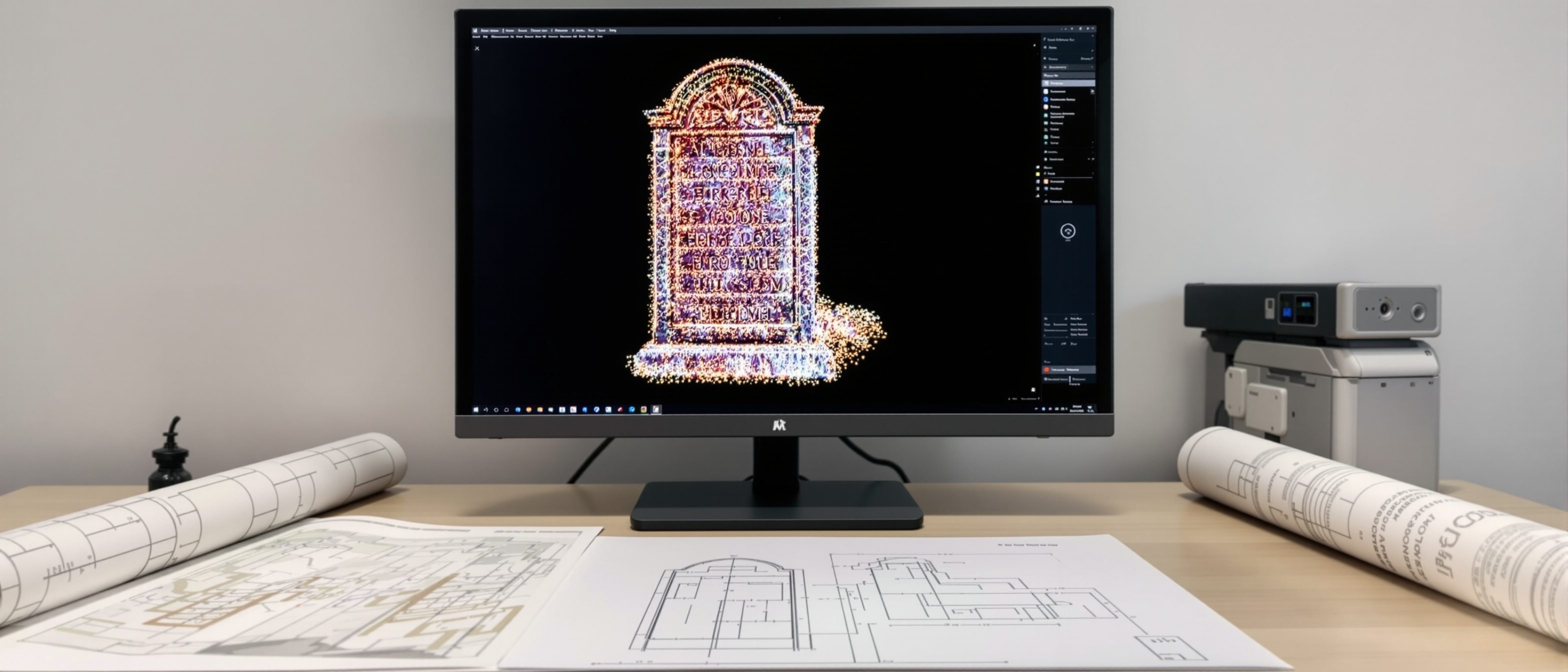
Documentation is made by TURNING DATA INTO MEANING. GIS supplies map DISPLAY, attribute QUERIES and spatial ANALYSIS; photogrammetry and scanning supply 3D models, ORTHOPHOTOS and sections. The bridge from raw data to documentation is the DERIVED DELIVERABLE — measured drawings and orthophotos generated FROM the point cloud or photo-model. A point cloud is impressive but raw; the plan, elevation and section traced from it are the documentation a conservator actually uses.[1]
Process model & survival
A defined capture-to-archive workflow keeps documentation consistent; HBIM is a queryable database of the building — and digital records survive only with open formats, redundancy and active migration.[2, 3]
Capture → product → archive
Good documentation follows a PROCESS MODEL — a defined workflow that keeps it consistent and repeatable: CAPTURE (scan, photograph, measure) → PROCESSING (register/align, georeference, build the point cloud/mesh/orthophoto) → PRODUCT (measured drawings, HBIM, reports) → ARCHIVE (deposit with metadata). HBIM and the DIGITAL TWIN extend this: a data-rich parametric model that is also a DATABASE — geometry linked to material, condition, history and intervention. MISCONCEPTION→correct: 'HBIM is just a 3D model' — it is a queryable knowledge base of the building, not a picture.[1, 3]
At a glance
| Aspect | Detail | Note |
|---|---|---|
| Raw | Point cloud, photos | Data — impressive but unusable alone |
| Derived | Measured drawings, orthophotos | Documentation a conservator uses |
| Makes it findable | Metadata + managed archive | Not a folder on a drive |
| HBIM | Geometry + linked information | A database, not just a model |
| Digital survival | Needs active migration | Does not last by itself |
Key terms
A measured drawing or orthophoto generated from a point cloud or photo-model.
The organised, archived body of documentation for a place.
Data about the data — what, when, who, how, accuracy, coordinate system.
The workflow: capture → processing → product → archive.
A data-rich, queryable model that is also a database of the building.
The decay of file formats and media; why digital records need active curation.
Studio task
Sketch the capture-to-archive process model for a heritage building you would document: name the capture method, the processing steps, the products (drawings, orthophoto, HBIM, report) and the archive. Then list four metadata fields every file needs, and write two sentences on what you would do so the record is still readable in fifty years.
Self-assessment
1. What turns a laser-scan point cloud into usable documentation?
2. Metadata in a heritage record is —
3. 'Digital documentation lasts forever' is —
Recap
References & further reading
- [1]Getty Conservation Institute, RecorDIM — Recording, Documentation and Information Management as linked tasks.
- [2]Digital Curation Centre / Archaeology Data Service guidance — metadata, archiving, digital preservation and obsolescence.
- [3]Murphy, McGovern & Pavia, 'Historic Building Information Modelling (HBIM)', Structural Survey 27(4), 2009.
- [4]ICOMOS Recording Principles (1996) + Venice Charter Art. 16 — the record and its public archive.
Further reading
- Getty Conservation Institute — Recording, Documentation, and Information Management.
- MacDonald — Digital Heritage.
- Eppich & Chabbi (eds.) — Recording, Documentation and Information Management (GCI).
Sources gathered and fact-checked June 2026. Published values vary by source, sample and method — treat as indicative and confirm against the cited standard before structural use.
The author
Amogh N P
Architect, interior designer, and creative polymath. Studio Matrx began in his notebooks — his vision of design made honest, useful, and open to everyone. Its Academy is written and taught in his memory, and free, forever.
More about Amogh →