
Basic Structural Concepts & Materials
The loads a building must carry — and the materials that resist them.
A structure is sized by two things: the loads it must carry, and the materials that resist them. This unit names the loads — dead, live, wind and seismic — and shows why concrete and steel are paired in reinforced concrete: each is strong exactly where the other is weak.
Learning objectives
By the end of this lesson, you will be able to — mapped to the course outcomes for Concept of Building Structures:
Identify dead, live (imposed), wind and seismic loads and where each comes from.
Combine loads with the limit-state factors used in Indian design.
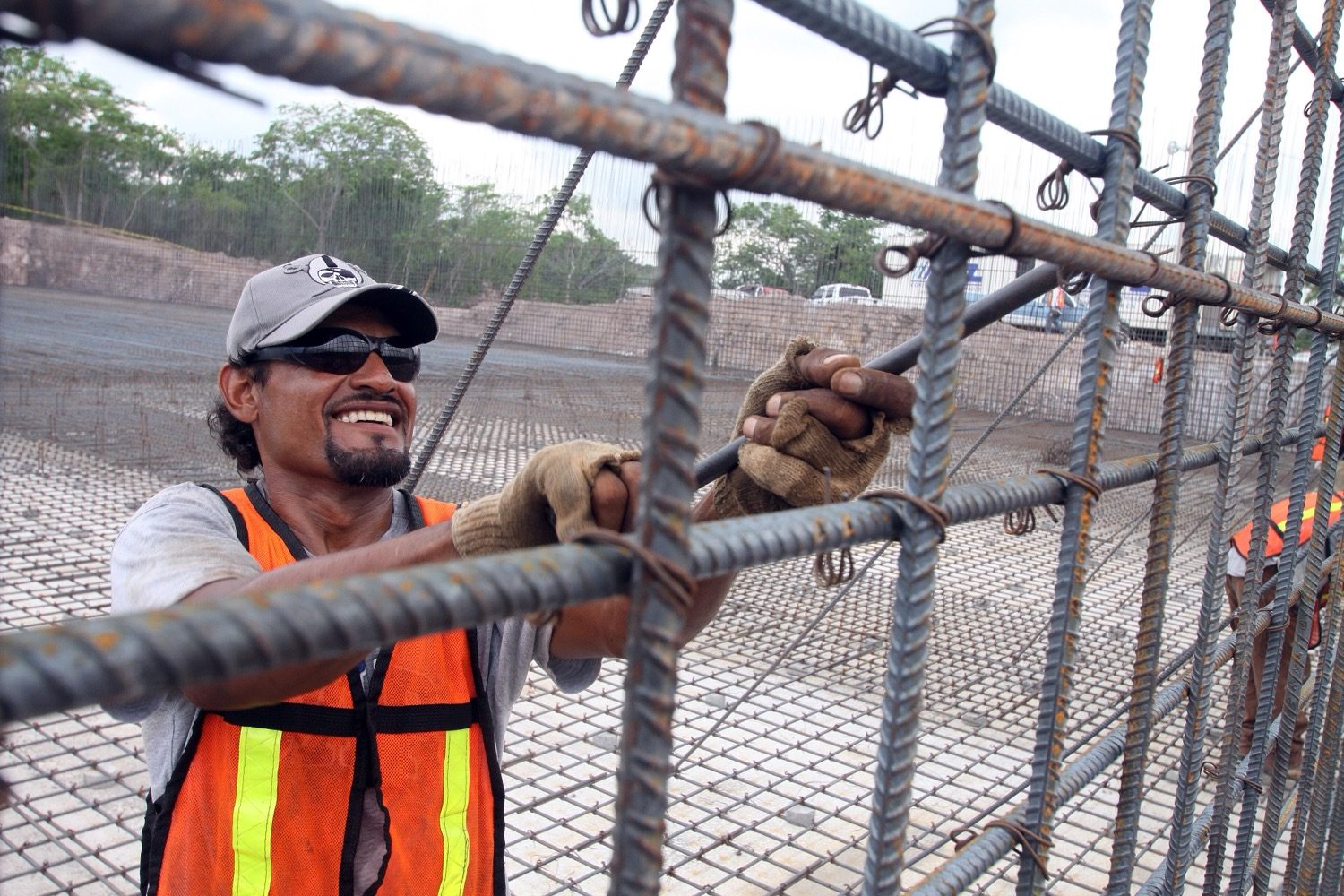
Explain why concrete is weak in tension and how steel reinforcement fixes it.
Pick a sensible material for a member given the stresses it must resist.
The loads on a building
Dead load is the permanent self-weight; live (imposed) load is the movable load of use; wind acts horizontally and grows with height; and seismic load is the inertial force of a shaking ground. Indian codes: IS 875 Parts 1–3 and IS 1893.[1, 2]
Dead load (DL)
The permanent self-weight of the structure and everything fixed to it — slabs, beams, walls, finishes. Constant and predictable; densities are tabulated in IS 875 Part 1.[1]
Combine the loads
Loads rarely act alone. In limit-state design the basic factored combination is 1.5 (DL + LL) — the load the section is actually designed for. Set the dead and live loads and watch it.
Load combination · limit state
Basic factored combination (IS 456 limit state): 1.5 (DL + LL).
0.0 kN/m²
Service load (DL + LL)
0.0 kN/m²
Factored load 1.5(DL+LL)
The factored load is what the section is designed to resist.
The materials
Concrete is cheap, mouldable, fire-resistant and strong in compression — but it cracks in tension. Steel is strong in both and ductile, but corrodes and weakens in fire. Reinforced concrete puts steel bars exactly where the tension is.[3]
| Property | Concrete | Steel |
|---|---|---|
| Strong in compression | Concrete — yes | Steel — yes |
| Strong in tension | Concrete — no (weak, cracks) | Steel — yes |
| Fire resistance | Concrete — good | Steel — poor (needs protection) |
| Self-weight | Concrete — heavy | Steel — light for its strength |
| Role in RCC | Concrete takes compression | Steel bars take tension |
Study task
For a typical 3 m × 4 m bedroom, estimate the dead and live load per square metre and compute the factored load with 1.5(DL+LL). Note where you would expect tension in the floor slab below.
Self-assessment
1. The permanent self-weight of a building's slabs, beams and walls is the —
2. Why is steel placed in the tension zone of a reinforced-concrete beam?
3. Which Indian code maps the country into seismic zones II–V?
Recap
References & further reading
- [1]IS 875 (Parts 1–3):1987 — Code of Practice for Design Loads (Dead, Imposed, Wind) for Buildings and Structures. BIS.
- [2]IS 1893 (Part 1):2016 — Criteria for Earthquake Resistant Design of Structures. Bureau of Indian Standards.
- [3]IS 456:2000 — Plain and Reinforced Concrete — Code of Practice. BIS. https://law.resource.org/pub/in/bis/S03/is.456.2000.pdf
- [4]B.C. Punmia et al., Strength of Materials and Theory of Structures (Vol. I). Laxmi Publications.
- [5]R.K. Bansal, A Textbook of Strength of Materials. New Delhi: Laxmi Publications.
Further reading
- R.K. Bansal, A Textbook of Strength of Materials.
- S. Ramamrutham, Strength of Materials. Dhanpat Rai & Sons.
- Mario Salvadori, Why Buildings Fall Down (with Matthys Levy).
Sources gathered and fact-checked June 2026. Published values vary by source, sample and method — treat as indicative and confirm against the cited standard before structural use.
The author
Amogh N P
Architect, interior designer, and creative polymath. Studio Matrx began in his notebooks — his vision of design made honest, useful, and open to everyone. Its Academy is written and taught in his memory, and free, forever.
More about Amogh →