
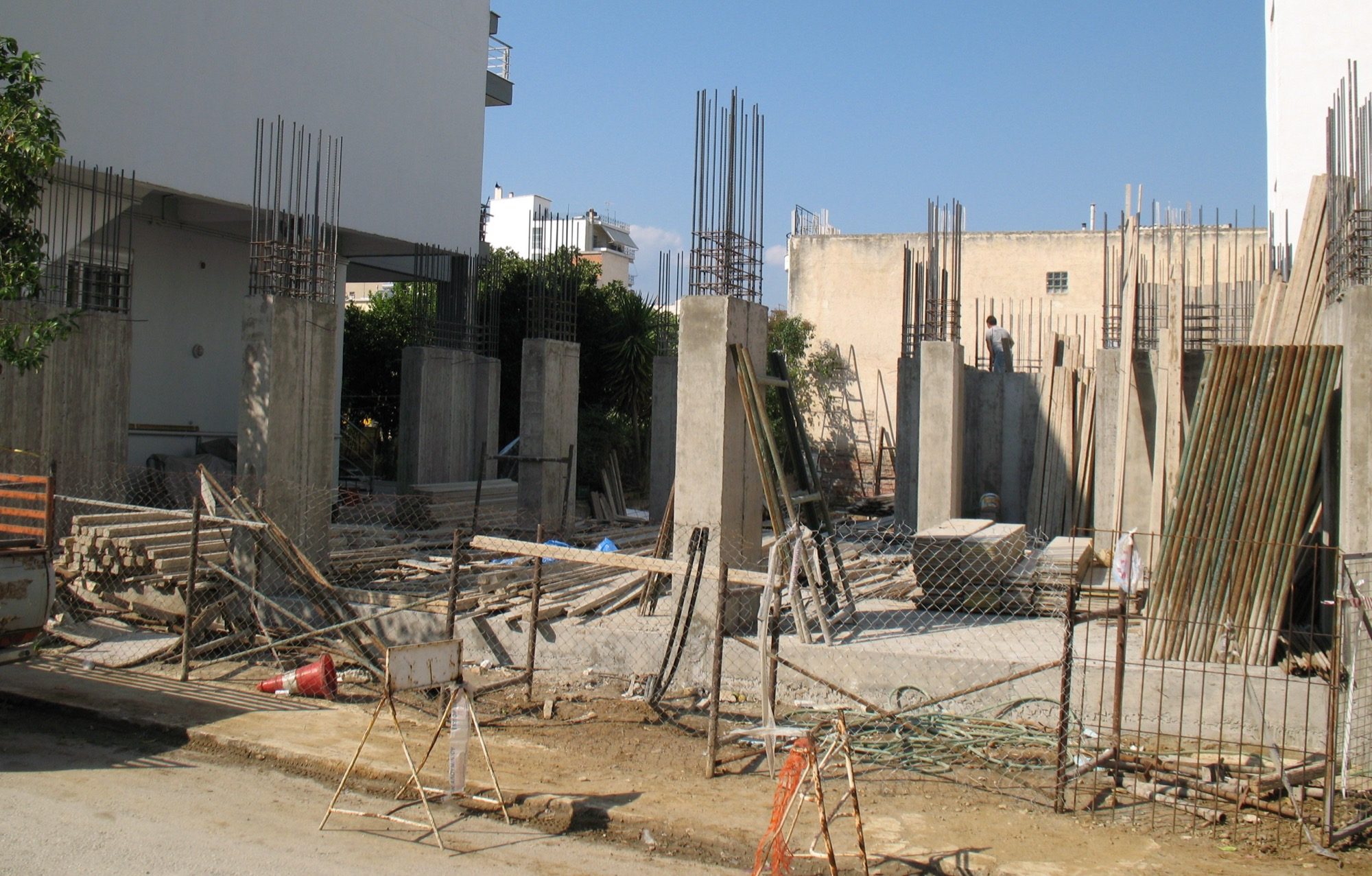
RCC Building Components
Beams, slabs, columns, footings and stairs — and the beam that bends.
Reinforced concrete is the Indian workhorse, and an architect must read its parts fluently — which member carries which load, and why. This unit walks the components from footing to staircase, then puts a beam under load so you can watch its bending moment and shear change.
Learning objectives
By the end of this lesson, you will be able to — mapped to the course outcomes for Concept of Building Structures:
Name the RCC components of a building and the job each one does.
Tell a one-way slab from a two-way slab by how it spans.
Compute the maximum bending moment and shear in a simply-supported beam.
Read which component carries which load in a building frame.
The RCC components
Beams carry slab loads to columns in bending (plinth, lintel, roof, cantilever); slabs carry floor loads to beams; columns carry compression down; footings spread it onto the soil; and the staircase is an inclined slab between landings.[1]
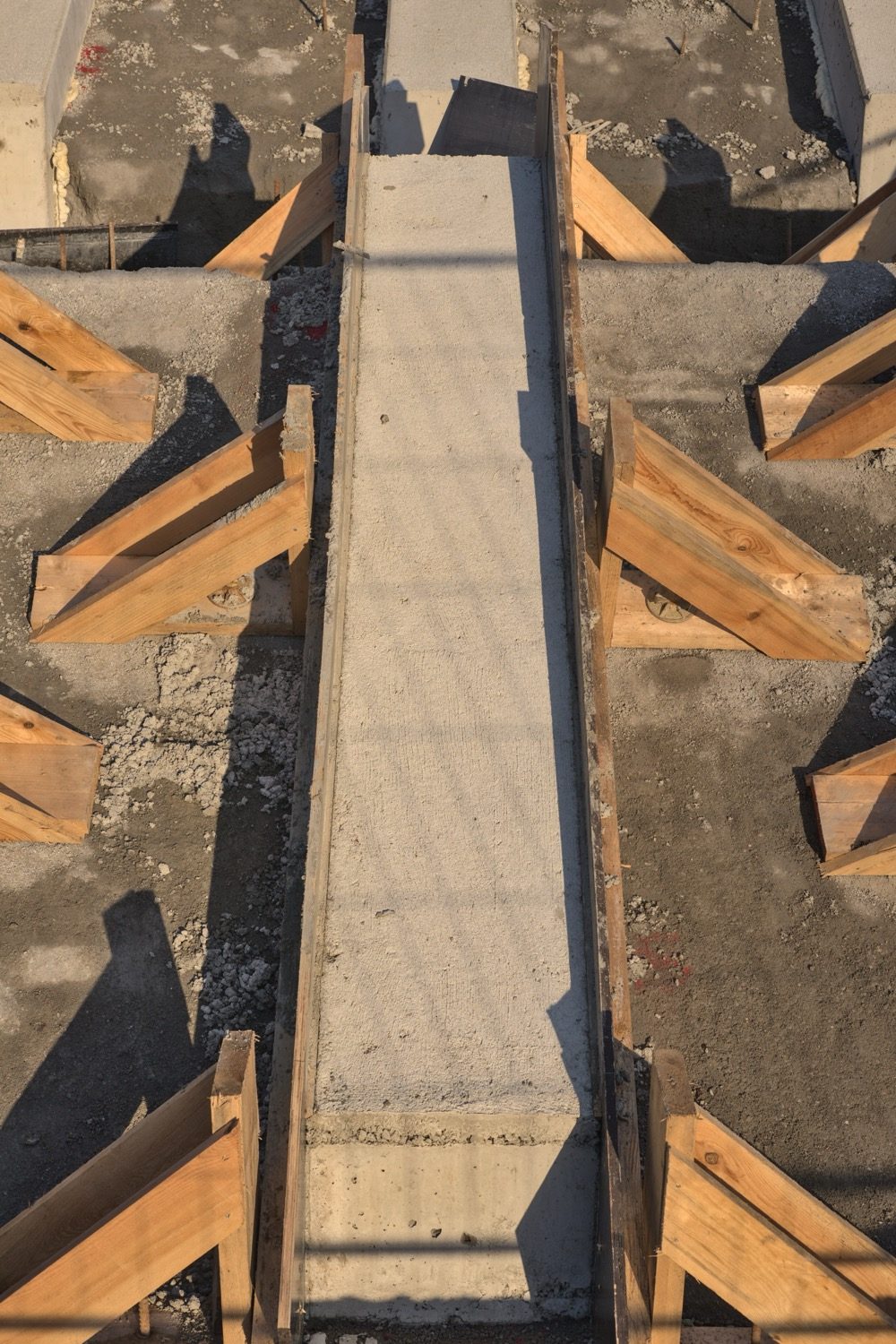
One-way & two-way slabs
A slab spans the short way first. If the long side is more than twice the short, it acts essentially one-way; if the sides are closer (ratio ≤ 2) it spans two-way, sharing load to all four beams.
| Aspect | One-way slab | Two-way slab |
|---|---|---|
| Spanning | One-way: one direction | Two-way: both directions |
| Length:breadth ratio | > 2 | ≤ 2 |
| Main steel | along the short span | in both directions |
| Load goes to | two opposite beams | all four edge beams |
| Economy | good for narrow rooms | good for near-square rooms |
The bending beam
A simply-supported beam under a uniform load w over span L has its greatest bending moment at midspan, wL²/8, and its greatest shear at the supports, wL/2. Change the span and load and watch the diagram.
Simply-supported beam · uniform load
Max bending moment M = wL²/8; max shear V = wL/2.
0.0 kNm
Max bending moment
0.0 kN
Max shear force
Bending moment diagram (sagging parabola)
Study task
For a 5 m beam carrying 25 kN/m, compute the maximum bending moment and shear by hand, then check yourself with the calculator. Sketch where the steel should go to resist the sagging.
Self-assessment
1. For a simply-supported beam of span L carrying a uniform load w per metre, the maximum bending moment is —
2. A rectangular slab with a long-to-short side ratio of 3 will behave as a —
3. Which component spreads a column's load safely onto the soil?
Recap
References & further reading
- [1]IS 456:2000 — Plain and Reinforced Concrete — Code of Practice. BIS. https://law.resource.org/pub/in/bis/S03/is.456.2000.pdf
- [2]B.C. Punmia, Ashok K. Jain & Arun K. Jain, Reinforced Concrete Structures. Laxmi Publications.
- [3]IS 1904:1986 — Design and Construction of Foundations in Soils — General Requirements. BIS. https://law.resource.org/pub/in/bis/S03/is.1904.1986.pdf
- [4]S. Ramamrutham, Design of Reinforced Concrete Structures. Dhanpat Rai & Sons.
- [5]Pillai & Menon, Reinforced Concrete Design. McGraw-Hill Education.
Further reading
- Pillai & Menon, Reinforced Concrete Design — the standard Indian text.
- B.C. Punmia et al., Reinforced Concrete Structures.
- S. Ramamrutham, Design of Reinforced Concrete Structures.
Sources gathered and fact-checked June 2026. Published values vary by source, sample and method — treat as indicative and confirm against the cited standard before structural use.
The author
Amogh N P
Architect, interior designer, and creative polymath. Studio Matrx began in his notebooks — his vision of design made honest, useful, and open to everyone. Its Academy is written and taught in his memory, and free, forever.
More about Amogh →