
Mechanical Systems
Pumps that move water, boilers that heat it, and the refrigeration that cools the air.
Behind the architecture sit the machines: pumps that move water against gravity, boilers that heat it, and the refrigeration cycle that cools the air. An architect need not size them, but must understand what they do and the space, power and servicing they demand.
Learning objectives
By the end of this lesson, you will be able to — mapped to the course outcomes for Concept of Building Services:
Describe the uses and types of building pumps and the head they work against.
Distinguish sensible and latent heat and explain change of state.
Trace the four stages of the vapour-compression refrigeration cycle.
Explain the role of a refrigerant and the pressure–temperature relationship.
Pumps, boilers and heat
The centrifugal pump is the building workhorse, sized by discharge and head; boilers heat water; and the distinction between sensible heat (temperature change) and latent heat (change of state) underlies all of refrigeration.[12, 13]
Moving water uphill
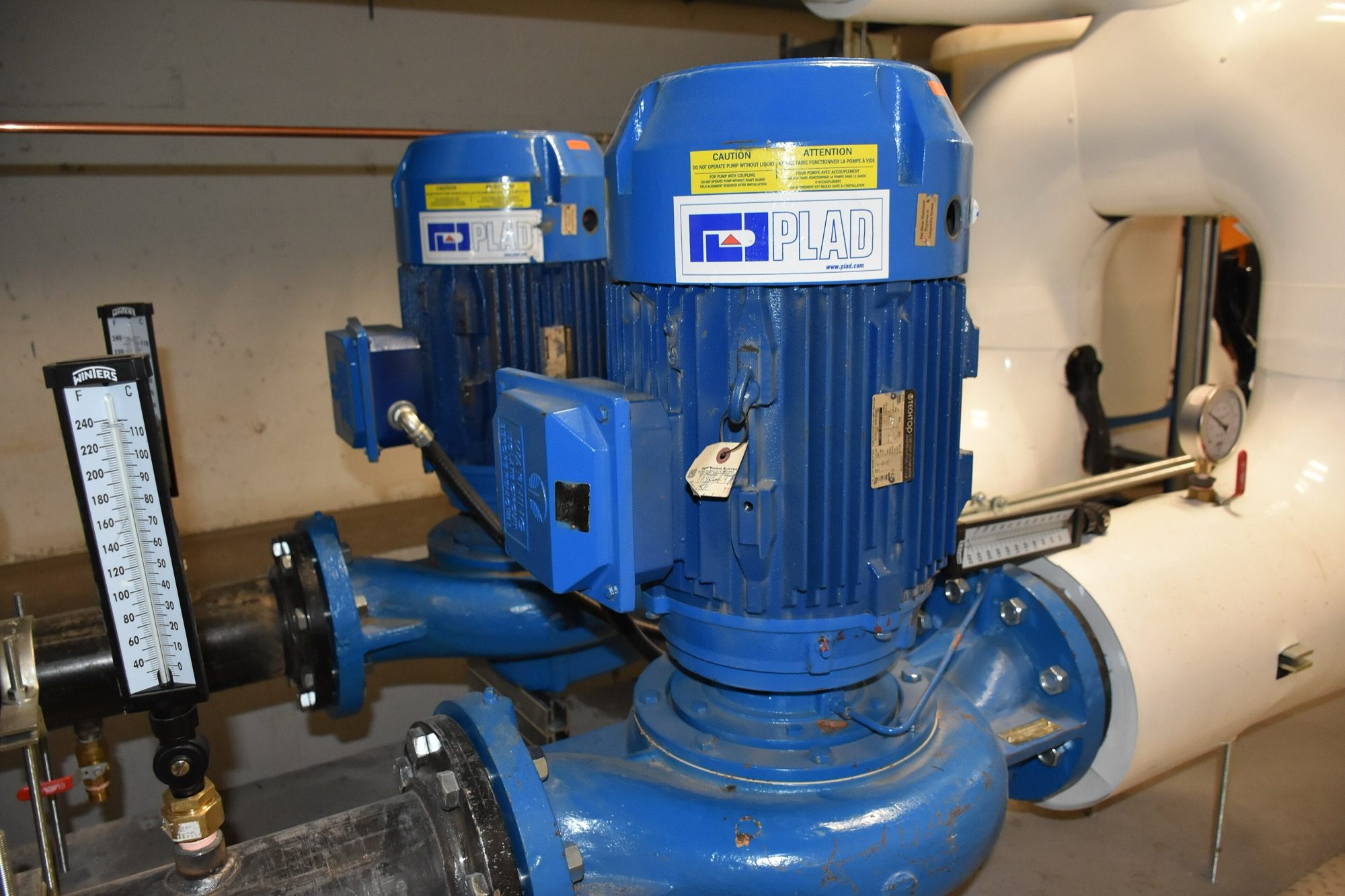
Pumps lift water to tanks, boost pressure at upper floors, drain sumps and feed fire systems. The centrifugal pump (a rotating impeller) is the building default — smooth flow, compact; reciprocating and submersible types serve high-head and borewell duties. Two numbers define the duty: discharge Q and total head H.[12]

The refrigeration cycle
Every air-conditioner runs the vapour-compression cycle: a refrigerant boils cold in the evaporator (absorbing heat), is compressed, condenses warm (rejecting heat outside), then expands cold again — moving heat from inside to out.[13]
The contrasts to hold
| Aspect | One | The other |
|---|---|---|
| Temperature change | Sensible heat: yes | Latent heat: none (constant) |
| Change of state | Sensible heat: no | Latent heat: yes |
| Pump principle | Centrifugal: impeller, smooth flow | Reciprocating: piston, pulsating |
| Pump duty | Centrifugal: high flow, moderate head | Reciprocating: high head, low flow |
| Cycle: heat in vs out | Evaporator absorbs heat (cooling) | Condenser rejects heat (outside) |
Key terms
A rotating impeller converts kinetic energy to pressure head — the common building pump.
The equivalent height of liquid a pump must overcome (static + friction + residual), in metres.
An appliance heating water for hot-water supply or space heating (electric/gas, storage/instantaneous).
Heat is energy in transit (joules); temperature is the degree of hotness (°C/K).
Heat that changes temperature with no change of state (Q = mcΔT).
Heat absorbed/released during a change of state at constant temperature.
The boiling/condensing temperature of a fluid at a given pressure.
The working fluid (e.g. R-134a, R-410A) that carries heat by boiling and condensing.
Study task
Draw the vapour-compression cycle as a loop, labelling the four components and marking where heat is absorbed and where it is rejected. Then in one line each, say what sensible and latent heat are and give an everyday example of each.
Self-assessment
1. The commonest pump for building water supply and circulation is the —
2. During a pure change of state (water boiling at 100 °C), the temperature —
3. In the vapour-compression cycle, the component that absorbs heat from the space is the —
Recap
References & further reading
- [12]Fred Hall & Roger Greeno, Building Services Handbook. London: Routledge.
- [13]William H. Severns & Julian R. Fellows, Air Conditioning and Refrigeration. New York: John Wiley & Sons.
- [14]ASHRAE Handbook — Fundamentals. American Society of Heating, Refrigerating and Air-Conditioning Engineers.
Further reading
- Fred Hall & Roger Greeno, Building Services Handbook.
- W.J. McGuinness, B. Stein & J.S. Reynolds, Mechanical and Electrical Equipment for Buildings.
- ASHRAE Handbook — Fundamentals / Refrigeration.
Sources gathered and fact-checked June 2026. Published values vary by source, sample and method — treat as indicative and confirm against the cited standard before structural use.
The author
Amogh N P
Architect, interior designer, and creative polymath. Studio Matrx began in his notebooks — his vision of design made honest, useful, and open to everyone. Its Academy is written and taught in his memory, and free, forever.
More about Amogh →