
 Lesson 7.4
Lesson 7.4 · Form-Finding & Structural Logic
Shells & Gridshells
Where curvature becomes the structure
A shell only centimetres thick can span an entire hall - because its strength is in its curvature, not its thickness.
Hold a flat sheet of paper by one edge and it flops. Curve that same sheet slightly and it holds itself out straight. Nothing changed but the shape - yet the curved sheet is dramatically stiffer. That is the entire secret of shells: curvature, not thickness, is where the strength lives.
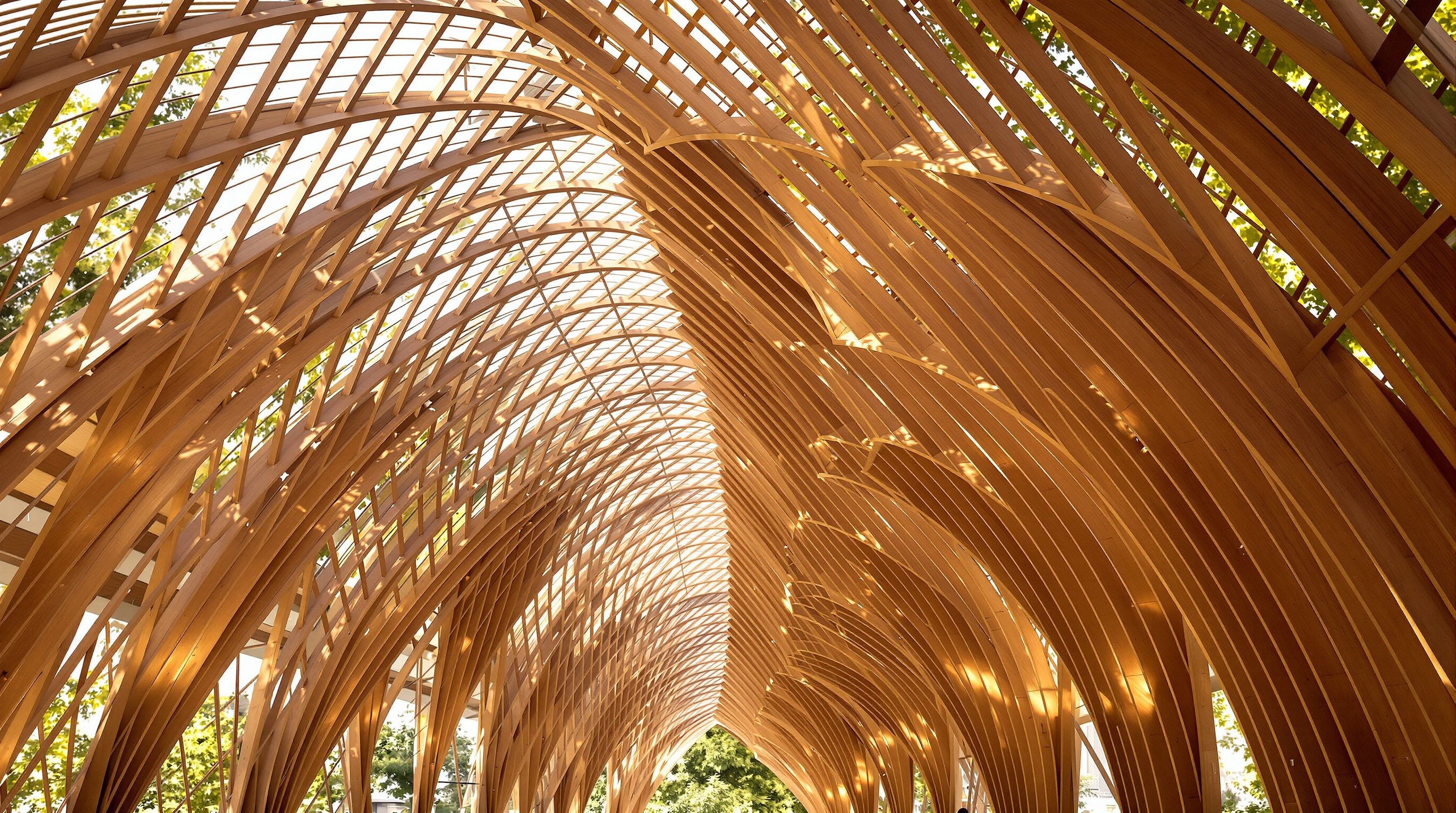
A gridshell takes the idea one step further: replace the solid shell with a lattice of slender members following the same curved surface. You keep most of the structural magic of the curvature while turning the roof into something light, glazed and buildable - the great glass roofs over courtyards are gridshells. But curvature that carries load is also curvature that must be built, and buildability is where beautiful shells live or die.
Curvature is strength. Gridshell = shell as a lattice. Triangulate for flat panels. Buckling-critical: engineer verifies.
Why a thin shell is strong: curvature as structural depth
A flat plate resists load by bending, and bending stiffness depends steeply on thickness - halve the depth and you lose most of the stiffness. That is why a flat roof needs beams: depth to fight bending. A shell cheats this entirely. Because it is curved, an applied load is carried mostly by in-plane forces - membrane tension and compression running within the surface - rather than by bending across it. The curvature effectively gives the thin material a structural 'depth' it does not physically have, letting it work like the funicular arch from lesson one, but in two directions at once.
The kind of curvature matters. A surface curved the same way in both directions (a dome, synclastic) and a surface curved oppositely in each direction (a saddle, anticlastic) are both doubly curved, and double curvature is what makes a shell genuinely stiff, because the two curvatures brace each other. A singly curved surface (a cylinder or cone, which can be unrolled flat) is far weaker - it can still buckle or flatten in the uncurved direction. This is why the most efficient shells - Heinz Isler's concrete roofs, form-found domes - are doubly curved: the geometry itself is doing the structural work, and it was frequently found by exactly the hanging-and-inverting method of lesson 7.1.
You can feel all of this with a sheet of paper. Flat, it flops the instant you hold it out; give it the gentlest curl and it stiffens enough to cantilever. Nothing changed but the shape - which is the whole argument in miniature.
So a shell is form-finding's ultimate pay-off. Get the doubly curved, funicular geometry right and a few centimetres of concrete, or a thin timber lattice, can span tens of metres in near-pure compression. Get it wrong - too shallow, singly curved, or not funicular for the load - and the same material bends, buckles and fails. The shape is not styling; it is the structure.
Flat paper flops; curved paper holds. Double curvature = built-in structural depth. Shape IS the structure.
From solid shell to gridshell: members from a surface
A solid shell is wonderful but hard and expensive to build (formwork, mass, no daylight). A gridshell keeps the curved-surface structural logic but replaces the solid with a network of slender members following the surface, with glazing or cladding in the gaps. You get light, transparency and far less material - at the cost of introducing all the node and member questions from the diagrid lesson.
Parametrically, deriving a gridshell is a direct extension of what you already know. Take the (usually form-found) surface, lay a grid of points across it with Divide Surface, and connect neighbours into a member network - orthogonal, diagonal (a diagrid-shell), or a more relaxed pattern. The members are then given a structural depth: real gridshells are not paper-thin, so you offset the members or add a second layer to create the depth that resists buckling - the dashed rise in the figure. Two families of gridshell are worth knowing. A rigid, pre-shaped gridshell (like the steel-and-glass roof over the British Museum's Great Court) is engineered node by node to its final geometry, every member and joint bespoke - a triumph of computational geometry, since almost every panel and node is unique and had to be individually calculated. A strained / elastic gridshell (the classic being the Mannheim Multihalle by Frei Otto) is assembled as a flat, loose lattice of thin timber laths and then bent into its curved shape, exploiting the timber's flexibility - so the form must be one the flat grid can actually deform into.
That distinction is not trivia; it drives the whole definition. A rigid gridshell can follow almost any found surface but demands that you manage thousands of unique members and nodes. A strained gridshell severely constrains the geometry (the flat grid can only bend so far, and only into developable-ish shapes) but rewards you with near-identical straight laths and simple nodes. Which one you are designing changes what your Grasshopper definition must guarantee.
Buildability: the constraints that make a shell real
This is the lesson's heart, because a doubly curved surface is easy to draw and hard to build. Several buildability questions decide whether your shell is architecture or a render. Panel geometry: the cladding in each grid cell is often glass, and flat glass is far cheaper than curved glass - but a flat quad panel cannot sit on a doubly curved surface without gaps or twist. So designers either triangulate (three points always define a flat plane, which is one big reason gridshell-shells are often triangulated), or use the planarization tricks from the Kangaroo lesson to nudge quads flat, or accept cold-bent / curved glass at a cost. Member bending: in a strained gridshell the laths must physically bend to the curvature without snapping, which limits how tight the curvature can be relative to the timber's minimum bend radius.
Nodes return as the dominant problem, just as in diagrids. On a doubly curved surface the angle at which members meet changes from node to node, so unless you constrain the geometry, every node is unique - a fabrication nightmare. Much of advanced gridshell design is really the search for geometry that keeps nodes and panels as repeatable as possible while still spanning and looking right. Concepts like developable surfaces (surfaces that can be unrolled flat without stretching, so they can be made from flat sheet) and planar-quad (PQ) meshes are the geometry world's answers to these fabrication constraints - deep enough to be their own field (see architectural geometry).
And the standing rule of the module applies with full force here. Shells and gridshells are buckling-critical, geometry-sensitive structures where a small change in curvature, support or load can have large consequences - they are among the least forgiving structures to get wrong. Form-finding and parametric modelling give you a superb, efficient, buildable-looking geometry; they do not tell you the shell is safe. Shell thickness, member sections, buckling capacity, connection design and the response to asymmetric and dynamic loads are specialist structural engineering, requiring proper analysis (FEA, Karamba3D as a bridge) and a qualified engineer - ideally one experienced specifically with shells. Design the shape; let them make it stand.
Doubly curved = strong but hard to build. Flat panels want triangles/PQ meshes. Buckling-critical: get an engineer.
Bringing the module together
Step back and the four lessons form one arc. Form-finding (7.1) taught the founding idea: let equilibrium choose an efficient shape, hanging for tension, inverting for compression. Kangaroo (7.2) made that idea interactive, relaxing meshes to minimal surfaces and hanging shells inside Grasshopper. Diagrids (7.3) resolved found surfaces into triangulated member networks and exposed the density-versus-node trade. Shells and gridshells (7.4) close the loop: they are what you get when the found surface's own curvature becomes the structure, built either solid or as a member lattice.
The through-line is a single conviction: in structural form, shape and force are the same thing. A well-found shell is efficient not because it is thick but because its geometry keeps the material in the forces it is good at. Computational tools are so powerful here precisely because they let you shape geometry and reason about force paths in the same parametric breath - find a surface, mesh it, pattern it, curve it, and read the consequences instantly.
But the same through-line carries the same discipline, and it is worth stating once more plainly as you leave the module: these tools find and express structure; they do not certify it. Every found shape, relaxed membrane, tuned diagrid and curved gridshell in this module is a hypothesis about how a building might stand - a very good, physics-informed hypothesis, and a far better starting point than a shape drawn by eye. Turning that hypothesis into a safe, sized, code-compliant structure is the work of a structural engineer, and the best computational designers are the ones who make that engineer's job easier by handing over geometry the forces already like. Design the shape the forces want; collaborate on the structure that carries them.
Thin shell
A thin, curved surface structure carrying load in-plane
Curvature gives it stiffness, not thickness. Doubly curved, funicular shells are the most efficient. Isler's concrete roofs are the exemplars.
Gridshell
A shell built as a lattice of members following a curved surface
Keeps curved-surface efficiency while adding light and transparency. Rigid (Great Court) or strained/elastic (Mannheim).
Double curvature
Curvature in two directions (synclastic dome / anticlastic saddle)
The source of shell stiffness; singly curved surfaces are far weaker. Also complicates fabrication of flat panels.
Developable surface
A surface that unrolls flat without stretching
Buildable from flat sheet and easy to bend into; a key rationalisation target for panels and strained gridshells.
Karamba3D / FEA
Structural analysis for verifying a shell
Shells are buckling-critical; use proper analysis and a qualified engineer. Form-finding gives the shape, not the safety check.
Workshop - a gridshell from a found surface, with a buildability audit
You will turn a form-found surface into a gridshell member network, then interrogate it for buildability - the honest test of whether a beautiful shell could ever be built. The point is as much the audit as the geometry.
Rhino + Grasshopper (with Kangaroo for the found surface); LunchBox optional. Structural adequacy is discussed, not computed - that step belongs with an engineer and analysis software.
Goal: derive gridshell members from a curved surface and assess their buildability
Inputs: a doubly curved surface (form-found in Kangaroo if possible), Rhino/Grasshopper, LunchBox optional
Time: ~55 minutes
- 1Start from a doubly curved surface - ideally one you form-found by relaxing or inverting a hanging mesh in the Kangaroo lesson. Confirm it is doubly curved (a saddle or dome), not just a bent cylinder.
- 2Lay a member network: Divide Surface into a UV grid of points and connect neighbours into a quad or diagonal (triangulated) member network. Extract the members as lines and the nodes as points.
- 3Audit the panels: for each grid cell, test how far its corners are from being coplanar (compare a mesh face to its best-fit plane). Note where quads are badly non-planar - those are the cells that would need triangulating, planarising, or curved glass.
- 4Audit the nodes: measure the angles between members at a sample of nodes and see how much they vary across the surface. Many unique node angles = a fabrication problem; discuss how constraining the grid could reduce node types.
- 5Write a one-page buildability verdict: is this closer to a rigid (bespoke-node) or strained (bendable-lath) gridshell, what would you rationalise, and one clear sentence stating that shell adequacy and buckling must be checked by a structural engineer.
You’ll walk away with
A gridshell member network derived from a found surface, a simple map of panel non-planarity and node-angle variation, and a one-page buildability verdict that explicitly hands structural verification to a qualified engineer.
Three altitudes on the same idea
Read the band that fits you — or all three.
Shells and gridshells are where ambitious span and material economy meet - a form-found roof that carries itself in near-pure compression, expressed as a luminous lattice. Your leverage is geometric: find a doubly curved, funicular surface and rationalise its members and panels for buildability, then engineer it together with a shell specialist. The Great Court and Mannheim roofs are the canon to study.
Even a modest curved lattice ceiling or a shell-like canopy behaves and reads better when its geometry is doubly curved and its panels rationalised to sit flat. Understanding why curvature is stiffness helps you specify feature structures that are light and self-supporting, and why a designer's freeform surface may need triangulating or planarising before anyone can actually fabricate it.
A form-found gridshell is a flagship portfolio project: it ties together everything - NURBS surfaces, Kangaroo relaxation, diagrid patterning and buildability - in one image. Study Mannheim (strained timber) versus the British Museum Great Court (rigid steel-glass) to show you understand that geometry and fabrication are inseparable, and always note that a real shell needs specialist structural engineering.
“A thin shell is fragile because it is thin - the thicker I make it, the safer it is.”
Do it yourself
Confirm you can explain a shell honestly.
- 1Why is a curved sheet of paper so much stiffer than a flat one?
- 2What is the difference between single and double curvature, and why does it matter structurally?
- 3How does a gridshell differ from a solid shell, and what does it gain and give up?
- 4Why is a rigid gridshell (Great Court) fabricated differently from a strained one (Mannheim)?
- 5Name two buildability constraints that decide whether a doubly curved gridshell is real - and who verifies its safety.
The one line to carry out
Peer-reviewed journals & authoritative standards
- 01Gridshell (overview and examples) — Wikipedia, 2026.
- 02Pottmann, Asperl, Hofer, Kilian - Architectural Geometry — Bentley Institute Press, 2007.
- 03Developable surface — Wikipedia, 2026.
- 04Karamba3D - parametric structural engineering — Karamba3D, 2026.
- 05Kangaroo Physics (Daniel Piker) — food4rhino, 2026.
You have now let forces shape geometry - found, relaxed, patterned and curved it. The next module hands the search itself to the computer: optimization, where Galapagos and Wallacei explore the design space to find not just a working form but the best ones.
The author
Amogh N P
Architect, interior designer, and creative polymath. Studio Matrx began in his notebooks — his vision of design made honest, useful, and open to everyone. Its Academy is written and taught in his memory, and free, forever.
More about Amogh →