
B.Arch CurriculumFree, forever
A tribute to Amogh N P
Computational Design Process
Computational design is not a tool and not a style — it is a way of thinking. Instead of drawing the finished object, you author the logic, rules and relationships that generate it, then explore the family of designs that logic produces. This elective is about the method: computational thinking, parametric and associative modelling, algorithmic and generative systems, performance-driven optimisation, and the digital-fabrication and AI frontier. The throughline is a single mental shift — you author the system that makes the object, not the object itself — and a single discipline: the human stays the author of intent.
Course byAmogh N P· Architect & interior designer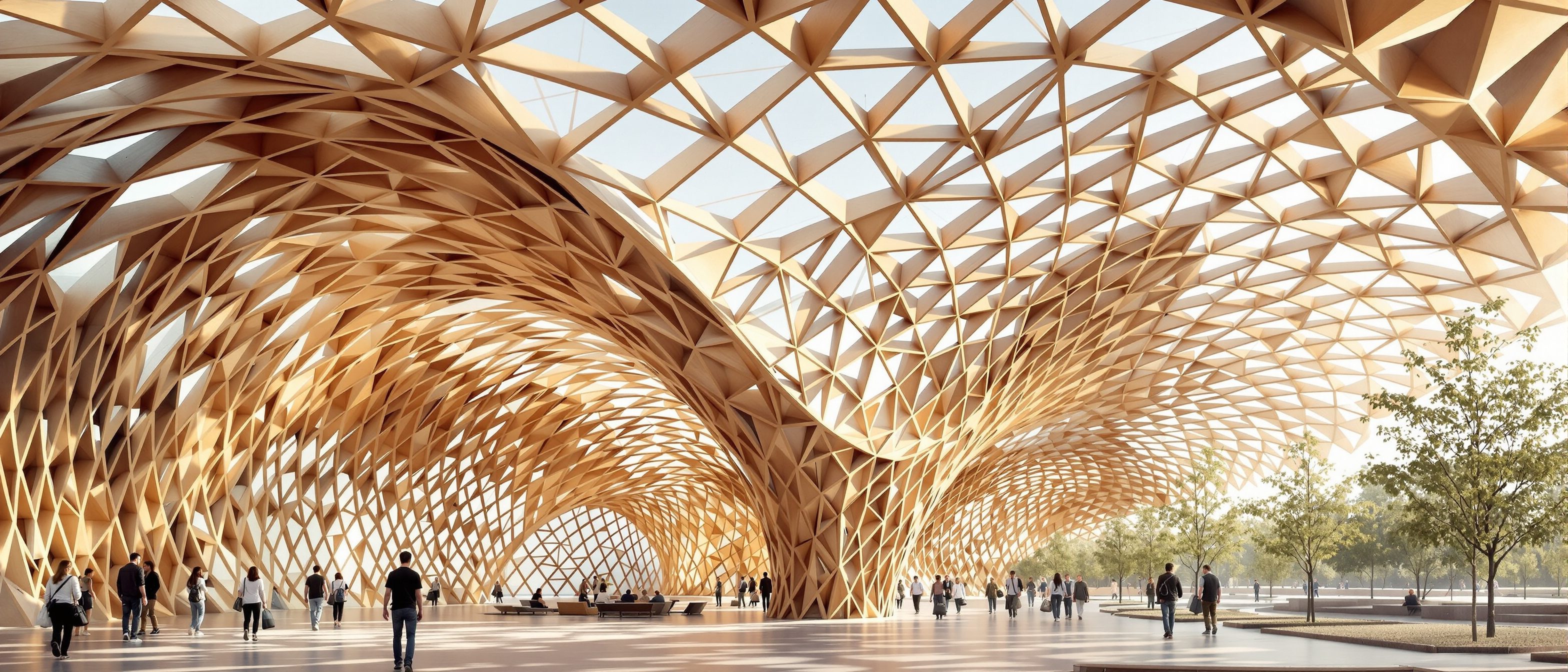
The syllabus
5 units · 5 liveTranscribed from the official B.Arch syllabus. All 5 units are live as full interactive lessons, each with original diagrams, a self-assessment quiz and a studio task.
Unit 1 — Foundations
LiveWhat computational design is (authoring the logic that generates form) vs CAD (drawing the result); the four pillars of computational thinking (decomposition, pattern recognition, abstraction, algorithm design); the shift from authoring objects to authoring systems; and a concise lineage (Sketchpad 1963, shape grammars 1971, Frazer 1995). Computation is a way of thinking, not a style.
Unit 2 — Parametric & Associative Design
LiveParameters, relationships and constraints; the parametric model as a dependency graph (change propagates downstream); explicit vs associative modelling; visual programming (node-and-wire dataflow, Grasshopper/Dynamo) as the medium; data lists/trees; a model is only as good as its logic; and when parametric helps vs the 'parametric trap'.
Unit 3 — Algorithmic & Generative Design
LiveAlgorithms, loops, conditionals, recursion and controlled randomness; generative systems (L-systems, cellular automata, fractals, Voronoi/Delaunay, agent-based/swarm, reaction–diffusion) and what each generates; form-finding (catenary, minimal surfaces, physics relaxation); and emergence — global order from simple local rules. Generative ≠ arbitrary.
Unit 4 — Performance & Optimisation
LiveSimulation-in-the-loop (daylight, energy, structure, airflow, acoustics feeding back into form); the fitness function (defining 'good' numerically); objectives vs constraints; single- vs multi-objective optimisation and the Pareto front; evolutionary/genetic algorithms (how the search works); design-space exploration; and the honest caveat — 'optimised' is only as good as the fitness function.
Unit 5 — Fabrication & the AI Frontier
LiveFile-to-factory (the model drives CNC, laser/water-jet, robotic and additive machines); subtractive/additive/formative/robotic processes; mass-customisation; the BIM and digital-twin connection; AI/ML in computational design (generative ML, surrogate models) AND its honest limits (training bias, no engineering judgement, AI image ≠ buildable design, authorship); and the workflow + ethics — the human stays the author of intent.
Course outcomes
What you will be able to doExplain computational design and computational thinking, and how they differ from CAD.
Build parametric/associative logic as a clean dependency graph — and avoid the parametric trap.
Use algorithmic and generative systems and form-finding to generate form.
Couple models to simulation and optimisation — fitness functions, multi-objective trade-offs.
Describe file-to-factory fabrication and the AI frontier, with its honest limits.
Keep the human as the author of intent — judge what computation and AI cannot.
The author
Amogh N P
Architect, interior designer, and creative polymath. Studio Matrx began in his notebooks — his vision of design made honest, useful, and open to everyone. Its Academy is written and taught in his memory, and free, forever.
More about Amogh →Author the system, not the object.
Computational thinking, parametric and generative design, optimisation, fabrication and AI. Read the five units, study the diagrams, then test yourself.
The curriculum is free, forever