
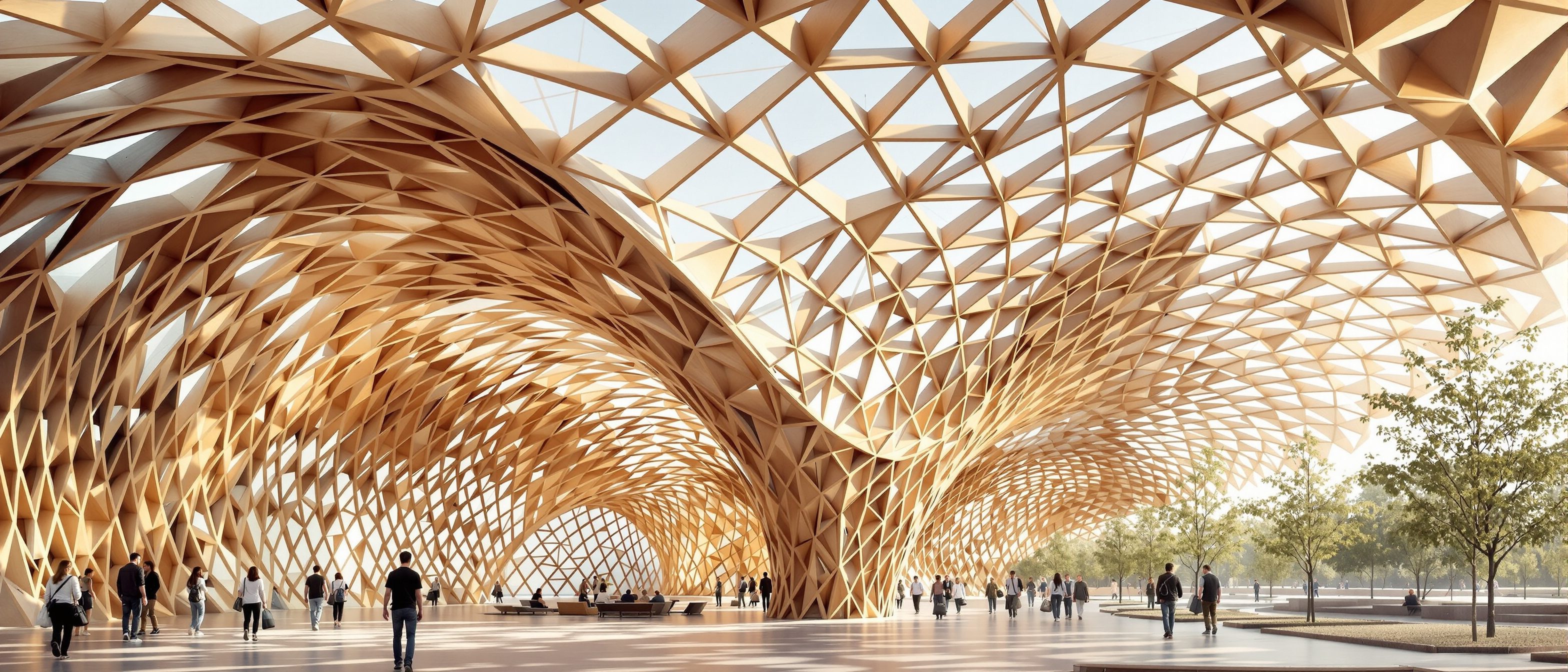
Parametric & Associative Design
The dependency graph — and the discipline that keeps it from becoming a trap.
A parametric model is built from parameters (the adjustable inputs), relationships (the rules linking them) and constraints (the limits that must hold) — and its central mental model is the dependency graph: change an upstream input and the change propagates downstream, regenerating everything that depends on it. Learn explicit vs associative modelling, visual programming as the medium, data lists and trees, the discipline that a model is only as good as its logic, and when parametric helps vs the 'parametric trap'. Try the live parametric tower.
Learning objectives
By the end of this lesson, you will be able to — mapped to the course outcomes for Computational Design Process:
Identify parameters, relationships and constraints in a parametric model.
Read and build a clean dependency graph where change propagates downstream.
Distinguish explicit from associative modelling and reason about data structure.
Judge when parametric helps — and recognise and avoid the parametric trap.
The dependency graph
A parametric model is a directed dependency graph; associative modelling commits to relationships, authored as legible node-and-wire dataflow over well-structured data.[1, 4]
Parameters, relationships, constraints
PARAMETERS are the adjustable inputs (a span, an angle, a panel count, a sun position). RELATIONSHIPS are the rules linking inputs to geometry (panel width = span ÷ count). CONSTRAINTS are the limits that must hold (no panel narrower than 300 mm; this edge stays vertical). Authoring a good model is deciding which quantities are free, which are derived, and which are fixed.[1]
Build a parametric model
Move the sliders — floors, twist, taper. You authored the rule; the tower regenerates itself. That live propagation is the dependency graph at work.
Parametric tower · move the sliders
Each slider is an input; the floors are derived from it. Change one value and the whole tower regenerates — that is the dependency graph at work.
You authored the rule, not the 14 floors — one model, a whole family of towers.
Discipline & the parametric trap
Parametric helps for repetition, coordination and performance; over-engineering a brittle, unreadable graph is the parametric trap. Parametric is not automatically 'better'.[1]
Amplifies clarity AND confusion
Because the machine faithfully executes whatever you specify, a parametric model AMPLIFIES both clarity and confusion — sloppy logic produces confidently wrong geometry at scale. Discipline: name and group inputs, keep the graph shallow and readable, isolate one rule per region, anticipate edge cases (count = 0? self-intersecting curve?), document intent. A well-built model degrades sensibly at the limits rather than exploding.[1]
At a glance
| Aspect | Explicit | Parametric |
|---|---|---|
| What you commit to | Explicit: fixed coordinates | Parametric: relationships |
| On change | Explicit: manual re-edit | Parametric: auto-propagation downstream |
| Best for | Explicit: one-offs, irregular, settled | Parametric: repetition, coordination, performance |
| Underlying structure | Explicit: a static geometry database | Parametric: a directed dependency graph |
| Failure mode | Explicit: tedious manual updates | Parametric: brittle / over-complex graph (the trap) |
Key terms
An adjustable input that drives a model.
Modelling by relationships so geometry updates automatically on change.
The directed network of 'feeds-into' relations in a model.
Authoring logic via node-and-wire dataflow on a canvas.
A nested (list-of-lists) data structure organising model data.
Over-engineering a model until it costs more than it saves.
Studio task
Sketch the dependency graph (as boxes and arrows) for a parametric façade: name the inputs (free parameters), the derived quantities, and the constraints, and draw which feeds which. Then identify one place where a careless dependency would make it brittle — and decide, honestly, whether this façade is worth modelling parametrically at all or would be faster drawn explicitly.
Self-assessment
1. A parametric model is best understood as a —
2. The 'parametric trap' refers to —
3. In a node-and-wire visual program, the wires primarily represent —
Recap
References & further reading
- [1]Robert Woodbury, Elements of Parametric Design (Routledge, 2010) — propagation-based parametric modelling.
- [2]Wassim Jabi, Parametric Design for Architecture (Laurence King, 2013) — concepts and patterns.
- [3]Kostas Terzidis, Algorithmic Architecture (2006) — computation vs computerisation.
- [4]Branko Kolarevic (ed.), Architecture in the Digital Age (Spon Press, 2003) — parametric-to-fabrication context.
- [5]Grasshopper (Rhino, David Rutten) & Dynamo (Revit) — the standard visual-programming environments (verify versions).
Further reading
- Robert Woodbury — Elements of Parametric Design.
- Wassim Jabi — Parametric Design for Architecture.
- Kostas Terzidis — Algorithmic Architecture.
Sources gathered and fact-checked June 2026. Published values vary by source, sample and method — treat as indicative and confirm against the cited standard before structural use.
The author
Amogh N P
Architect, interior designer, and creative polymath. Studio Matrx began in his notebooks — his vision of design made honest, useful, and open to everyone. Its Academy is written and taught in his memory, and free, forever.
More about Amogh →