
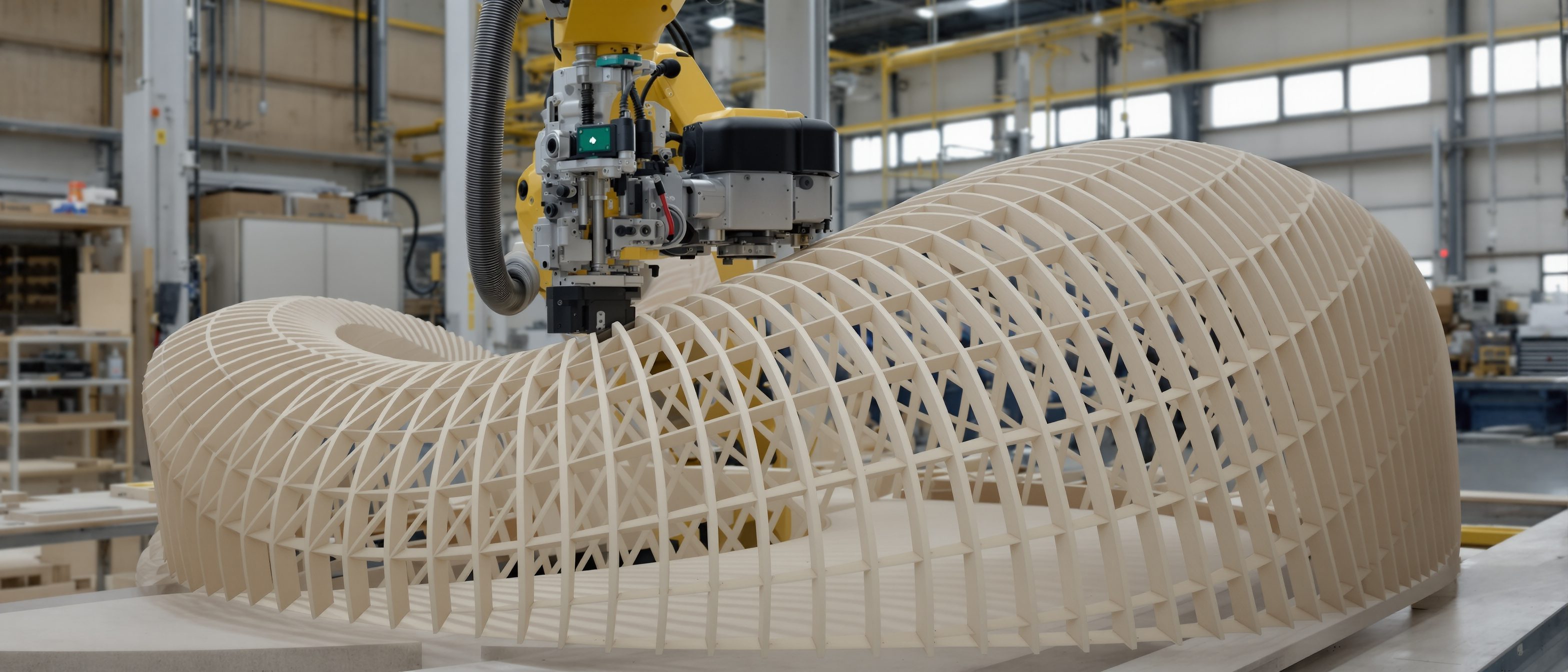
Fabrication & the AI Frontier
File-to-factory, mass-customisation — and AI as a co-pilot, not an architect.
The payoff of a computational model is that its data can drive a MACHINE directly. Learn file-to-factory (the model drives CNC, laser, robotic and additive fabrication), the process families, mass-customisation, and the BIM and digital-twin connection. Then AI/ML in computational design — its real uses (generative ML, surrogate models) AND its honest limits: training bias, no engineering judgement, 'AI image ≠ buildable design', authorship questions. The unifying ethic: the human stays the author of intent.
Learning objectives
By the end of this lesson, you will be able to — mapped to the course outcomes for Computational Design Process:
Explain file-to-factory and the subtractive/additive/formative/robotic families.
Explain mass-customisation and the BIM / digital-twin connection.
Describe AI/ML's real roles in computational design AND its honest limits.
Keep the human as the author of intent — judge what computation and AI cannot.
File-to-factory & mass-customisation
The same logic that generates form generates the machine instructions; mass-customisation makes varied parts at standard cost; and BIM/digital-twin extend the data thread into operation.[1, 2]
The model drives the machine
FILE-TO-FACTORY (central to Kolarevic) means the geometry and fabrication data flow from the design model to the machine — CNC milling, laser/water-jet cutting, robotic arms, 3D printing — with minimal manual re-drawing. The same parametric logic that generates form also generates toolpaths, cut-lists and assembly data, collapsing the historic gap between representation (drawing) and production (building).[1]
The AI frontier — and its limits
AI accelerates generation and evaluation but lacks structural, code and constructability judgement — an AI image is not a buildable design. The human stays the author of intent.[4, 5]
Accelerating exploration
ML's legitimate roles: GENERATIVE ML (text/image-to-image and diffusion models for rapid concept imagery and options); ML-assisted optimisation / SURROGATE MODELS (a fast neural approximation of a slow simulation, so thousands of variants screen in seconds — genuinely useful in performance loops); classification (auto-tagging plans, flagging code issues); and generative layout for space planning. Used well, ML WIDENS the funnel of options and speeds the feedback loop.[4]
At a glance
| Aspect | Static BIM | Digital twin |
|---|---|---|
| Data link to asset | Static BIM: none | Digital twin: live, sensor-fed |
| Time horizon | BIM: design/construction | Twin: whole operational life |
| Purpose | BIM: coordination, documentation | Twin: monitoring, simulation, maintenance |
| Updates | BIM: manual, by designers | Twin: continuous, from real data |
| AI's role | Co-pilot: accelerates generate/evaluate | Not: structural/code/constructability judgement |
Key terms
Direct flow of model data to fabrication machines.
Building form layer-by-layer (3D printing).
Removing material from stock (milling, cutting).
Producing many varied parts at near-standard cost.
A live, data-linked virtual replica of a built asset (not just static BIM).
A fast ML approximation standing in for a slow simulation.
Studio task
Take one computational form and describe its file-to-factory path: which fabrication process you'd use, what geometry rule it imposes (tool access, supportable overhang), and how mass-customisation would label and assemble the unique parts. Then take an AI-generated design image and list three things that must be checked before it could be built — proving why 'AI image ≠ buildable design' and where you, the human, author the intent.
Self-assessment
1. 'File-to-factory' means —
2. Why is 'AI image ≠ buildable design' the key caveat?
3. A digital twin differs from a static BIM model mainly because it —
Recap
References & further reading
- [1]Branko Kolarevic (ed.), Architecture in the Digital Age: Design and Manufacturing (Spon Press, 2003) — file-to-factory.
- [2]Nick Dunn, Digital Fabrication in Architecture (Laurence King, 2012) — methods and implications.
- [3]Lisa Iwamoto, Digital Fabrications: Architectural and Material Techniques (Princeton Arch. Press, 2009).
- [4]Mario Carpo, The Second Digital Turn (MIT Press, 2017) — data/AI-era implications and authorship.
- [5]Current AI/ML tools and capabilities change rapidly — verify specifics against up-to-date sources; do not cite from memory.
Further reading
- Branko Kolarevic — Architecture in the Digital Age.
- Nick Dunn — Digital Fabrication in Architecture.
- Mario Carpo — The Second Digital Turn.
Sources gathered and fact-checked June 2026. Published values vary by source, sample and method — treat as indicative and confirm against the cited standard before structural use.
The author
Amogh N P
Architect, interior designer, and creative polymath. Studio Matrx began in his notebooks — his vision of design made honest, useful, and open to everyone. Its Academy is written and taught in his memory, and free, forever.
More about Amogh →