
 Lesson 6.3
Lesson 6.3 · The Envelope as a System
WWR, Glazing and SHGC
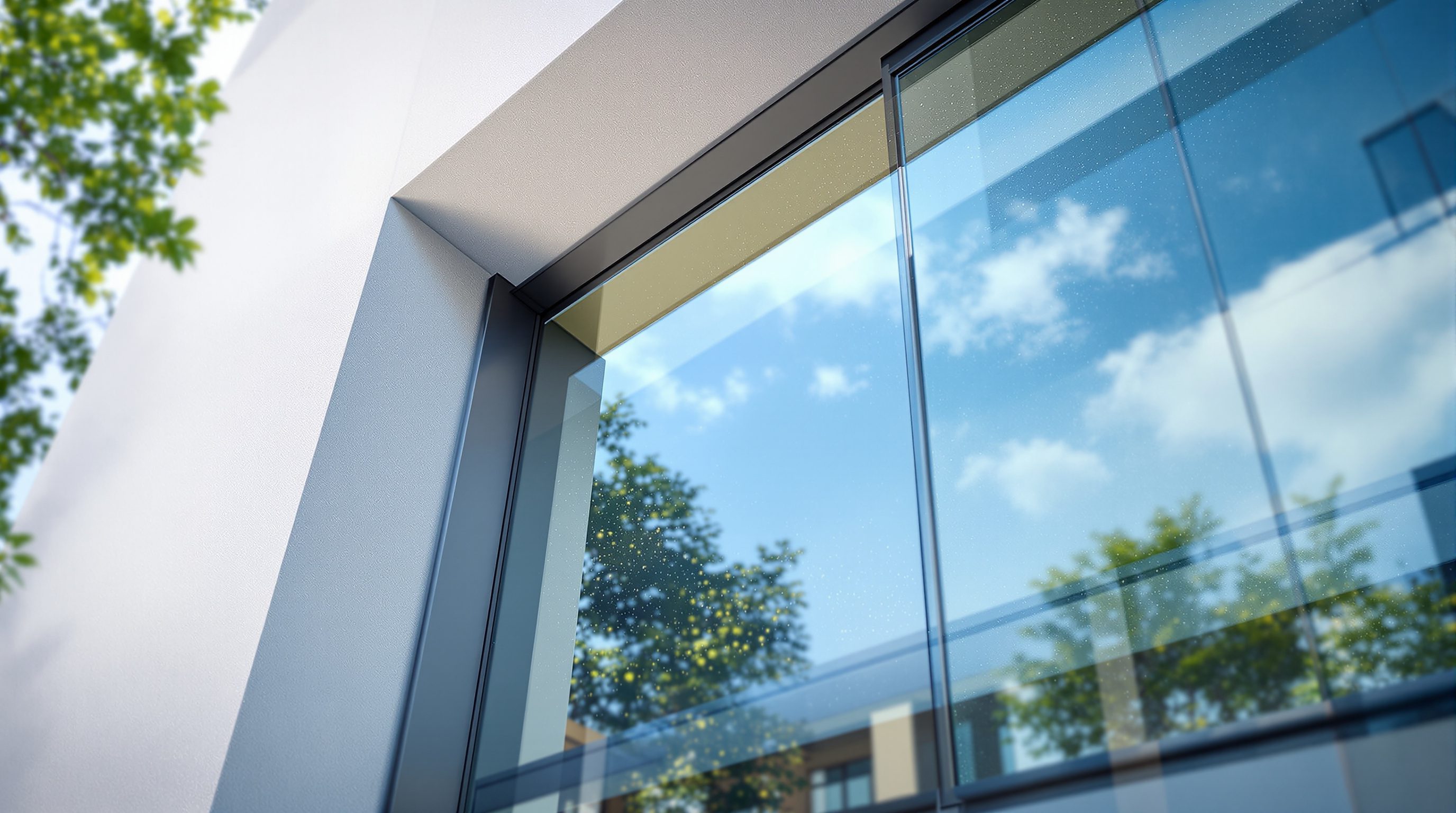
The window wants two opposite things at once — let in light, keep out heat; good glass lets you have both.
The glass that keeps a room cool is often the one you can see straight through
The RETV (6.2) made it official: in a sunny country, the heaviest envelope term is the heat through the glass. The glazed opening is asked to do two opposing things. We want daylight — free, beautiful, and it saves the electricity a lamp would burn. We don't want the heat riding in on the same sunbeam. The naive response treats them as one dial: more glass, more light and heat; less glass, less of both. But the secret of modern glazing is that light and heat can be separated — the right glass lets in most of the daylight while rejecting most of the heat, breaking the trade-off a plain sheet forces on you. Knowing how to do that, and how big to make the window, is the difference between a bright cool room and a dim oven.
Sunlight splits in two at the glass: visible light walks in to brighten the room, infrared heat bounces off. Size the window for need, then specify it for cleverness.
WWR, SHGC and VLT — what each number does
A window is governed by three numbers. WWR, the window-to-wall ratio, is the fraction of the façade that is glass — in a hot climate you keep it modest, because every extra square metre admits both heat and light. SHGC, the solar heat gain coefficient, is the fraction of solar heat the glass lets through, from 0 to 1 — here you want it low, to reject the heat. VLT, visible light transmittance, is the fraction of daylight the glass passes, also 0 to 1 — you want it high enough to admit the light. WWR sets how much opening you have; SHGC and VLT set what each square metre does with the sun.
Plain clear single glass has a high SHGC (about 0.82) and a high VLT (about 0.88) — it lets in almost everything. The craft is to push SHGC down for the heat while keeping VLT up for the light. Their ratio, VLT divided by SHGC, is so important it has a name: the light-to-solar-gain ratio, or selectivity. A higher ratio means a glass that is better at separating light from heat — exactly what a hot, bright country wants.
Think of selectivity as the glass's cleverness. Cheap tint is dumb — it dims light and heat together, like sunglasses for the whole room. Spectrally-selective low-E glass is clever — it waves the visible light through and turns the invisible infrared heat away. To a careless eye the two can look equally dark; their physics is opposite.
Three dials on one window: WWR is how big, SHGC is how much heat, VLT is how much light. The hot-climate move is low SHGC, high VLT.
The false trade-off, and how good glass breaks it
A plain sheet sets a trap. To cut the heat you tint it darker — but tint lowers SHGC and VLT together, so you reject heat only by dimming the room, which forces the lights on. That is the false trade-off: with ordinary glass, less heat means less light.
Spectrally-selective glazing escapes it. Sunlight carries energy in two parts — the visible light we want, and the invisible near-infrared that is pure heat. A selective low-E coating transmits the visible while reflecting the infrared. The result is a low SHGC with a still-high VLT: rejecting roughly 60% of the solar heat while passing 60 to 70% of the daylight. This is not magic — it simply treats light and heat as the physically distinct things they are.
For a hot Indian building this is the single most valuable property to specify, and it is why double glazing alone is not the answer: the coating, not merely the second pane, is what separates light from heat. A double-glazed unit with no selective coating still lets the heat pour through.
Tint dims both light and heat together. A low-E coating waves the visible through and bounces the infrared back — same darkness to the eye, opposite physics.
Sizing the window: WWR in its place
Good glass solves the quality of an opening; its size still matters, because even the best glass is far less insulating than the wall it replaces and still lets some heat through. WWR is a real lever, and the climate sets the target. Hot zones keep it modest — rarely above a third of the façade — lean on the gentle south and north, and minimise it on the punishing east and west (4.4). And daylight has diminishing returns: beyond a point, more glass adds heat and glare faster than it adds useful light. The cold zone flips toward the south for winter gain (5.1), balanced against night-time loss.
The honest summary is a two-step rule. First choose the smallest window that genuinely delivers the daylight, view and ventilation the room needs. Then make it from the most selective glass you can justify. Size for need, then specify for cleverness — never reach for darker, smaller glass when better glass would keep the room both bright and cool.
Three altitudes on the same idea
Read the band that fits you — or all three.
Two ideas guide most window decisions. First, bigger is not better — size your windows for the light and views you actually want, because oversized glass mostly brings in heat and glare. Second, when you buy glass, ask for its SHGC and VLT numbers: in a hot place you want a low SHGC (less heat) with a high VLT (still bright). Good solar-control or low-E glass gives you both at once; cheap dark tinting makes the room gloomy and hot at the same time. Sensible window sizes, good glass, and proper shading together give you bright, cool rooms and lower electricity bills — without ever having to darken a room to keep it cool.
Specify glazing by SHGC, VLT and U-value, not by tint or appearance. In hot zones, target a low SHGC (roughly 0.25 to 0.4) with the highest VLT available for it — maximise the light-to-solar-gain ratio (selectivity), favouring spectrally-selective low-E over body-tinted glass. Set WWR per orientation and daylight need, and pair it with external shading so the effective SHGC in the RETV drops further. Watch glare and visual comfort, not just energy — a very low VLT harms daylighting and triggers lights-on. In cold zones, allow a higher SHGC on the south for winter gain, a low U-value throughout, and night insulation. Confirm whole-window values (not centre-of-glass), and check the result against your RETV and ENS targets (6.2).
Selectivity is LSG = VLT / SHGC. Clear single glass (VLT 0.88, SHGC 0.82) gives LSG = 1.07. Body-tinted (0.50 / 0.60) gives 0.83 — worse than clear, because it dims more than it cools. Reflective (0.20 / 0.35) gives 0.57 — it cuts heat but kills daylight. Spectrally-selective low-E (0.65 / 0.30) gives 2.17 — twice the daylight per unit of heat of clear glass.
Now work it through the RETV, where the solar term scales with SHGC. Swapping clear (SHGC 0.82) for low-E (SHGC 0.30) cuts the window's solar-gain contribution by about 1 - 0.30 / 0.82 = 0.63, a 63% reduction, while the room stays bright (VLT only falls 0.88 -> 0.65, so 74% of the daylight is kept). That single substitution can move a non-compliant façade back under the RETV line without shrinking a window or darkening a room — the most efficient rupee in the envelope, precisely because the glass term is the heaviest. Note that solar gain ~= WWR * SHGC, so shrinking WWR is the cruder lever; raising selectivity is the smarter one.
“Dark or tinted glass cuts heat — the darker the glass, the cooler the room.”
Run the method yourself
Run the glazing trade-off explorer and the selectivity maths once before the next lesson, and watch light and heat come apart.
- 1Compare clear, tinted, reflective and low-E glass at the same WWR. Which gives the most daylight for the least heat? Read off its selectivity.
- 2Compute the LSG (VLT / SHGC) for a glass with VLT 0.70 and SHGC 0.27. Is it clever glass — and how does it compare with clear glass at 1.07?
- 3By how much does swapping clear glass (SHGC 0.82) for low-E (SHGC 0.30) cut the window's solar-gain term? Does the room get noticeably darker?
- 4Explain why simply shrinking the window is an inferior fix to specifying better glass — and name the case where shrinking is still the right move.
↳ Use the worksheet below to record your answers.
Take it with you
Light and heat can be separated
We have given the wall its U-value and the window its selectivity. But one surface takes more direct sun than any wall, all day, in every Indian climate — the one the Eco-Niwas Samhita pinned with a single hard U-value limit from Kochi to Leh. The next lesson confronts the roof: why it is the worst thermal offender in the typical Indian building, how a bare concrete terrace becomes a ceiling-mounted radiator, and what it takes to tame the surface the sun hits hardest.
The author
Amogh N P
Architect, interior designer, and creative polymath. Studio Matrx began in his notebooks — his vision of design made honest, useful, and open to everyone. Its Academy is written and taught in his memory, and free, forever.
More about Amogh →