
 Lesson 6.4
Lesson 6.4 · The Envelope as a System
The Roof: The Worst Offender
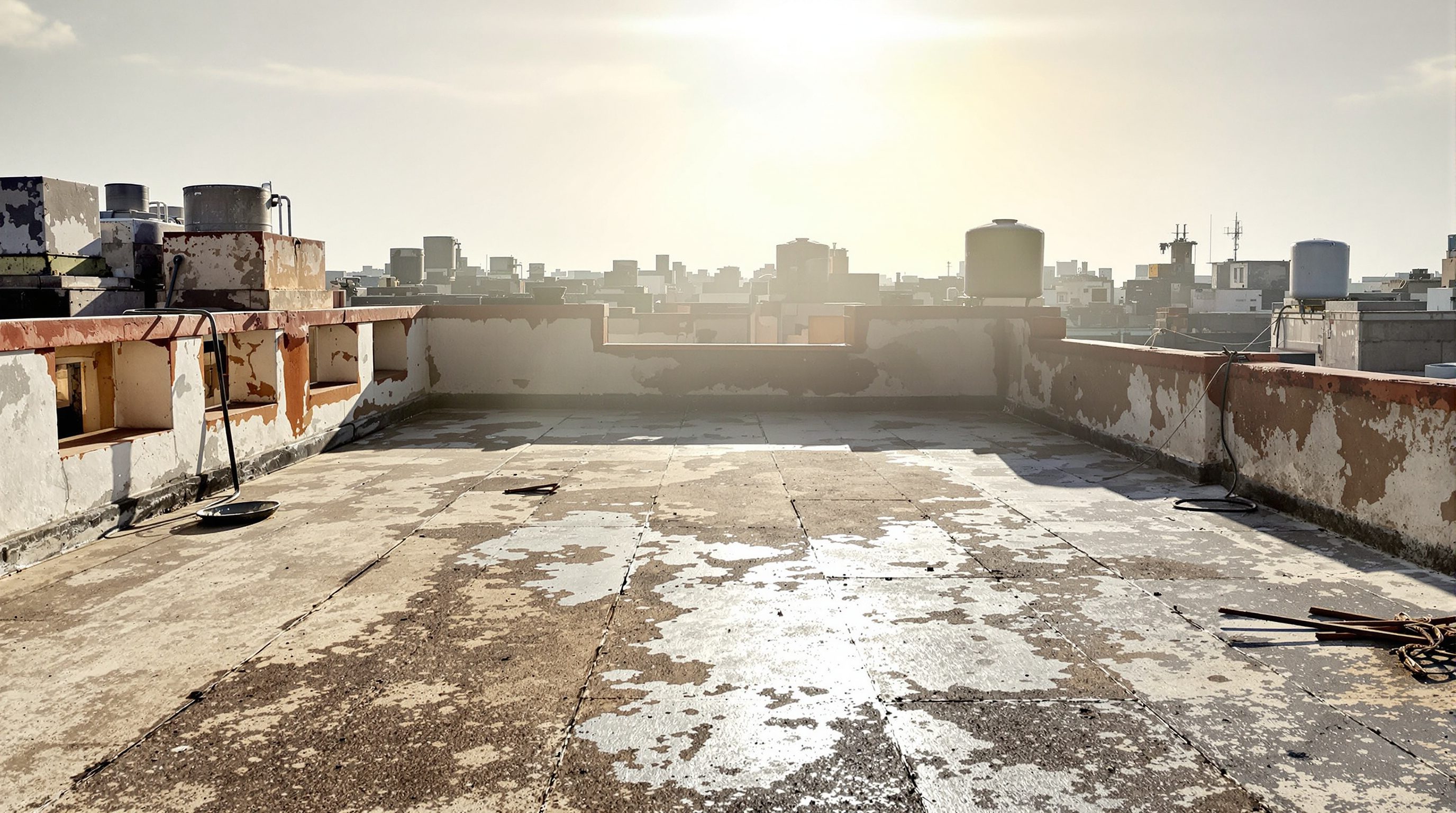
The high summer sun hits the roof head-on, all day — fix the roof first, and the top floor stops cooking.
The code gave one element a hard limit — and it wasn't the wall
The Eco-Niwas Samhita gave exactly one element a hard, universal U-value limit — the same number from Kochi to Leh — and it wasn't the wall or the window. It was the roof. The code knows what every top-floor Indian flat resident knows in their bones: in summer the topmost room is an oven while the floors below stay bearable.
The reason is geometry. The high summer sun beats down almost vertically, so a flat roof catches its near-full force — several times the load any wall receives — from dawn to dusk, while each wall is only grazed for part of the day. A bare RCC slab soaks up this relentless heat, conducts it through, and by late afternoon the ceiling underside is hot enough to radiate down on you like a grill. The roof is the single worst thermal offender in the typical Indian building, and taming it is the highest-value envelope move you can make.
Fix one thing in an Indian building? Fix the roof. It takes the most sun, all day, in every climate.
Why the roof, not the wall
Three things gang up on the roof. Sun angle: the high summer sun sits nearly overhead, so a horizontal roof catches almost the full beam — several times what a vertical wall receives at noon. All-day exposure: the roof faces the open sky from sunrise to sunset, while each wall is sunlit only part of the day and east/west walls can be shaded by trees, overhangs or neighbours. You can't shade it: a wall can have a chajja, a tree, a neighbour; an open terrace roof has nothing between it and the sky.
In a single-storey house, or on any top floor, the roof can be responsible for the largest single share of summer heat gain — often more than all the walls combined. And the typical Indian roof is the worst possible response: a bare, dark-grey concrete slab, high in mass but with almost no insulation, that charges with heat all day (positive time lag, 2.1) and radiates it down into the rooms through the evening — a ceiling-mounted version of the humid coast's night-radiator (3.3), but charged by the most intense solar load on the entire building.
For centuries, hot-region roofs were sloped, thatched, vaulted, domed, double-layered, or topped with a shaded pavilion — and people slept on the terrace at night, when the roof finally turned from collector to radiator-to-the-sky. The flat bare RCC slab is a modern invention that forgot all of it.
The wall gets grazed; the roof gets hit square-on, all day. Fix the roof first.
Four ways to tame it
Because the roof gets the most sun, fixing it has the largest payoff — four levers, best combined. Insulate it: a layer above or below the slab cuts conducted heat dramatically and is the surest route to U ≤ 1.2. A bare RCC roof is about U 4.5; just ~30 mm of insulation brings it into line. Reflect the sun before it is ever absorbed: a light, high-reflectance "cool roof" finish keeps the slab far cooler by bouncing most sunlight back to the sky (6.5). Shade it: a raised pergola, a PV array, a second lightweight roof, or a roof garden intercepts the sun before it reaches the structural slab. Ventilate the gap: in a double roof or under raised tiles, let air sweep the absorbed heat away.
The best Indian roofs combine these — reflect what you can, insulate the rest, and shade and ventilate above the slab wherever the brief allows. None of the four is exotic; the cool-roof coat is nearly free, and over-deck insulation rides along with the waterproofing you were already laying.
Reflect, insulate, shade, ventilate. Stack them and the slab goes quiet.
The roof heat-gain comparator
Set the time of day and the roof construction, and watch heat reach the ceiling and radiate into the room, with a wall shown alongside for scale. At 2 pm under a bare RCC roof, the heat flooding the top-floor ceiling dwarfs what the wall delivers — the geometry and the missing insulation compounding. Step to 9 pm and the slab, still charged from midday, is radiating that stored load downward into the bedroom exactly when you are trying to sleep.
Swap in a cool-roof coat and the slab runs far cooler because less sun was ever absorbed; swap in an insulated roof and far less of whatever heat is absorbed makes it through. The comparator is built to make one point land: the roof is not a little worse than the wall, it is several times worse — and that is why it is the first thing to fix.
Three altitudes on the same idea
Read the band that fits you — or all three.
A hot top-floor room, or a bare concrete terrace that bakes? The roof is almost certainly the culprit, and the most rewarding thing you can fix. The cheapest first step is a reflective cool-roof coating — or even traditional white china-mosaic or a lime wash. Light colours on the terrace can drop the ceiling temperature noticeably for very little money. Better still: add insulation above the slab (under the waterproofing) and shade the terrace with a pergola, plants, or a raised second roof. A well-treated roof can turn an unusable summer top room comfortable and cut your cooling bills sharply — a far smarter spend than another air conditioner fighting a radiator over your head.
Treat the roof as the priority envelope element. Hit U_roof ≤ 1.2 (Eco-Niwas Samhita, all zones) with insulation — typically over-deck (above the slab, under the waterproofing and screed) to keep the slab's mass coupled to the interior and avoid interstitial condensation. Specify a high-SRI cool-roof finish (6.5) to cut the absorbed load at source. Where the brief allows, add over-roof shading (a PV array does double duty), a ventilated double roof, or a roof garden. The roof is also the rain and waterproofing line, so insulation placement, vapour control and drainage all resolve together — coordinate them as one detail. In multi-storey buildings the roof still dominates the top floor: design for the top-floor occupant, who suffers the most and is usually the one forgotten.
Two effects stack. Solar load first: under a high summer sun at altitude beta, a horizontal surface receives beam radiation proportional to sin(beta) while a vertical wall receives cos(beta). At beta = 78, sin 78 / cos 78 = tan 78 = 4.7 — the roof catches almost five times the wall's instantaneous load, and it is sunlit all day, not just part of it. Fabric second: a bare RCC roof has U = 4.5 W/m2K (6.1), far worse than even an uninsulated wall. Combine both in Q = U * A * dT_sol-air, where the sol-air temperature difference bundles the absorbed solar load into an equivalent temperature gap. The roof's dT_sol-air can reach 30 to 40 (a dark slab can hit 65 to 70 against ~35 air) versus only 10 to 15 for a shaded or partly-sunlit wall. With both a higher U AND a far higher dT_sol-air, the roof's heat gain per m2 dwarfs the wall's — so on a single-storey footprint (roof area ~= floor area) the roof commonly contributes the largest single share of cooling load. Insulating (U 4.5 -> ~0.5) attacks the first term; reflecting (cutting dT_sol-air) attacks the second. Do both and you collapse Q from both directions at once. Note tan(beta) blows up as beta -> 90: the closer the noon sun is to overhead, the more lopsidedly the roof loses to the wall.
“My roof is a thick, heavy concrete slab, so it's well protected from the heat.”
Run the method yourself
Use the comparator to feel why the roof wins the heat contest — then do the geometry by hand.
- 1Set 2 pm with a bare RCC roof; note the heat reaching the room and the roof-vs-wall comparison. Why is the roof so much worse?
- 2Step to 9 pm with the bare roof. What's happening to the heat the slab absorbed at midday, and why is that the worst possible time for it to arrive?
- 3Compare the cool-roof coat and the insulated roof. Which one attacks the absorbed-heat term and which the conduction term — and why do you want both together?
- 4Using tan(beta), compute how many times more instantaneous solar load a flat roof gets than a sun-facing wall at a noon altitude of 75° (you should get about 3.7×).
↳ Use the worksheet below to record your answers.
Take it with you
Fix the roof first
Q = U·A·dT_sol-air blows up. A bare RCC slab is a ceiling-mounted radiator: mass stores the heat and dumps it into bedrooms at night. Fix it with four levers — insulate (meet U ≤ 1.2, ideally over-deck), reflect (cool roof), shade and ventilate above the slab. The roof is the highest-value envelope move there is.Of the four ways to tame the roof, one is uniquely powerful in sunny India and almost free: stop the heat being absorbed at all, by making the roof *reflect* the sun rather than soak it up. The final Module 6 lesson examines the **cool roof** — high-reflectance, high-emittance finishes that keep a slab dramatically cooler — and its living counterpart, the **green roof**, where soil and plants shade, insulate and evaporatively cool the slab while giving back a garden. Two ways to turn the building's hottest surface into one of its calmest.
The author
Amogh N P
Architect, interior designer, and creative polymath. Studio Matrx began in his notebooks — his vision of design made honest, useful, and open to everyone. Its Academy is written and taught in his memory, and free, forever.
More about Amogh →