
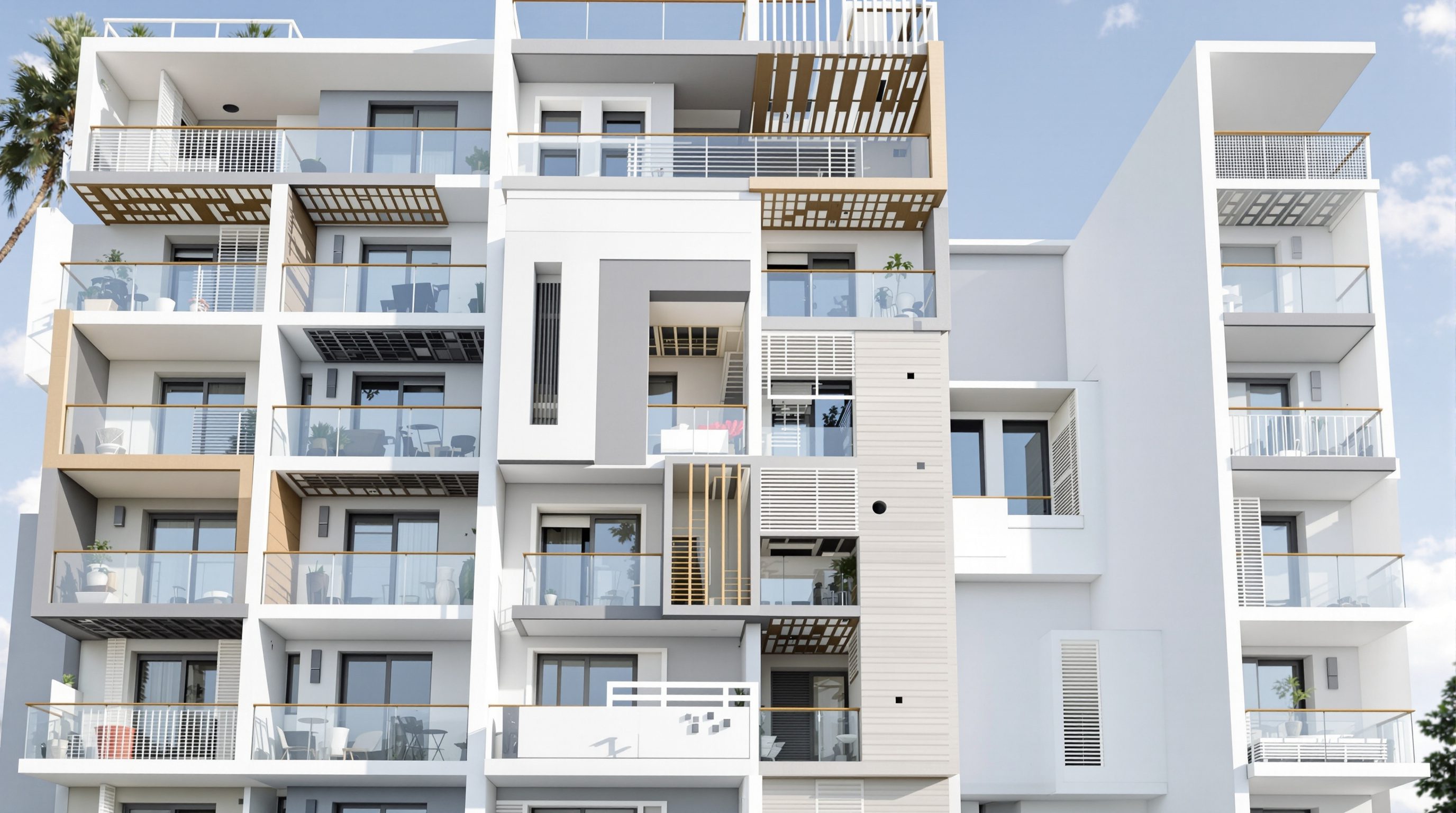
 Lesson 6.2
Lesson 6.2 · The Envelope as a System
ECBC Compliance: The Eco-Niwas Samhita
The U-value you just learned to compute becomes a legal line in the sand — India's home energy code, in four checks.
Once a U-value is a number, it can be a requirement
India's home energy code — the Eco-Niwas Samhita ("energy-efficient home code"), also called ECBC-Residential, launched by the Bureau of Energy Efficiency in 2018 — sets minimum envelope performance for every climate zone. The fascinating part, and a genuinely Indian piece of code design: it does *not* simply hand you a maximum wall U-value the way a European or American code might. Because most of India is cooling-dominated and bright, the code recognises that what matters for a wall is not just insulation but the *whole* heat gain — conduction through the opaque wall plus solar radiation through the glass — and bundles these into a single cleverer metric. Understanding the ENS is understanding how India chose to regulate comfort: roof, walls, windows and daylight, judged together, tuned to a hot country.
The roof gets one hard rule everywhere; the walls-and-windows get judged by how much real heat they let in. Design well and you clear the line without trying.
Four checks the home must pass
ENS Part I — the envelope part — asks a home to satisfy four checks, all demonstrable with hand calculations straight from the drawings, no simulation needed.
First, an openable window-to-floor ratio (WFRop) at or above a minimum, to guarantee natural ventilation. Second, a minimum visible light transmittance (VLT) of the glazing, to guarantee daylight. Third, a roof thermal transmittance Uroof <= 1.2 W/m2K in every zone, to cap roof heat gain and loss. Fourth, for the rest of the vertical envelope, either RETV <= 15 W/m2 in the four hot and temperate zones, or a simple envelope U-value <= 1.8 W/m2K in the cold zone.
Notice the architecture of it. The code regulates ventilation and daylight so an efficient house stays healthy and liveable, not a sealed bunker. It singles out the roof with a firm universal U-value because the roof is the worst offender. And it judges the rest of the vertical envelope by the combined RETV for the hot majority, switching to a plain U-value only for the cold zone where heat *loss*, not solar gain, dominates. The roof gets the one hard universal U-value (1.2) in every zone, Kochi to Leh — the code saying, in its driest voice, what climate-responsive design shouts: in India, fix the roof first.
The verified figures, Eco-Niwas Samhita 2018: RETV <= 15 W/m2; Uroof <= 1.2 W/m2K; Uenvelope,cold <= 1.8 W/m2K. The minimum openable window-to-floor ratio varies by zone — Composite 12.5%, Hot-Dry 10.0%, Warm-Humid 16.66%, Temperate 12.5%, Cold 8.33%.
Four boxes to tick: enough openable window, enough clear glass, a cool roof everywhere, and walls-plus-windows that don't let the heat in.
RETV: the cleverness of the Indian code
The Residential Envelope Transmittance Value is the heart of the ENS, and genuinely elegant. Rather than asking "is the wall insulated enough?", it asks the better question: over the cooling season, how much heat does the whole vertical envelope let in *per square metre* — through opaque walls by conduction, *and* through windows by both conduction and solar radiation?
It rolls wall U-value, window U-value, window area (WWR), glazing SHGC, shading and orientation into one number, capped at 15 W/m2. So the code never needed a wall-U limit for the hot zones at all. A designer hits RETV <= 15 in many ways — a better wall, smaller windows, lower-SHGC glass, deeper shading, smarter orientation — and the code rewards *any* combination that cuts real heat gain.
This is a performance-based code, not a prescriptive one, and it quietly encodes every passive lesson of this course. The RETV is the climate-responsive intuition of the earlier modules — orientation, shading, modest glazing — written as a single legal inequality.
Complying without losing the passive intelligence
Here is the trap the code helps you avoid. You *can* meet RETV <= 15 by brute force — take a bad, over-glazed, west-facing design and bolt on expensive low-SHGC glass and thick insulation until the number finally drops below the line. It complies. And it is still worse than a building that complied through good passive design in the first place.
The intelligent path hits the targets the way the earlier modules taught: orient well, shade the glass (which RETV explicitly rewards through its shading factor), keep the window-to-wall ratio modest, and let a decent wall and a well-insulated roof do the rest. Done this way, compliance is almost a by-product of good design — the code a floor your passive intelligence clears easily, not a ceiling you scrape under with bought-in technology.
So the ENS is best understood not as a constraint to satisfy but as the minimum the physics of this course already exceeds. Design for comfort first, and compliance arrives on its own.
Three altitudes on the same idea
Read the band that fits you — or all three.
Building a home of reasonable size? Ask your architect whether it meets the Eco-Niwas Samhita. In plain terms it asks four sensible things: enough openable window for fresh air, enough clear glass for daylight, a well-insulated roof, and walls-plus-windows that together don't let in too much heat. You needn't chase the numbers yourself — a home designed around shade, sensible window sizes and a good roof meets them comfortably, stays cooler, and costs less to run. Compliance and comfort point the same way: the house that ticks the code's boxes is the house that is pleasant to live in.
Run the four ENS checks early, straight from the drawings: the zone-specific WFRop and VLT minimums, Uroof <= 1.2, and RETV <= 15 in the hot and temperate zones or U_envelope <= 1.8 in the cold. Treat RETV as a design tool, not a final audit: it rewards shading (the external shading factor), orientation, lower WWR and lower SHGC, so trade these against wall and glass U-values through the envelope. Hit the roof limit with insulation early — it is non-negotiable and universal. ENS applies to plots of 500 m2 and above, and its legal force depends on state notification, so treat it as best practice regardless. Verify the current edition and any state amendments before certifying.
RETV is a per-m2, area-weighted sum of three heat-gain pathways over the vertical envelope (excluding the roof):
RETV = (1/A_env) * [ a*sum(A_opaque*U_opaque) + b*sum(A_nonopaque*U_nonopaque) + c*sum(A_nonopaque*SHGC_eq*omega) ] <= 15 W/m2
Here A_env is the envelope area; the three terms are wall conduction, window conduction and window solar gain; omega is the orientation factor; SHGC_eq folds in external shading; and a, b, c are zone coefficients. The solar term carries the largest coefficient (c ~= 1.85 in the worked examples) — the code's way of saying solar gain through glass dominates in India.
Read it and the passive lessons leap out: the solar term falls with lower SHGC, smaller window area, external shading and good orientation. The code didn't invent new physics; it weighted the physics you already know and drew a line at 15. For the cold zone the requirement instead becomes a plain U_envelope <= 1.8 W/m2K, because there heat loss, not solar gain, is the enemy. The roof limit U_roof <= 1.2 W/m2K is universal across all five zones.
“The Eco-Niwas Samhita sets a maximum wall U-value for each climate zone, just like Western codes.”
Run the method yourself
Run the compliance checker and the RETV maths before the next lesson, and watch the code's logic shift zone to zone.
- 1Switch the checker between Composite and Cold zones. How does the envelope requirement change — RETV in one, a plain U-value in the other — and why does that reflect the heat-versus-cold logic of the earlier modules?
- 2The roof limit (U <= 1.2) is identical in every zone. Work out roughly how much insulation a bare concrete roof needs to reach it (about 20-35 mm), and explain why this one limit is universal Kochi to Leh.
- 3List four design changes that would each lower a building's RETV. Which of them cost nothing but good design?
- 4Why is a wall U-value alone inadequate to regulate a hot-climate facade — what does RETV add that a U-value misses?
↳ Use the worksheet below to record your answers.
Take it with you
The physics of the course, written as law
The RETV made one thing unmistakable: in a hot, sunny country the heat through the **glass** — its area, its SHGC, its shading — carries the heaviest weight. The next lesson zooms into that term: window-to-wall ratio, glazing selection and SHGC, and how to size and specify glazed openings so they deliver light, view and ventilation without becoming the solar oven the curtain-wall office became. It is the quantitative sequel to the shaded-glazing intuition of Module 4.
The author
Amogh N P
Architect, interior designer, and creative polymath. Studio Matrx began in his notebooks — his vision of design made honest, useful, and open to everyone. Its Academy is written and taught in his memory, and free, forever.
More about Amogh →