
 Lesson 6.5
Lesson 6.5 · The Envelope as a System
Cool and Green Roofs
The cheapest way to beat the heat is to never let it in — reflect the sun away, or grow a garden that sweats it off.
The roof that bounces the sun back to the sky
Lesson 6.4 named the roof the worst offender. This lesson gives the most powerful, cost-effective answer, almost absurdly simple: don't absorb the heat in the first place. A dark concrete roof absorbs about 85% of the sun; a white reflective "cool roof" absorbs 20–30% and bounces the rest back to the sky. The difference is dramatic — a conventional terrace can reach 70 °C on a sunny afternoon while a reflective one beside it stays more than 25 °C cooler. For a few rupees of the right coating you attack the roof's heat at its source, before any insulation deals with anything. And to do more — give the heat somewhere to go, and get a garden in the bargain — you grow a green roof, where soil and plants shade, insulate and evaporatively cool the slab at once. Reflect it, or plant it.
Never absorb what you can bounce back. The cheapest degree of cooling is the sunbeam that never lands.
The cool roof — reflect, and emit
A cool roof works on two properties, and you need both. The first is solar reflectance (albedo) — the fraction of sunlight a surface bounces straight back, never absorbing it, on a scale of 0 to 1. The second is thermal emittance — the surface's ability to shed whatever heat it does absorb by radiating it away as infrared, also 0 to 1. Reflectance stops most of the heat being absorbed at all; emittance lets the surface dump the small remainder to the sky. A cool roof aims high on both.
The two are bundled into the Solar Reflectance Index (SRI), scaled so a standard black roof (reflectance 0.05, emittance 0.90) scores 0 and a standard white (0.80, 0.90) scores 100 — higher is cooler. India's ECBC asks a cool roof for an initial solar reflectance of at least 0.7 and a thermal emittance of at least 0.75.
The crucial subtlety is that colour alone is not the whole story. About half the sun's energy arrives as invisible near-infrared, so a specially-pigmented "cool colour" coating can reflect that infrared and stay much cooler than ordinary paint of the same visible shade. That is how cool roofs come in colours other than brilliant white. The humble lime wash and white china-mosaic terrace, traditional across hot India, were cool roofs centuries before the term existed — high reflectance, high emittance, dirt cheap, and they doubled as waterproofing. Again the vernacular was right; the bare grey slab is the aberration.
Reflect most of the sun, radiate away the little you absorb. White china-mosaic was doing both long before anyone measured an SRI.
The green roof — shade, insulate, evaporate, all at once
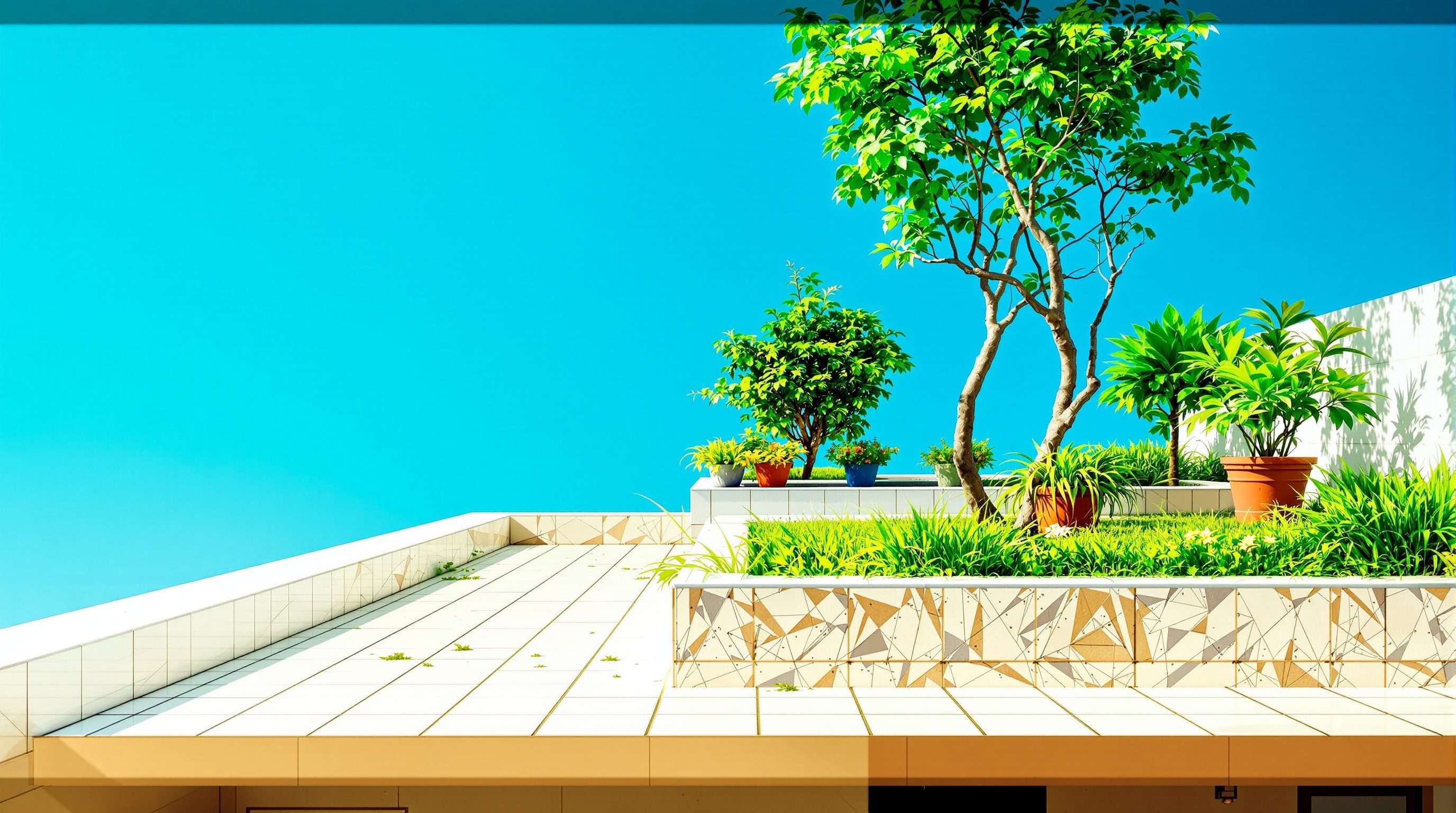
A green roof — soil and planting over a waterproofed, drained slab — is the roof's most complete answer, fighting heat with three of this course's mechanisms at the same time. Plants and soil shade the slab, putting Lesson 4.4's shading up on the roof. The soil layer insulates, adding resistance that lowers the effective U-value of Lesson 6.1. And the plants transpire while soil moisture evaporates, actively cooling by the same physics that cools the desert in Lesson 2.3 — a roof that sweats.
Beyond the thermal benefit, a green roof manages rainwater (vital in monsoon cities), supports biodiversity, cools the surrounding air to cut the urban heat-island effect, and gives back usable green space where ground is scarce. The cost is real — structural load from saturated soil, waterproofing, drainage, irrigation and maintenance — so it is a considered investment, not a quick coat of paint. But it is the most generous treatment of all, turning the building's worst surface into a living one.
Comparing four roofs under the same sun
Put four roof surfaces under the same midday sun and the differences stack up fast. The bare dark slab absorbs roughly 85% of the radiation, climbs to 65–70 °C, and re-radiates that heat down into the top-floor rooms all evening — the ceiling-mounted radiator of Lesson 6.4.
A cool white roof reflects about 75% and settles 25–30 °C cooler, passing a fraction of the heat inward. A cool-colour coating, pigmented to reflect near-infrared, runs almost as cool as the white while letting the architect keep a darker visible shade. And the green roof barely warms at all — shaded, insulated and evaporatively cooled together — while quietly soaking up the monsoon downpour the others shed straight into the storm drain.
The lesson of the comparison is an order of operations. Reflect first, because it is cheap and attacks the heat at source; insulate second; and where structure and budget allow, plant — because the green roof does everything the others do, and more.
Three altitudes on the same idea
Read the band that fits you — or all three.
The single most cost-effective comfort upgrade for most Indian homes is a cool roof — a reflective white (or specially-pigmented cool-colour) coating, or the traditional white china-mosaic or lime wash, on your terrace. It is cheap, often a DIY weekend job, and it can drop your top-floor ceiling temperature noticeably within a day. If you have the structure and the budget to go further, a terrace garden gives shade, cooling and green space at once — just make sure the waterproofing and drainage are done properly first, before any soil goes down. Start with the reflective paint; dream of the garden.
Specify cool-roof finishes to meet or exceed ECBC — initial solar reflectance ≥ 0.7, emittance ≥ 0.75 — and track both SRI and aged values, since reflectance degrades with soiling, so clean or recoat on a schedule. Cool roofs are the highest return-on-cost roof measure there is; combine them with over-deck insulation to hit U_roof ≤ 1.2 (the Eco-Niwas Samhita limit), cutting both the absorbed and the conducted terms of Lesson 6.4. For green roofs, engage a structural engineer early — saturated soil is heavy — and resolve waterproofing (a root-resistant membrane), drainage and irrigation; then choose extensive (shallow, low-maintenance) versus intensive (deep garden) to suit the load and the use. Quantify the green roof as added R-value plus shading plus evaporative cooling. At city scale both measures cut the urban heat island — a public benefit as well as a private one.
The absorbed solar load is q_absorbed = alpha * I, where the absorptance alpha = (1 - reflectance). Under midday I ~= 800 W/m2: a dark slab (reflectance 0.15, so alpha 0.85) absorbs 0.85 * 800 = 680 W/m2; a cool white roof (reflectance 0.75, alpha 0.25) absorbs 0.25 * 800 = 200 W/m2. The cool roof absorbs 1 - 200/680 ~= 71% less heat at the source.
So surface temperatures diverge sharply: the dark slab climbs to 65-70 C, while the reflective roof settles 25-30 C cooler — its high emittance also re-radiating the small load it does absorb. Feed this through the Lesson 6.4 conduction term Q = U * A * dT_sol-air: cutting the absorbed load slashes the sol-air temperature dT_sol-air, so even before any insulation the reflective roof passes far less heat inward. Reflect first (cheap, attacks dT_sol-air), insulate second (attacks U) — and a green roof does both at once, plus the evaporative cooling no coating can offer.
“A cool roof is just white paint — and white paint is white paint, so the cheapest tin will do.”
Run the method yourself
Compare the four roofs and run the absorbed-load maths before Module 7 begins.
- 1Compare the dark slab and the cool white roof in the simulator. By how much does the surface temperature drop, and why does so much less heat reach the room below?
- 2Compute the absorbed load for reflectance 0.15 versus 0.75 under I = 800 W/m² using q = (1 − reflectance) × I. By what percentage does the cool roof cut the absorbed heat?
- 3Name the three mechanisms by which a green roof cools the slab, linking each to an earlier lesson.
- 4Explain why plain "white paint" may not qualify as a cool roof — give one physics reason and one maintenance reason.
↳ Use the worksheet below to record your answers.
Take it with you
Bounce it back, or plant it green
That completes Module 6 — and with it the envelope as a system. The five climate modules gave the intuition; Module 6 made it rigorous. You can now compute a wall's U-value from its layers, read and meet India's energy code (the Eco-Niwas Samhita and its RETV), tune glazing by SHGC, VLT and selectivity, and tame the roof — the worst offender — by insulating, reflecting, shading and greening it. The envelope is no longer five separate climate strategies but one quantified system. Module 7 — the capstone — stops teaching techniques and starts applying them, walking complete design responses to three real briefs across the climate range: a composite-climate home in Hubballi, a warm-humid house in Kochi, and a cold house in Leh. Then it distils a climate self-audit framework for reading any site, and a habit for carrying this practice through a whole career.
The author
Amogh N P
Architect, interior designer, and creative polymath. Studio Matrx began in his notebooks — his vision of design made honest, useful, and open to everyone. Its Academy is written and taught in his memory, and free, forever.
More about Amogh →