
 Lesson 2.2
Lesson 2.2 · Hot-Dry Strategies
Courtyards and Jaalis
The hot-dry house turns its back on the desert and opens inward — to a well that breathes cool air and a screen that softens the glare.
A house that shows the street nothing, and opens a sky inside
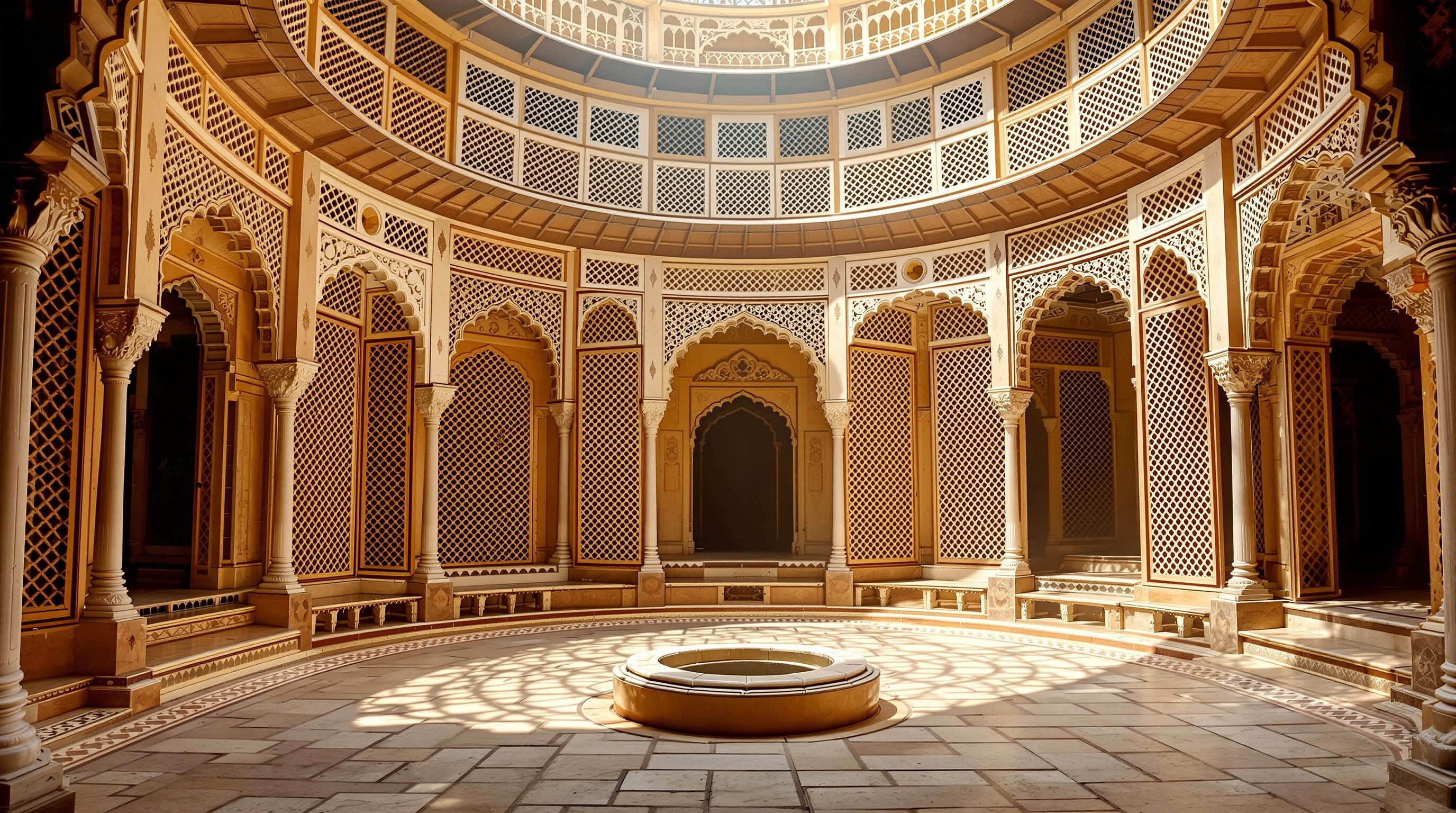
A Jaisalmer haveli shows the street almost nothing, but opens inside to a bright, calm chowk — an internal courtyard with the sky for a ceiling. By night the well fills with cool, heavy desert air the rooms drink in; by day it sits in its own shade. The windows are not glass but jaalis — perforated stone that turns brutal glare into soft, dappled light. The thick wall of Lesson 2.1 was the defence. The courtyard and the jaali are how the house still manages to breathe and to see.
Mass was the defence. The courtyard and the jaali are how the house still breathes and sees.
The courtyard as a climate machine
A hot-dry courtyard is not a decorative void; it is a machine that runs on a daily cycle, and it works only because desert nights are cool and still.
At night, the air in the open court loses its heat to the clear sky, grows dense, and sinks. Cold air pools at the base of the well and feeds into the rooms that open onto it — a slow, gravity-driven flush of coolness with no fan and no wind. By morning the court still holds the last of that cool, and its depth keeps the floor in shade. At noon the sun reaches in only briefly; a deep, narrow court limits how far it gets. By evening the warmed walls release their heat gently, and the chowk becomes the most comfortable living space in the house.
The single thing that tunes all of this is proportion. A deep, narrow court stays cool but goes dark; a wide, shallow one floods with daylight but also with the noon sun. The chowk is tuned between those extremes — and the right tuning shifts with latitude, because the sun sits at a different height over Jaisalmer than over the south.
The jaali as a tuned screen
The jaali solves a problem that defeats both the solid wall and the plain window. A solid wall is dark and airless; a plain window in the desert is a glare-bomb and a heat inlet. The jaali threads between the two: its perforations break the harsh sunbeam into soft points of light, its remaining mass shades most of the opening, and air still moves freely through the holes.
The number that tunes a jaali is its open-area ratio — the proportion of the screen that is hole rather than stone. Push that ratio up and airflow and daylight rise with it; push it past roughly 35% and the glare and heat the screen was meant to exclude begin to return. Traditional jaalis sit in a 25–40% sweet spot, where the screen still delivers a brisk draught and soft light while blocking most of the sun.
What makes the jaali remarkable is that it does four jobs with one stone. It shades (the solid fraction blocks direct sun), it lights softly (diffuse, glare-free daylight reaches deep into the room), it ventilates (a fine screen can even speed the breeze through its holes), and it screens for privacy (you see out, but the street cannot see in). No single modern component matches that range.
The form survives across climates; the physics does not. Always ask which engine your courtyard runs on.
Sizing the court: sky view factor
The proportion you choose can be put on a number. The sky view factor (SVF) is the fraction of the overhead sky a point at the bottom of the court can actually see, and for a long courtyard of width W and wall height H it is roughly W divided by the square root of (W squared plus four H squared).
A court 4 m wide and 6 m tall has an H:W of 1.5, giving an SVF of about 0.32 — little direct sun reaches the floor, but daylight is also dimmer. Halve the height to an H:W of 0.75 and the SVF climbs to about 0.55: brighter, but now the noon sun rakes in. The design sits in the tension between those two readings — low enough to limit the sun, high enough to light the rooms.
For the jaali, the partner physics is flow through small holes. Because a screen concentrates the same flow through a smaller open area, the local velocity through each perforation rises even as total area falls — which is why a 30%-open jaali can still push a noticeable draught into a room while blocking 70% of the sun.
Three altitudes on the same idea
Read the band that fits you — or all three.
A central courtyard or light-well is the single most powerful hot-dry move you can make: it gives you daylight, fresh air and a private outdoor room without ever exposing yourself to the street or the harsh afternoon sun. On your hottest façades, jaali screens — in stone, concrete jaali block, or even a deep timber lattice — give you daylight and breeze without the glare a plain window would bring. Think of the court as the cool heart of the plan and the jaali as the skin that lets the house see out without being seen.
Size the court's proportion to latitude and use: H:W of roughly 1.5–2 for the hottest, lowest-latitude desert sites; shallower where you want to admit winter sun. Detail for the physics — low room openings onto the court so night-cooled air can pool and flow inward, and a daytime closure (a vela or awning) for the worst weeks. Specify jaali open ratios around 25–40%, and shape the depth of the perforations so they cut the specific summer sun angles you derived in Lesson 1.1. Specify washable screens: desert dust clogs a jaali, and a clogged jaali is just an awkward wall.
Court daylight and sun follow the sky view factor SVF = W / sqrt(W^2 + 4*H^2). A 4 m wide by 6 m tall court (H:W = 1.5) gives SVF ~= 0.32 — little sun, less daylight. Halve the height (H:W = 0.75) and SVF ~= 0.55 — brighter, more sun. Jaali airflow follows Q = Cd * A * sqrt(2 * dP / rho), where A is the open (hole) area and dP the pressure difference. The trick is that a screen concentrates flow through small holes, so local velocity rises even as A falls: a 30%-open jaali still delivers a brisk draught while its 70% solid fraction blocks the direct sun.
“A courtyard always cools a building — it works in any climate.”
Run the method yourself
Tune both devices on real proportions before the next lesson.
- 1In the cycle widget, set a deep proportion and step from Night to Noon. At roughly what H:W does the noon floor stay mostly shaded?
- 2Compute the SVF for your own proposed H:W. Is it low enough to limit the sun, yet high enough to light the rooms behind it?
- 3In the jaali explorer, find the open ratio where airflow and daylight are both strong but glare and heat stay low — then read off the percentage.
- 4Sketch a hot-façade jaali at that ratio, with the perforation depth set to block the summer noon sun angle you found in Lesson 1.1.
↳ Use the worksheet below to record your answers.
Take it with you
Defend with mass, then breathe through a void and a screen
Mass defers heat, the courtyard pools cool air, the jaali filters the sun — but all three only *manage* heat. The desert offers one way to actively *destroy* it, hiding in the very dryness that makes the climate so harsh: evaporative cooling, from the surahi and the wetted khus screen to the courtyard fountain — and the wet-bulb limit that decides how far it can ever go.
The author
Amogh N P
Architect, interior designer, and creative polymath. Studio Matrx began in his notebooks — his vision of design made honest, useful, and open to everyone. Its Academy is written and taught in his memory, and free, forever.
More about Amogh →