
 Lesson 2.3
Lesson 2.3 · Hot-Dry Strategies
Evaporative Cooling
Dry air, given water, will cool itself — but only to one hard floor: the wet-bulb temperature.
How a clay pot beats 42 °C with no machine
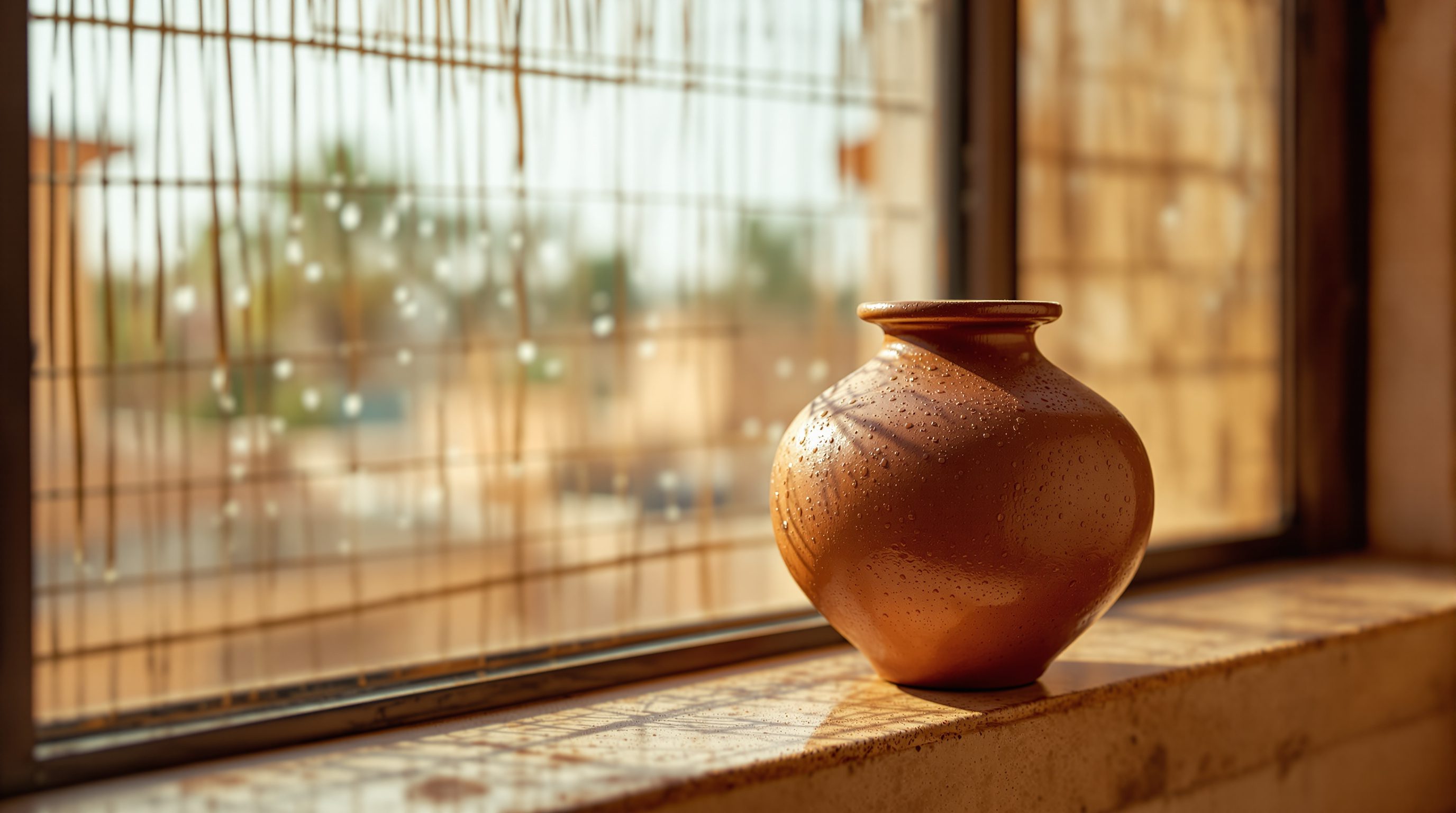
A surahi sweating on a Jodhpur windowsill keeps its water cool at 42 °C — no ice, no compressor, no electricity. The unglazed clay seeps water that evaporates off its skin, and every gram that turns to vapour steals heat from the water left behind. The wetted khus screen on the door and the courtyard fountain do the same trick at larger scale. This is the one hot-dry strategy that genuinely destroys heat rather than just moving it around — but it answers to a single hard limit you already met in Lesson 1.2: the wet-bulb temperature.
Before you spec a cooler, ask one number: how far is the wet-bulb? That gap is all the cooling you'll ever get.
Spending heat to turn water into vapour
Turning liquid water into vapour costs roughly 2,400 kJ for every kilogram — the latent heat of vaporisation. That energy doesn't come from nowhere: it is pulled out of the surrounding air as heat, so the air cools as the water leaves it.
The driver is how dry the air already is. Drier air accepts new vapour far more readily, so evaporation runs faster and pulls more heat. This is why the desert's brutal dryness is exactly what makes evaporative cooling powerful in Jodhpur — and exactly why the same device is useless in humid Kerala, where the air is already nearly full of moisture and has no room to take more.
There is a catch built into the physics: evaporative cooling adds moisture to the air as it cools it. Cool and dry are in direct tension here. In a desert that trade is fine — the air had moisture to spare. On a humid coast it is a disaster.
Every gram of water that becomes vapour carries away ~2,400 kJ. Evaporation doesn't move heat — it spends it.
One principle, four scales — surahi to cooler
The same physics reappears across a whole family of Indian devices, each working at a different scale.
A surahi or matka cools a single object: water seeps through the porous clay and evaporates off the outer skin, leaving the contents cool. A khus-tatti — a screen of wetted vetiver roots hung in a doorway — cools the air at an opening as the breeze passes through the damp root mat. A courtyard fountain cools a room or a whole court, its water surface chilling the surrounding air. And the modern desert cooler cools a building: a fan drags outdoor air through a wet pad and blows the cooled, moistened air inside.
Different scales, identical mechanism. Once you see the surahi and the desert cooler as the same machine, the design question stops being "which device" and becomes "how dry is the air I'm feeding it."
The wet-bulb floor — and what the psychrometric chart was for
Evaporation can cool air toward its wet-bulb temperature and not one degree further. The wet-bulb is the floor; the gap down to it is the entire resource you have to work with.
Compare two cities on the same hot day. Jodhpur at 42 °C has a wet-bulb of about 23 °C — a potential drop of nearly 19 °C, deep into comfort. Mumbai at 33 °C has a wet-bulb of about 30 °C — barely 3 °C of headroom, and what little cooling you get arrives clammy. Same machine in both rooms; the air's moisture content decides everything.
The psychrometric chart from Lesson 1.2 was this lesson's rulebook all along. The horizontal distance from a city's dry-bulb point down to its wet-bulb line *is* the cooling that evaporation can deliver. Plot the city first; the chart tells you whether to reach for a cooler at all.
Evaporation only cools down to the wet-bulb. The drier the air, the further away that floor sits — and the more cooling you get.
Three altitudes on the same idea
Read the band that fits you — or all three.
A desert cooler is brilliant, cheap and low-power in a dry-summer city — Jodhpur, Jaipur, Delhi or Nagpur before the monsoon breaks. It costs a fraction of an AC to run and cools beautifully while the air is dry. But the moment the monsoon arrives the same cooler turns rooms sticky and miserable: it is the wrong tool for wet air, not a worse machine. The simple rule is seasonal — run the cooler through the dry months, and switch to fans and ventilation once the air turns humid.
Check the design-month wet-bulb depression (dry-bulb minus wet-bulb) before you specify anything. Above ~10–12 °C the strategy is strong; below ~5 °C it is futile. Where humidity already exists, favour *indirect* evaporative cooling — it chills a surface or a secondary air stream and cools the occupied air without dumping moisture into it; reserve *direct* evaporative cooling for genuinely dry air. Integrate the cooling into the courtyard or the building's air path rather than bolting on a box, and plan for the water supply and the maintenance the wet pads demand.
The outlet temperature is T_out = T_db - eps*(T_db - T_wb), where the saturation efficiency eps is roughly 0.7 to 0.9 for a good direct cooler. Jodhpur, T_db = 42, T_wb = 23, eps = 0.85: T_out = 42 - 0.85*(42 - 23) = 42 - 16.15 = 25.8 — a ~16 °C drop, straight into the comfort band. Mumbai, T_db = 33, T_wb = 30, eps = 0.85: T_out = 33 - 0.85*(33 - 30) = 30.5 — a useless ~2.5 °C. The wet-bulb depression (T_db - T_wb) is the whole resource; eps only decides how much of it you capture. No device can cool below the wet-bulb — that would violate the second law.
“An air cooler and an AC do the same job — one's just the cheaper version.”
Run the method yourself
Run the wet-bulb test on your own city before the next lesson.
- 1Set the calculator to your hottest month's dry-bulb temperature and relative humidity, then read off the wet-bulb and the cooling drop.
- 2Compute the wet-bulb depression (dry-bulb minus wet-bulb). Is it above ~10 °C (strong), 5–10 °C (marginal), or under 5 °C (futile)?
- 3Apply Tout = Tdb - eps*(Tdb - Twb) with eps = 0.85. Does the result reach your comfort band?
- 4Now slide the humidity up to monsoon levels — at what RH does the cooler stop being worth running?
↳ Use the worksheet below to record your answers.
Take it with you
A marvel in the Thar, a mistake on the coast
The thermal mass we charged in Lesson 2.1 has a debt to settle — the heat it stored all day must be flushed out before dawn, or tomorrow simply starts hot. The final Module 2 lesson closes the daily cycle and makes the mass worth having: night flushing, the cool desert night put to work.
The author
Amogh N P
Architect, interior designer, and creative polymath. Studio Matrx began in his notebooks — his vision of design made honest, useful, and open to everyone. Its Academy is written and taught in his memory, and free, forever.
More about Amogh →