
 Lesson 7.1
Lesson 7.1 · Putting It Together (Capstone)
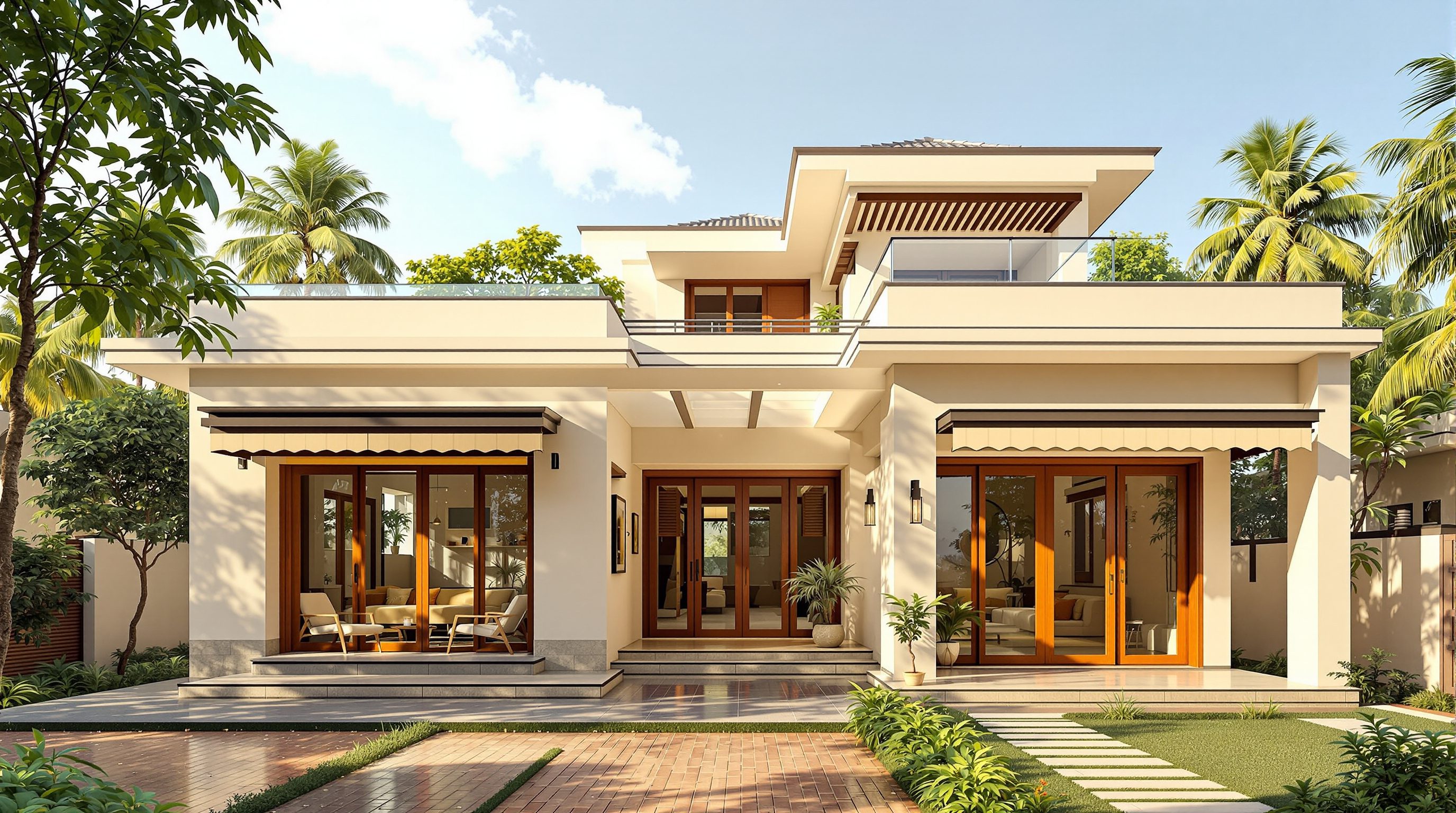
Hubballi: A Composite-Climate Home
Six modules of theory now meet one real plot: a 2BHK in Hubballi, reasoned from the sky down.
Six modules of theory, one real plot
Until now every lesson taught a single tool. From here we use them all at once — the way real design works, where everything must resolve into one building. Our first client: a family in Hubballi, the commercial twin-city of north Karnataka, who want a comfortable 2BHK that stays liveable year-round without leaning on AC. Hubballi is the ideal place to start because its climate is *composite* — by turns three different climates — and a home there must answer all of them. Watch a careful site reading flow into a passive strategy and a quantified envelope, each decision falling out of the last. The whole course, performed on one plot.
The order matters: site the courtyard badly and ventilation never works. Design is a chain, not a checklist.
Step 1 — read the site: three seasons, one house
Hubballi sits on the Deccan plateau at about 650 m, an elevation that tempers its heat, and its year splits cleanly into three seasons — the textbook composite signature.
From March to May it is hot-dry, peaking near 36 degrees C in April: hot days, but cooler plateau nights and a real diurnal swing. From June to October the monsoon arrives — about 900 mm of rain, 70 to 80 percent humidity, overcast and muggy; temperatures actually drop to around 26 degrees C, but the air turns heavy. From November to February it is mild and pleasant, dry and sunny with cool nights near 16 degrees C — the easy season, when you mostly just open up.
That reading gives our brief straight from nature: defend against dry heat in summer, shed humidity and rain in the monsoon, and stay open and gently warm in winter. Three jobs, one house. This is the switching building of Module 4 — no single fixed strategy will do.
The client brief: a family of four with joint-family visits common; a 2BHK of about 110 m2 with living and dining, kitchen, pooja niche, two beds, two baths and a terrace; a 9 by 18 m plot with its long axis roughly north-south, road on the south; a modest budget, passive-first, comfortable year-round without habitual AC.
Step 2 — orientation, courtyard, ventilation: the bones
Each move follows from the last; orientation sets up the courtyard, which organises the plan, which decides where mass and glass go.
First, orientation. We run the long axis east-west so the main rooms face north and south, and we keep west glass to a minimum — that single decision buys both summer sun control and a little winter gain (Lessons 1.1 and 4.4). Second, a central courtyard becomes the organising void at the heart of the plan: a year-round mediator that performs differently in each of the three seasons (Lesson 4.2). Third, we drive cross-ventilation through every room toward that court, so the plan answers both monsoon humidity and the summer night flush (Lessons 3.1 and 2.4).
The order matters more than it looks. Get orientation wrong and no glazing saves you; site the courtyard badly and ventilation never works. Design here is a chain of consequences, not a checklist.
Get orientation wrong and no glazing saves you. The court comes second only because the axis came first.
Step 3 — mass, shading, roof: the envelope
With the bones set, the envelope decisions fall out in turn.
Fourth, selective mass: heavy, shaded internal walls that stay cool, paired with a lighter monsoon-exposed skin. The mass helps in the dry summer and stays harmless in the monsoon, because it is shaded and internal rather than baking in the sun (Lesson 4.3). Fifth, deep shading — chajjas over every opening, the court, and a verandah on the south and west — to exclude the high summer sun while still admitting the low winter sun (Lesson 4.4). Sixth, a cool, insulated roof plus modest, selective glazing: the roof is the worst single offender on an Indian home, so we tame it first, then add just enough good glass for daylight without heat (Lessons 6.4, 6.5, 6.3).
Nothing here is exotic. Every move is a standard element of the North Karnataka house — courtyard, chajja, verandah, terrace — now deployed deliberately and quantified. Climate-responsive design in India is less about importing technology than understanding why the old moves worked, and applying them with intent.
Step 4 — rain and damp, then one plan for three seasons
The seventh decision answers the monsoon directly: deep roof overhangs to throw driving rain clear of walls and openings, and a raised plinth to keep ground damp out of the floor (Lessons 3.4 and 3.2).
Now watch the one unchanging plan behave three ways. In the hot-dry summer the shaded court and chajjas keep the high sun off; thick shaded internal mass stays cool and is flushed each night by cool plateau air drawn through the court, while the cool roof rejects the worst load. In the warm-humid monsoon the court turns into a stack chimney pulling cross-ventilation through every room; the deep overhangs and raised plinth shed driving rain and ground damp, and the light monsoon skin stores no heat. In the mild winter the low sun slips under the chajjas into the south rooms and the court, and the house simply opens up — the building at rest.
One fixed plan, three behaviours, switched by the season. Module 4 realised in brick and stone on a real Hubballi plot.
Three altitudes on the same idea
Read the band that fits you — or all three.
Building in Hubballi or any three-season place? The single most valuable idea is a central courtyard with rooms opening onto it, deep shades over every window, a light-coloured insulated terrace, and a raised plinth. No imported technology — just the traditional courtyard house done carefully: shade in summer, breeze in the monsoon, sun in winter. Get those bones right and fans alone carry most of the year — and your electricity bill shows it.
Sequence the design as a chain: orientation, then courtyard, then ventilation, then mass, then shading, then roof and glazing, then rain and damp. Validate against the Eco-Niwas Samhita: with a modest WWR, deep external shading (low effective SHGC), a cool insulated roof (U_roof at or below 1.2) and a shaded-internal-mass wall, this house clears RETV at or below 15 W/m2 comfortably — compliance falls out of good passive design rather than being bolted on. Tune the court proportion to Hubballi's latitude near 15 degrees N so it excludes summer and admits winter sun, keep the monsoon-exposed west and south-west skin lighter and well-overhanged, and document the seasonal operation — a passive house only works if it is lived in correctly.
Check the headline moves with arithmetic. Roof (the worst offender, 6.4): a bare RCC slab is roughly U = 4.5; a cool finish plus over-deck insulation drops it to about U = 0.5, cutting the absorbed load by ~70% and removing the dominant single heat source. Night flush (2.4): Hubballi summer nights sit at ~22-24 C against ~36 C days, a ~13 C diurnal swing — ample to discharge the shaded internal mass overnight, and it is the plateau elevation that makes this work, unlike the humid coast. Comfort band (0.2): T_comfort = 0.54 * T_out + 12.83; for a ~25 C monthly mean the neutral temperature is ~26.3 C, and the band extends about +3 C to ~29 C. So for much of the year the house need only hold a few degrees below the hot-afternoon peak — which shading + mass + night flush + ventilation achieve without a compressor. The arithmetic confirms the intuition: in composite Hubballi a well-sequenced passive design does the overwhelming majority of the comfort work, and mechanical cooling becomes an occasional guest.
“A real design just needs the single best strategy for the climate — pick the most important move and optimise it.”
Run the method yourself
Run the capstone method yourself before the next brief takes you to the coast.
- 1Step through all seven decisions for the Hubballi house and, for each, state the climate fact and the lesson it comes from.
- 2Read your own city's climate into seasons, as we did for Hubballi. What jobs must a house there do?
- 3Trace one element — the courtyard, say — through your city's seasons. Does it earn its place the way Hubballi's does?
- 4Using the adaptive comfort relation, estimate the neutral temperature for your city's hottest month. How far below the afternoon peak must the house hold?
↳ Use the worksheet below to record your answers.
Take it with you
The whole course, on one plot
Hubballi's composite climate let many strategies take turns. Kochi offers no such relief: on the Kerala coast it is hot *and* wet almost all year, with little diurnal swing and no dry season to exploit. The next capstone designs a home for that unforgiving warm-humid climate — where mass becomes a liability, the night offers no flush, and the building must become a machine for catching every breeze and shedding relentless rain. The same method, a very different answer.
The author
Amogh N P
Architect, interior designer, and creative polymath. Studio Matrx began in his notebooks — his vision of design made honest, useful, and open to everyone. Its Academy is written and taught in his memory, and free, forever.
More about Amogh →