
 Lesson 5.2
Lesson 5.2 · Cold Strategies
Compactness and Insulation
Capturing the sun fills the tank; a compact, insulated shell is what stops it draining before dawn.
Warm at midnight or frozen by dinner — two levers decide
Lesson 5.1 gave the house a furnace of free sunlight. But heat flows relentlessly from warm to cold, and on a Himalayan night the gradient across a wall can be 40 °C and more. Every square metre of exposed surface is a leak. A curled-up cat and a huddled flock both shrink their exposed skin to stay warm, and the cold building does the same — it pulls into a compact shape that shows as little skin as possible, then wraps that skin in insulation that slows the escape. Capture filled the tank; compactness and insulation stop it draining. Get them right and the day's sun lasts the night; get them wrong and it is gone by dinner.
Curl up like a cat: show less skin, and wear a thicker coat. The cold house does both — compact form, heavy insulation, blanketed glass at night.
Lever one — compactness, the building with less skin
Heat escapes through *surface*; warmth and living happen in *volume*. The number that ties the two together is the surface-to-volume ratio — exposed envelope area divided by the volume it encloses. A large volume held in a small surface loses heat slowly; a sprawl studded with wings, bays and projections loses fast.
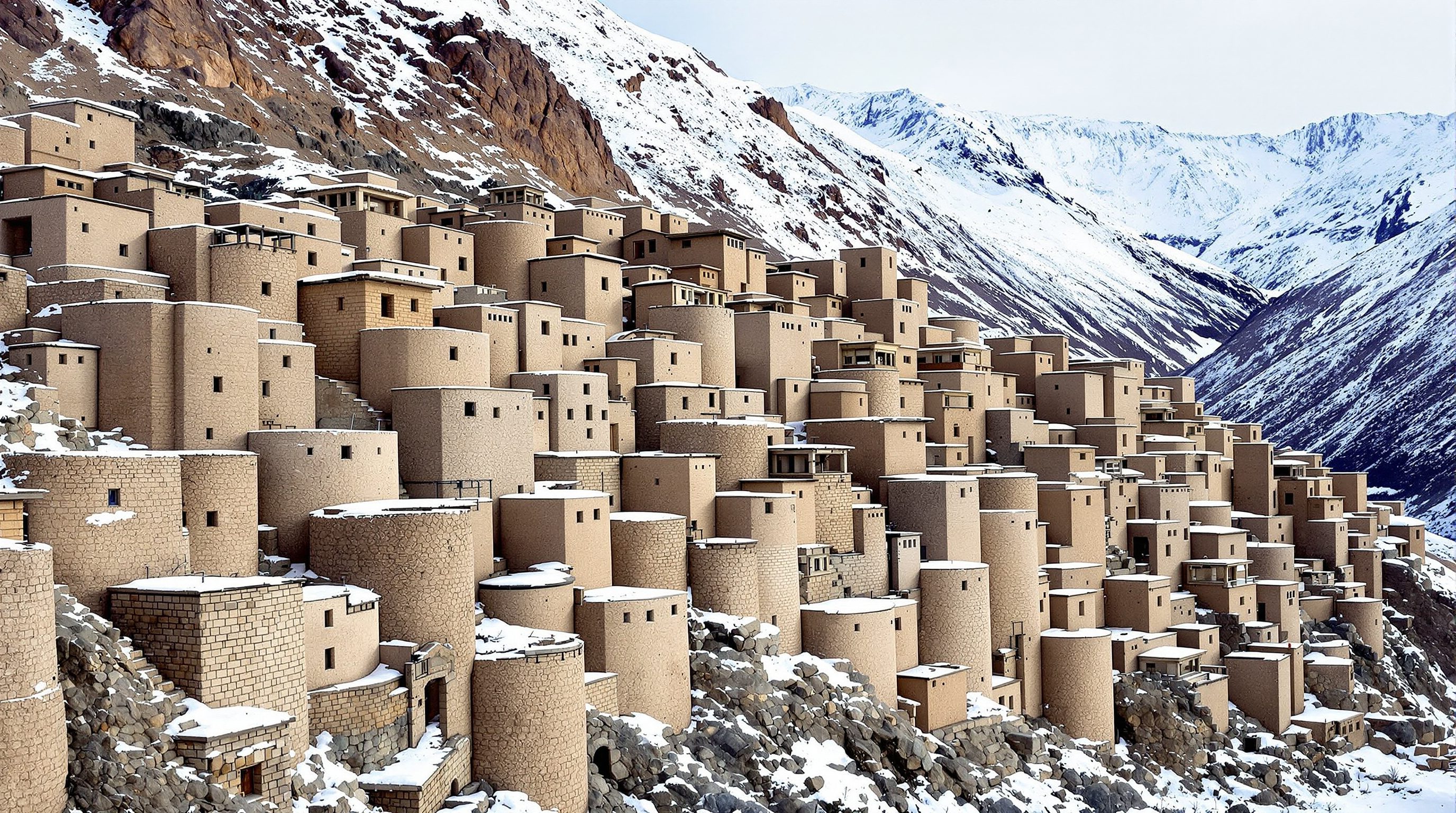
This is the exact opposite of the warm-humid house of Lesson 3.2, which spread itself thin to catch every breeze. In the cold, thinness is the enemy. The most compact form of all is a sphere, then a cube; the leakiest is a long thin block or one broken into articulated pieces. Ladakhi and Tibetan vernacular shows the lesson built in stone — squat, cuboidal, thick-walled houses clustered tightly, often sharing walls, turning the smallest possible surface to the cold sky.
Shared walls are free insulation. A house in a tight cluster, or a flat in the middle of a block, exposes far less surface than a detached house of the same floor area. Dense mountain villages are not only social arrangements; they are thermal ones. Your neighbour's wall is your blanket.
A cube shows less skin than a sprawl of the same volume. Cluster the houses and each one hides a wall behind its neighbour.
Lever two — insulation, slowing the escape per square metre
Compactness reduces *how much* skin loses heat; insulation reduces *how fast* each square metre of it lets heat through. Insulation works by trapping still air inside a low-conductivity material, so heat must crawl rather than rush through the wall, roof and floor.
The measure is the U-value — the rate of heat flow per square metre per degree of difference, in W/m2K. Lower is better. A bare uninsulated stone or concrete wall sits around 2 to 3 W/m2K; add a good insulating layer and it drops below 0.3 — a tenfold cut in the rate of loss. The roof deserves the most insulation of all, because heat rises and the roof faces the coldest part of the night sky. The glazing, captured so carefully in Lesson 5.1, is the weakest link in the shell, which is exactly why night insulation — shutters and heavy curtains drawn after dark — earns its keep there.
Compactness cuts the area; insulation cuts the rate per square metre. You need both, and the roof gets the thickest blanket.
Why the two levers compound
Fabric heat loss scales with the U-value times the area times the temperature difference. Because compactness shrinks the area and insulation shrinks the U-value, cutting either one helps — and cutting both at once multiplies, not merely adds.
The heat-loss explorer makes this visible. Choose a form and set an insulation level, and watch the night-time loss rate against the roughly 17 kWh of solar gain the south window banked through the day. A spread-out, thin-walled house drains that gain in an hour or two and is cold by evening. Pull the same volume into a compact shape and wrap it well, and the loss rate collapses — now the day's sun carries the house warm through the whole fourteen-hour night.
This is the partner half of Lesson 5.1. Capture and retention are designed together: a compact, well-insulated shell with one generous, protected south face. Capture without retention is a bucket with a hole in it.
Three altitudes on the same idea
Read the band that fits you — or all three.
Two moves keep you warm and cut your fuel bills. First, favour a compact, simple shape and share or cluster walls wherever you can — every extra wing and projection is one more cold surface bleeding heat. Second, insulate generously, especially the roof and the floor, and use night shutters or thick curtains over the glass once the sun is down. A compact, well-insulated house holds the day's sun-warmth deep into the night; a sprawling, thin-walled one is cold by dinner however much sun it caught. Resist the temptation to add bays and balconies on every face — in the cold, a plain box is the warm choice.
Minimise surface-to-volume — compact, low-articulation forms, shared party walls, clustered or stepped settlement following the vernacular model. Drive down U-values across the whole envelope, roof first (highest priority, largest temperature difference to the night sky), then walls and floor, comfortably below the ECBC cold-zone maxima. Eliminate thermal bridges and air leakage, which can dominate real heat loss even when the nominal U-values look good. Provide operable night insulation for all glazing. Then balance against Lesson 5.1: compactness must not sacrifice the south solar aperture — the target is a compact form carrying one generous, well-insulated south face. Capture and retention are specified as a single system, never separately.
Fabric heat loss is Q_loss = (sum of U*A) * dT. Take a small house with a 150 m2 envelope at a poor U = 2.0, inside 18 C and outside -15 C, so dT = 33: Q = 150 * 2.0 * 33 ~= 9900 W ~= 9.9 kW continuous. The 16.8 kWh south window from Lesson 5.1 drains in under 2 hours. Insulate to U = 0.3 and Q ~= 150 * 0.3 * 33 ~= 1485 W — a near-sevenfold cut. Now make it compact, 150 -> 110 m2 of envelope: Q ~= 110 * 0.3 * 33 ~= 1090 W. Together the loss falls from 9.9 kW to about 1.1 kW, and the day's gain now lasts roughly 15 hours — through the night. The compactness ratio is surface area / volume: for a fixed volume a cube has a lower ratio than any sprawl, which is why A (and so Q_loss) is smallest for the compact form. Because loss scales with U*A, cutting either factor helps and cutting both compounds.
“Thick heavy stone walls are good insulation — that's why mountain houses are built of stone.”
Run the method yourself
Run the heat-loss explorer and the maths once before the final cold lesson.
- 1Set a spread-out form with no insulation and read the loss rate — how fast would the day's ~17 kWh of solar gain drain away?
- 2Switch to a compact cube with full insulation. By what factor does the loss drop, and does the day's sun now last the night?
- 3Compute Q_loss = (sum of U*A)*dT for a 120 m2 envelope at U = 0.3, inside 18 C and outside -12 C, then compare it with the same house at U = 2.0.
- 4Explain in one line why a thick solid stone wall is not the same as an insulated wall — and what detailing fixes it.
↳ Use the worksheet below to record your answers.
Take it with you
Capture fills the tank; compactness and insulation keep it full
Direct gain warms the room while the sun shines, and mass and insulation help it linger — but a bare sunlit floor releases its heat unevenly, and a wall of glass becomes a liability the moment the sun sets. The final cold lesson refines capture-and-store into dedicated devices: the Trombe wall, a sun-facing mass wall behind glass that soaks heat all day and radiates it gently through the evening, and the sunspace or attached greenhouse that buffers the house and banks warmth — the most elegant passive solar-heating elements, closing the cold module.
The author
Amogh N P
Architect, interior designer, and creative polymath. Studio Matrx began in his notebooks — his vision of design made honest, useful, and open to everyone. Its Academy is written and taught in his memory, and free, forever.
More about Amogh →