
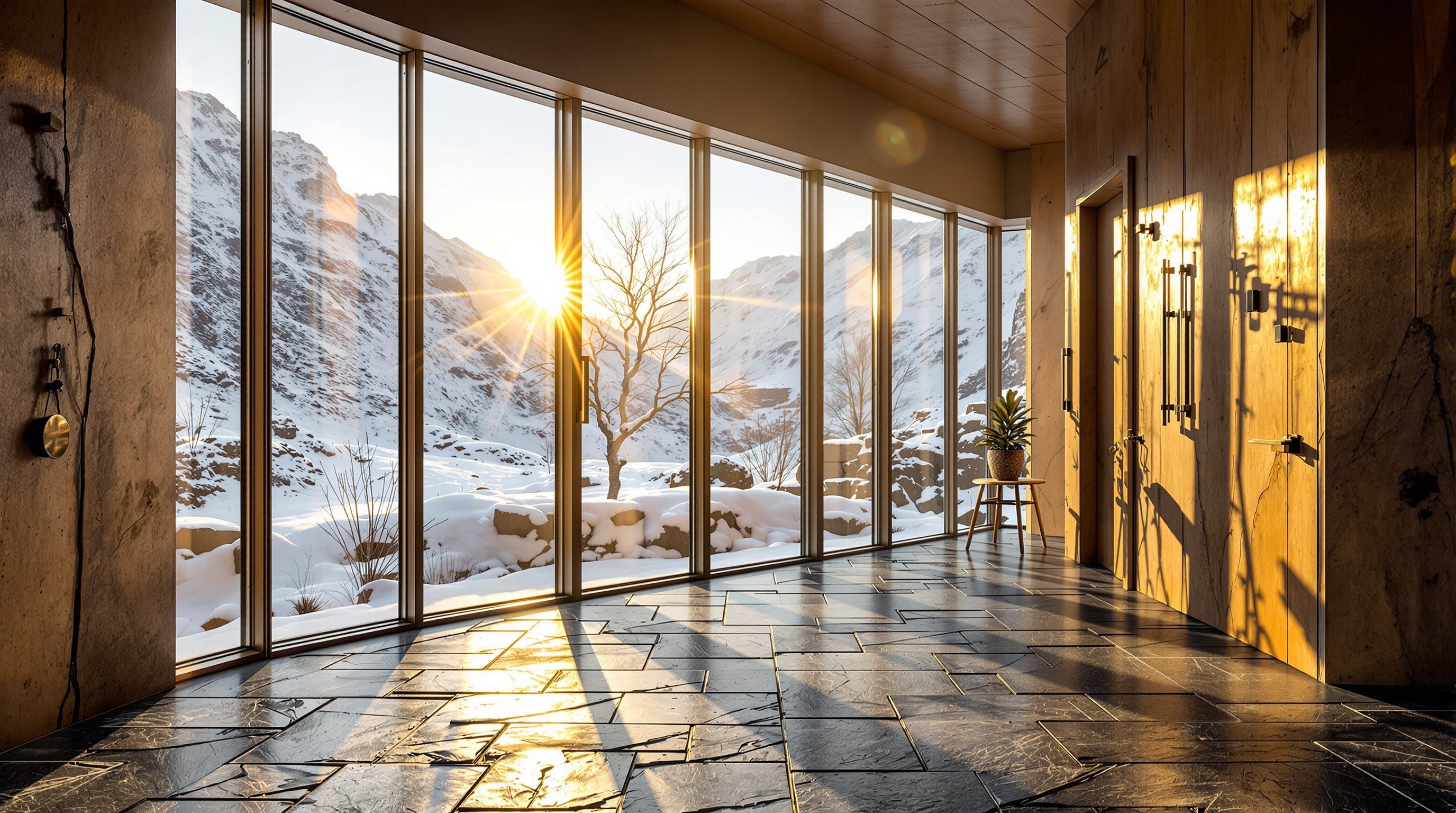
 Lesson 5.3
Lesson 5.3 · Cold Strategies
Trombe Walls and Sunspaces
A dark wall behind glass that banks the noon sun all day and pays it back as gentle warmth into the freezing evening.
Store the noon sun, release it at 8 pm — the wall that runs hours late on purpose
Direct solar gain (5.1) has a timing problem: the sun is strongest at midday, but a sunny Himalayan house is often already comfortable at midday and doesn't get truly cold until sunset and the long night. Direct gain delivers heat at the wrong time, and a glass wall that warmed you at noon is leaking by evening. What if you could *store* the noon sun and release it slowly, so warmth peaks in the cold evening? That's the Trombe wall: a thick, dark, sun-facing mass wall behind glass, soaking solar heat all day and, with a built-in time lag, radiating it into the room through the evening. The marriage of two ideas you already know — solar capture (5.1) and thermal time lag (2.1) — as a silent, fuel-free evening heater.
Bank the noon sun, spend it at 8 pm. Thickness sets the hour the warmth walks into the room.
A glazed, dark mass wall that banks the sun
From outside in: a pane of glass, a small air gap, then a thick, dark masonry or concrete wall forming part of the room's south face. Sun passes the glass and is absorbed by the dark surface; the glass then traps that heat against the wall — the greenhouse effect in miniature — charging the mass far hotter than the open air outside.
Heat conducts slowly into the wall, and by evening it reaches the inner face, which radiates gently into the room for hours after sunset. This is the same time-lag physics as the desert wall in Lesson 2.1, but harnessed to a new end: there the lag held heat OUT until the cool night; here it carries solar heat IN for the cold night. Same physics, opposite intent.
Many Trombe walls add top and bottom vents so the hot air in the gap can circulate into the room by day, while the stored heat in the mass handles the night. Layer by layer the job is plain: the glazing admits sun and traps it, the air gap heats and can feed the room by day, the dark mass absorbs and stores while releasing on a delay, and the inner face radiates the banked warmth through the evening.
A Trombe wall is the desert's time-lagging mass wall (2.1) turned to face the sun and wrapped in glass. The desert delayed heat to keep it out; the mountain delays it to bring it in.
The Trombe-wall day-night simulator — a reusable instrument
Picture one day playing across the lesson's simulator. A gold curve traces the solar input, peaking at noon. A blue curve traces the wall's inner face — the warmth actually delivered to the room — and it lags far behind, charging through the afternoon and peaking hours after the sun has gone.
Push the wall thickness up and watch the blue peak slide later and flatter, until the banked warmth arrives squarely in the cold evening rather than at midday when the room is already comfortable. This is the whole point made visible: the wall is a battery that schedules its discharge for the hour the house actually needs heat.
This is not a one-lesson toy. It is the same charge-and-release instrument from Lesson 2.1, run in reverse — there the lag was the problem the desert exploited to stay cool; here it is the gift the mountain exploits to stay warm.
The sunspace: a Trombe wall you can sit in
Scale the idea up and you get the sunspace — the attached greenhouse, solar verandah, glassed balcony, or the Ladakhi rabsal — a glazed south room that captures the sun in a much larger volume.
By day it heats dramatically, becoming a bright, warm, usable room and a buffer that shields the house from the cold; its warm air can circulate inward to the living spaces. By night, doors and insulation close it off so it does not drain the house back through its own glass. It gives three gifts at once: a delightful sunny winter room, a thermal buffer wrapping the cold side of the plan, and a solar collector feeding warmth in.
This makes the sunspace the most generous and liveable of all passive solar devices — and why the glazed south verandah is the signature of a well-designed Himalayan house. The catch is the one non-negotiable: it must be closeable at night, or the buffer becomes a giant cold radiator after dark.
Three gifts in one glazed room: a sunny winter living space, a buffer on the cold side, and a solar collector — provided you can shut it at dusk.
Three altitudes on the same idea
Read the band that fits you — or all three.
Two lovely additions to a sunny mountain house. A Trombe wall — a dark, thick south wall sitting behind glass — quietly soaks up the day's sun and keeps a room warm into the evening, with no fuel and no moving parts. A sunspace or glazed south verandah gives you a bright, warm room on winter days and stores warmth for the evening too; just make sure you can close it off at night with doors or insulation so it doesn't pull the heat back out. Both turn free winter sun into evening comfort — but they only pay off on a house that is already well-oriented and well-insulated.
Specify Trombe walls on south façades where evening heating is the priority: dark, high-absorptance mass — roughly 200–400 mm of concrete or masonry — behind glazing with a ventilated air gap, the thickness tuned to deliver a time lag (Lesson 2.1) that lands the heat in the evening, plus operable vents and night insulation on the glazing. For sunspaces, glaze generously to the south, thermally separate the space from the house with insulated doors and glazing so the buffer can close at night, and place mass within it to moderate swings and store heat. Crucially, both combine with the compact, insulated envelope of Lesson 5.2 — they are storage-and-release refinements on capture and retention, never substitutes for them.
The Trombe lag is just the Lesson 2.1 time lag: phi ~= (L / d) (P / 2pi), with d = sqrt(alpha P / pi) and period P = 86400 s. The goal is to choose the thickness L so that the noon heat reaches the inner face in the cold evening — about 6 to 8 hours later.
Dense concrete (alpha ~= 5e-7 m2/s) gives d ~= 0.117 m. So 300 mm of concrete gives L/d ~= 2.56, hence phi ~= 9.8 h — noon heat arriving around 10 pm. 200 mm gives phi ~= 6.5 h (early evening); 400 mm pushes the arrival past midnight.
Wall thickness is the tuning dial: you size the masonry to set what time the stored sun walks into the room. The same formula that kept the desert cool now schedules the mountain's evening warmth — phi is the only thing you are designing for, and L is the only knob you turn.
“A Trombe wall or sunspace is a heater you can bolt onto any house to make it warmer.”
Run the method yourself
Run the simulator and the lag maths once before the mastery check.
- 1Play the simulator and watch the Trombe warmth (blue) peak hours after the solar peak (gold). Why is that timing exactly what a Himalayan evening wants?
- 2Using phi = (L/d)(P/2pi) with d = 0.117 m for concrete, find the thickness that gives a roughly 7-hour lag (about 215 mm). When does that heat arrive in the room?
- 3Name one thing a Trombe wall does that a sunspace doesn't, and one thing a sunspace does that a Trombe wall doesn't.
- 4Explain why a sunspace must be closeable at night — and what goes wrong, hour by hour, if it isn't.
↳ Use the worksheet below to record your answers.
Take it with you
The most refined passive solar device
That completes Module 5 — and with it the cold zone, the last of India's five climates. You can now design for the high Himalaya as the full inversion of everything before: capture the low winter sun on a generous south face, store it in dark internal mass, hold it with a compact, deeply-insulated, night-shuttered envelope, and refine capture-and-store with Trombe walls and sunspaces that schedule warmth into the freezing evening. But across all five zones the same physical components kept returning — wall, roof, glazing — each behaving differently by climate yet governed by the same physics. Module 6 steps back from the zones to the envelope as a system: U-values and wall assemblies, the ECBC and Eco-Niwas Samhita codes that regulate them, glazing and window-to-wall ratios, and the roof — the single worst thermal offender on most Indian buildings.
The author
Amogh N P
Architect, interior designer, and creative polymath. Studio Matrx began in his notebooks — his vision of design made honest, useful, and open to everyone. Its Academy is written and taught in his memory, and free, forever.
More about Amogh →