
 Lesson 5.1
Lesson 5.1 · Cold Strategies
Capturing Solar Gain
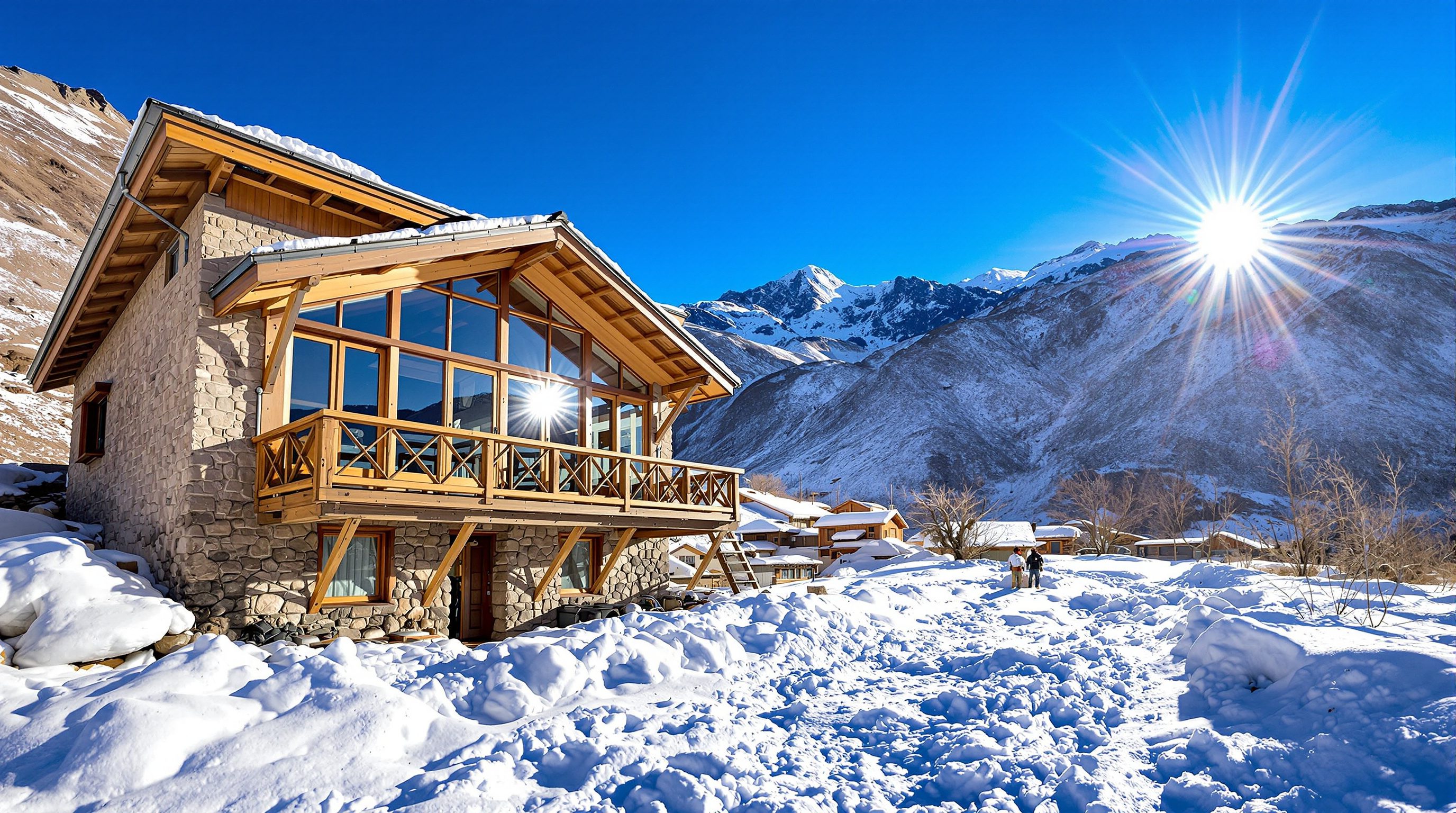
For four modules the sun was the enemy to shade; in the freezing Himalaya a south window becomes a free furnace.
The sun Chennai shades, Leh collects
In Leh in January the air is well below freezing, yet a south-facing room with a big glazed wall can be shirt-sleeve warm at midday — heated by nothing but sunlight through the glass. This is the great inversion. Everywhere else in this course, solar heat through glass was the danger we shaded against; here it is the prize. The Himalayan winter is brutally cold but astonishingly sunny — thin, clear, high-altitude air pours intense sunshine down even at -10 °C. So the cold-climate strategy begins with a single move: turn the building's biggest, best-glazed face to the south and let the low winter sun flood in.
The building leans toward the sun like a plant — big glass on the south, a blank insulated back to the cold north.
The cold-climate inversion
For four modules the sun was the enemy to be shaded; in Module 5 it becomes the friend to be captured. Where the desert flushed its mass with cool night air, the Himalayan night is the thief to be sealed against. Where the humid coast opened up to ventilate, the cold house closes up to hold its warmth in. Where the warm-humid plan spread out to chase the breeze, the cold house pulls compact to minimise heat loss. And where every hot zone put large openings on its hottest faces, the cold house concentrates its large glazing only on the sunny south.
The first and most powerful cold strategy is direct solar gain: sunlight enters through south glazing, strikes the floor and walls, and is absorbed and converted to heat directly in the living space. It is the simplest solar heating imaginable — no machinery, just glass facing the right way and a surface to soak up the sun. Done well, it carries a Himalayan house through a sunny winter day with little other heating — transformative where fuel is scarce, expensive and polluting. The traditional Ladakhi house already knows this: it opens to the south with timber-framed glazed balconies, the rabsal, and turns a blank insulated back to the cold north. The building leans toward the sun, like a plant.
Sun the enemy becomes sun the friend; night the cool ally becomes the thief. Read the sky, then invert everything.
The solar-gain capture simulator — a reusable instrument
Picture a Leh room in January. Set the glazing area and its orientation, and watch the low winter sun pour through the glass onto the floor inside. A readout tracks the free solar heat collected over the day — and the cost of facing the wrong way.
Swing the same window to the east and the daily total roughly halves: it catches only the weak morning sun and sits dark through the strongest hours. Swing it to the north and the gain collapses to almost nothing, while the glass keeps leaking heat all night — a pure liability. Drag the glazing area up and the daytime gain rises, but so does the night-time loss the next lesson will reckon with.
This is not a one-lesson toy. The same capture-and-orientation logic returns in 5.2 (holding the heat in) and 5.3 (Trombe walls and sunspaces), where the glass is paired with mass and a controlled buffer.
Glazing, absorber, and mass returns as ally
Direct gain has three working parts. The glazing faces true south and is ideally night-insulated (5.2). The absorber is a dark, exposed, sun-struck surface — a stone or concrete floor, a masonry wall — that converts incoming sunlight to heat. A sunbeam landing on a rug warms only the rug; landing on dark stone, it charges a thermal store.
And the third part is mass, which returns here as your ally. The same heavy material that was a humid-coast villain — radiating its stored heat into the bedroom all night — is here a hero, soaking up the day's solar gain and releasing it slowly through the long freezing night. The cold house wants heavy, sun-charged, internal mass: the exact opposite of the lightweight coastal envelope, and a return to the desert's love of mass — but now charged by the sun, for warmth instead of coolness.
For this to work, the sun must actually reach the mass. Cover the sun patch with a thick carpet or a sofa and you have insulated your battery from its own charger.
Glass to admit, dark mass to absorb, the night to release. The desert's wall, charged for the opposite season.
Three altitudes on the same idea
Read the band that fits you — or all three.
In cold sunny places — Leh, Spiti, Tawang, the higher hills — the biggest free win is to face your main living spaces and your largest windows due south, and keep the north side closed and well insulated. Let the winter sun fall on dark stone or tiled floors that store the warmth and give it back through the evening. At dusk, draw heavy curtains or insulated shutters over that glass so the day's heat does not simply leak straight back out. A glazed south sunroom or verandah, done right, becomes the warmest room in the house all winter — heated entirely for free.
Orient the long axis east–west so the major façade faces true south, then concentrate glazing there and keep north, east and west openings minimal to cut losses. Size the south glazing to the gain-to-loss balance — over-glazing overheats on sunny days and haemorrhages heat at night. Provide substantial dark, directly sun-struck internal mass (floor slabs, masonry) to absorb and time-shift the gain, and protect the sun patch so no rug or furniture blocks it. Specify night insulation for the glazing — shutters or heavy curtains — because the glass is the weakest link after dark. Integrate all of this with the compact insulated envelope of Lesson 5.2.
Daily solar gain through glazing is Q_solar = A_glazing * SHGC * I_day. Take SHGC ~= 0.7 for clear single glazing. A clear winter day in Leh delivers about I_day ~= 4 kWh/m2 on a south-facing vertical pane — the low sun strikes the vertical glass nearly square-on, which is exactly why vertical south glazing excels in winter while a horizontal skylight would not. For A = 6 m2 and SHGC = 0.7: Q = 6 * 0.7 * 4 = 16.8 kWh of free heat in one day — like running a 2 kW heater for over 8 hours, at no cost. Face that same glass east and it catches only the weak morning sun, so the daily total roughly halves. Face it north and it collects almost nothing while losing heat all night — a pure liability. Orientation is the whole game, and orientation is free. (Note: more glazing is not simply better — the night-time loss it adds is the subject of 5.2.)
“More south glass is always better in a cold climate — maximise the glazing to maximise the free heat.”
Run the method yourself
Run the simulator and the maths before the next lesson, and watch what orientation alone is worth.
- 1Set generous south glazing and read the daily gain. Now switch it to east, then north — how much free heat do you forfeit by facing the wrong way?
- 2Compute the daily gain for 6 m2 of south glazing using Q = A * SHGC * Iday with SHGC = 0.7 and Iday = 4 kWh/m2. How many hours of a 2 kW heater does that equal?
- 3Explain why a dark stone floor in the sun patch matters more than a thick carpet laid over the same spot.
- 4Ask what happens to the captured heat at 10 p.m. at -15 °C with no night insulation on the glass — and what single, cheap measure fixes it.
↳ Use the worksheet below to record your answers.
Take it with you
The sun is the prize
Capturing the sun fills the house with heat by day — but a Himalayan night is fourteen hours of brutal cold, and a leaky building loses everything by dusk. Capture is worthless without retention. Next: holding the heat in — the two great levers of heat loss, a compact form that minimises exposed surface and insulation that slows every watt's escape. Together they decide whether the day's free solar gain carries you warm through the night, or drains away before dawn.
The author
Amogh N P
Architect, interior designer, and creative polymath. Studio Matrx began in his notebooks — his vision of design made honest, useful, and open to everyone. Its Academy is written and taught in his memory, and free, forever.
More about Amogh →