
 Lesson 4.4
Lesson 4.4 · Composite and Temperate Strategies
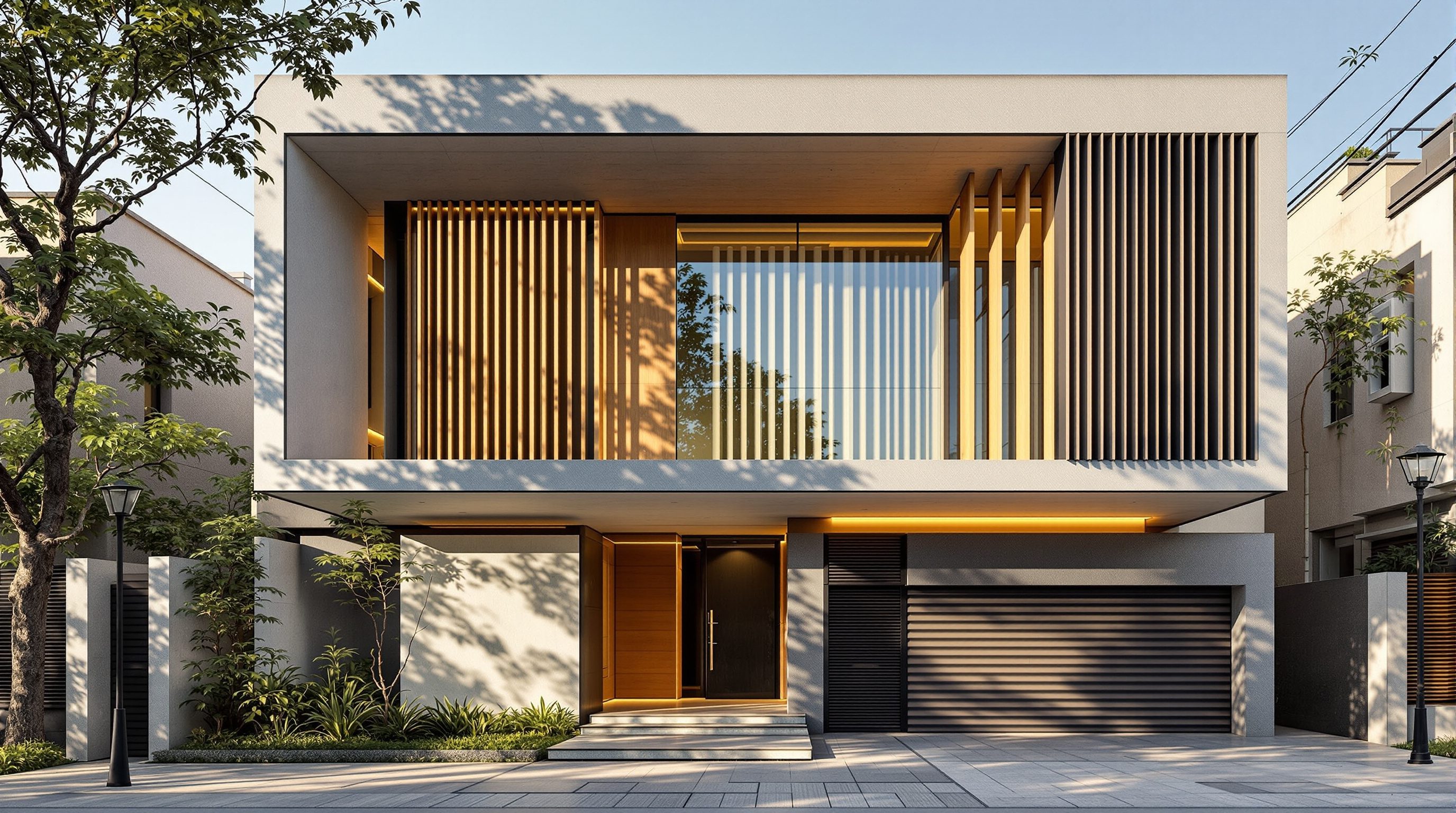
Shaded Glazing for Composite Facades
One window must reject the high summer sun, welcome the low winter sun, and breathe in the monsoon.
Glass is wonderful and dangerous
Glass gives you light, view and winter warmth — and it is also the easiest way to wreck comfort, because unshaded glass pours solar heat into a room you often can't cool back out. The glass curtain-wall office, copied from cold Northern cities into hot Indian ones, is the cautionary tale: a sealed glass box in Delhi or Chennai is a solar oven running its AC flat out all year. The answer isn't to abolish the window — it's to make it as selective as everything else in this module: reject the steep summer sun, admit the low winter sun, daylight without glare, open for the monsoon. The humble overhang, sized by Lesson 1.1's sun angles, does most of this for free.
The curtain wall forgot what the chajja always knew: the summer sun is high and the winter sun is low.
Shading, SHGC, WWR — and shading comes first
A composite window is governed by three properties, and they layer as defences in a strict order.
Shading (the overhang) decides which sun reaches the glass, by season — the aim is to block summer and admit winter. SHGC decides how much of the sun that does land on the glass passes through as heat — low on hot facades, higher where you actually want winter gain. WWR, the window-to-wall ratio, decides how much of the facade is glass at all — modest, enough for light and air, not a heat hole.
The crucial insight is that shading comes first. A deep overhang keeping summer sun off the glass beats any low-SHGC coating on glass baking in full sun, because the cheapest solar heat is the heat that never arrives. Geometry before glazing, always. Then the coating handles the diffuse and reflected radiation the overhang can't block, and a modest WWR keeps the opening from overwhelming the room. The traditional chajja — that projecting ledge over every opening — is exactly this device: a sun-angle filter sized by builders who knew the summer sun was high and the winter sun low. The curtain wall forgot what the chajja knew.
Geometry before glazing, always. The cheapest solar heat is the heat that never arrives.
Orientation changes everything
The horizontal overhang works beautifully on south (and reasonably on north): there the sun's seasonal change is mostly in height — high in summer, low in winter — which a horizontal ledge sorts neatly by angle.
On east and especially west, the summer sun is low, rising and setting, striking the glass almost horizontally. A horizontal overhang is nearly useless against it. West glass catches the brutal late-afternoon summer sun at the hottest moment of the day, and no eave will stop it.
Composite wisdom is blunt: put glass on south and north, keep it small on east, and minimise it ruthlessly on west — or defend unavoidable west glass with vertical fins, deep recesses, screens or planting, not a horizontal overhang. Orientation is a free variable. Spend it before you spend money on fancy glass.
Sizing the overhang — the chajja maths finally done
This is where the chajja sizing promised back in Lesson 1.1 is finally carried out. The geometry is simple: to fully shade a window of height H at the summer noon altitude, the horizontal overhang projection is the window height divided by the tangent of that sun angle.
Because the summer noon sun over most of India is very high, the required eave is surprisingly small. A Delhi window with the summer sun nearly overhead needs only a token projection to be fully shaded. The same small overhang then leaves the low winter sun almost entirely unobstructed, so winter warmth pours in — exactly the seasonal split you want.
The one trap is that the right depth depends on your local summer noon angle. The sun sits highest, and the eave is therefore smallest, near the summer sun's roughly 23 degrees-north declination; cities further north or further south see a slightly lower summer sun and need a slightly deeper overhang. Always size to your own latitude's angles from Lesson 1.1, and then verify the winter sun still slips underneath.
Three altitudes on the same idea
Read the band that fits you — or all three.
Two rules save most glass trouble. First, put a good deep overhang or chajja over every sunny window — it keeps the harsh summer sun out while still letting the gentler winter sun in. Second, be careful with west-facing glass: it catches the worst evening heat and an overhang will not stop it, so keep west windows small or shade them with screens, shutters, fins or trees. A big unshaded west window means a hot, glary room and huge electricity bills.
Design orientation-by-orientation. On south and north, size horizontal overhangs from the summer and winter noon altitudes (Lesson 1.1) to exclude summer and admit winter — the easy, high-value case. On east and west, minimise WWR and use vertical fins, deep reveals, operable screens or louvres and external shading, because the low sun defeats horizontal devices. Specify SHGC by orientation and shading; keep WWR modest for ECBC and for comfort. Keep shaded openings operable so they still serve monsoon cross-ventilation (Lesson 3.1). The hierarchy is fixed: orientation, then shading geometry, then glass, then size.
For a south overhang to fully shade a window of height H at the summer noon altitude betasummer, the projection is `P = H / tan(betasummer). For Delhi (beta_summer is about 84.8 degrees) and a 1.5 m window: P = 1.5 / tan(84.8) = 1.5 / 11.0 = 0.14 m — a tiny ledge, because the sun is nearly overhead. Now verify winter: the shadow cast at the winter noon altitude beta_winter is d = P * tan(betawinter) = 0.14 * tan(38) = 0.11 m`, shading only about 7 percent of the window, so the low winter sun pours in. The required depth follows the local_ summer noon angle — highest (eave smallest) near the sun's roughly 23 degrees-north declination: Delhi's 85-degree sun needs about 0.14 m, while both higher-latitude Srinagar and lower-latitude Chennai sit near 79 degrees and need a deeper roughly 0.27 m eave. Always size to local angles (Lesson 1.1).
“Low-E high-performance glass means you can have big glazed facades anywhere — the coating handles the heat.”
Run the method yourself
Test the geometry on your own city before moving on — the overhang either works or it doesn't, and the maths tells you which.
- 1Find the smallest overhang that fully shades the summer sun, then confirm the winter sun still reaches in. How small does it get for a high summer sun?
- 2Compute the overhang for your city with
P = H / tan(beta_summer), using your summer noon angle from Lesson 1.1 and a 1.5 m window. Compare it to Delhi's 0.14 m. - 3Imagine the same window facing west. Explain why the overhang stops working — and what you would use instead.
- 4Rank the four levers — orientation, shading, glass SHGC, size — in the order you would apply them, and justify the order.
↳ Use the worksheet below to record your answers.
Take it with you
The selective window, in strict hierarchy
P = H / tan(beta_summer)) blocks the high summer sun yet admits the low winter sun on south and north facades, but is useless against the low east/west sun, which needs vertical fins. Orientation, then shading geometry, then glass, then size — and no low-E coating rescues a wrong facade.For four modules the problem has been heat — keeping it out, moving it, storing it, shedding it. Now we climb into the Himalaya — Leh, Spiti, Tawang — where the logic inverts completely: the sun becomes a friend to capture, the night a thief to guard against, and the craft turns to _holding warmth in_. Module 5 opens cold-climate design — capturing solar gain, compactness and insulation, and the Trombe walls and sunspaces that let a building heat itself through a freezing mountain winter.
The author
Amogh N P
Architect, interior designer, and creative polymath. Studio Matrx began in his notebooks — his vision of design made honest, useful, and open to everyone. Its Academy is written and taught in his memory, and free, forever.
More about Amogh →