
HVAC & Ventilation
Cooling a sealed tower — and breathing life into its basements.
A modern glass tower is a sealed box that would cook in the sun without mechanical cooling, and suffocate in its basement without mechanical ventilation. Learn the central air-conditioning plant and the refrigeration cycle behind it — including the ton of refrigeration that is a rate of cooling, not a weight — then the air changes per hour that keep a car park, a kitchen and a toilet fit to breathe.
Learning objectives
By the end of this lesson, you will be able to — mapped to the course outcomes for Building Services for Special Buildings:
Describe the central air-conditioning plant and the refrigeration cycle.
Define the ton of refrigeration and compare chiller types.
Apply VRV/VRF and packaged systems to building zones.
Apply mechanical ventilation and air changes per hour.
The central plant
Chillers make chilled water by the refrigeration cycle; cooling is sized in the ton of refrigeration — a RATE (1 TR = 3.517 kW), not a weight.[6]
Chillers, AHUs, ducts
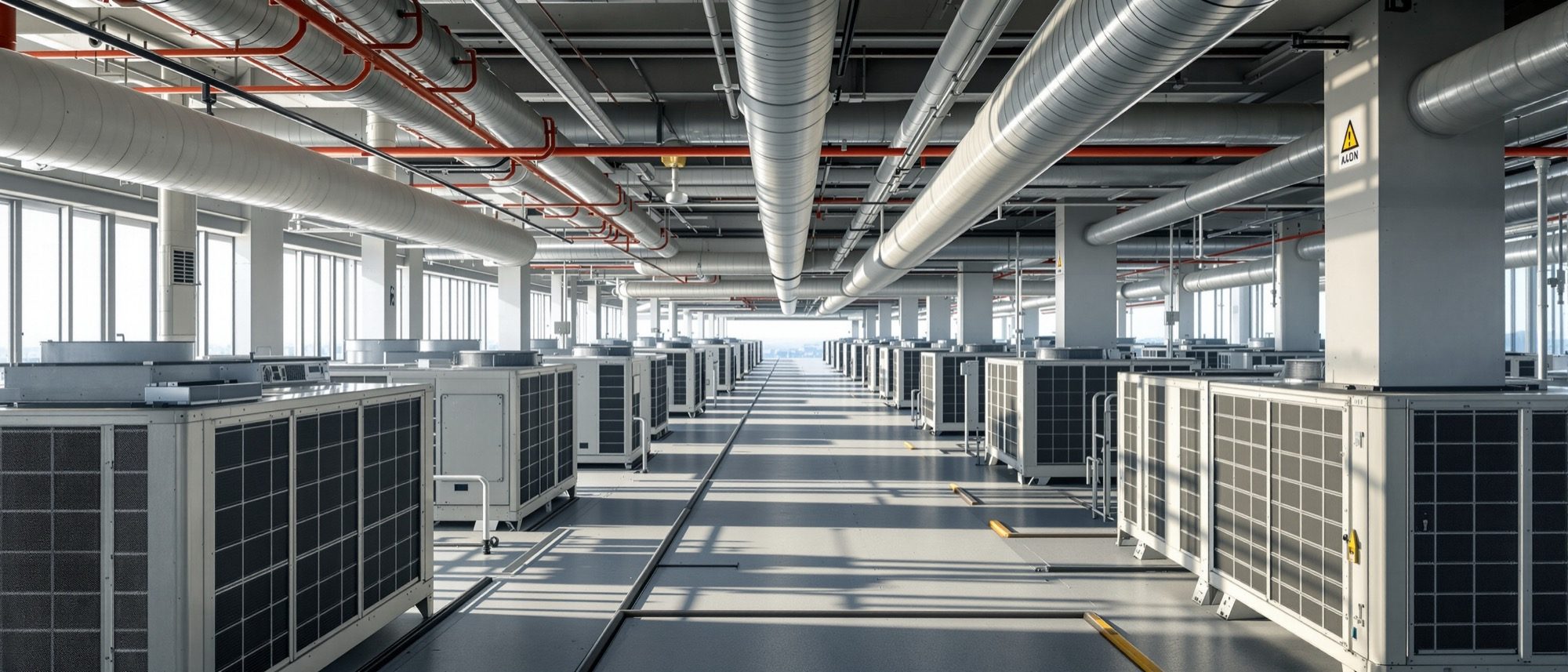
A large building is cooled by a CENTRAL PLANT. CHILLERS make chilled water by the refrigeration cycle (evaporator → compressor → condenser → expansion valve); AIR-HANDLING UNITS (AHUs) pass building air over chilled-water coils and push it through DUCTS to diffusers. AIR-COOLED chillers reject heat to the air (simple, no water); WATER-COOLED chillers with COOLING TOWERS are 30–40% more efficient for large loads. VRV/VRF systems serve mid-size zones with refrigerant directly; packaged and split units serve small ones.[6]
Ventilation & integration
Windowless spaces need mechanical ventilation (air changes per hour — basement ~6 normal, ~12 fire); and HVAC shapes the building, so design with it.[6, 4]
Air changes per hour
Where there is no window — a basement car park, an internal kitchen, a toilet — air must be moved MECHANICALLY, measured in AIR CHANGES PER HOUR (ACH), the number of times the room's whole air volume is replaced each hour. NBC 2016 requires a basement car park to have about 6 ACH in normal use, rising to 12 ACH in smoke/fire mode to clear smoke. Kitchens and toilets need high exhaust. Fresh-air supply (per ASHRAE 62.1) keeps the occupied air healthy.[6, 4]
At a glance
| Aspect | One | The other |
|---|---|---|
| Chiller type | Air-cooled: simple, no water | Water-cooled + tower: 30–40% efficient |
| The cooling unit | Myth: TR = a weight of metal | Reality: a RATE — 1 TR = 3.517 kW |
| System scale | Central chillers + AHUs: whole building | VRV/VRF, split: zones / small spaces |
| Ventilation measure | ACH: air volume replaced per hour | Basement: ~6 normal, ~12 fire (NBC) |
| Relation to design | Plant room, shafts, floor height | HVAC shapes the building, not vice versa |
Key terms
The plant that makes chilled water by the refrigeration cycle — air- or water-cooled.
Passes building air over chilled-water coils and pushes it through ducts.
Rejects a water-cooled chiller's heat to the air — 30–40% more efficient for large loads.
A RATE of cooling — 1 TR = 12,000 BTU/hr = 3.517 kW (heat to melt 1 ton of ice in 24 h).
Variable refrigerant flow — refrigerant-based system serving multiple mid-size indoor zones.
How many times a room's whole air volume is replaced each hour.
~6 ACH normal, ~12 ACH in fire/smoke mode for a car park (NBC 2016).
Outdoor air (per ASHRAE 62.1) brought in to keep the occupied air healthy.
Studio task
For an office floor, estimate the cooling load in tons of refrigeration (rule of thumb ~1 TR per ~10 m²) and sketch where the AHU room, the chilled-water risers and the duct routes would go — then show how the basement is ventilated.
Self-assessment
1. One ton of refrigeration (1 TR) is —
2. Compared with an air-cooled chiller, a water-cooled chiller with a cooling tower is —
3. NBC 2016 requires a basement car park to be ventilated at about — in normal use.
Recap
References & further reading
- [4]National Building Code of India 2016, Part 8 Section 3 — Air Conditioning, Heating and Mechanical Ventilation. BIS.
- [6]ASHRAE Handbook — HVAC Systems and Equipment; and the ton-of-refrigeration definition. https://en.wikipedia.org/wiki/Ton_of_refrigeration
Further reading
- ASHRAE Handbook — HVAC Systems and Equipment. ASHRAE.
- C. P. Arora, Refrigeration and Air Conditioning. McGraw-Hill.
- NBC 2016 Part 8 Section 3 — HVAC. BIS.
Sources gathered and fact-checked June 2026. Published values vary by source, sample and method — treat as indicative and confirm against the cited standard before structural use.
The author
Amogh N P
Architect, interior designer, and creative polymath. Studio Matrx began in his notebooks — his vision of design made honest, useful, and open to everyone. Its Academy is written and taught in his memory, and free, forever.
More about Amogh →