
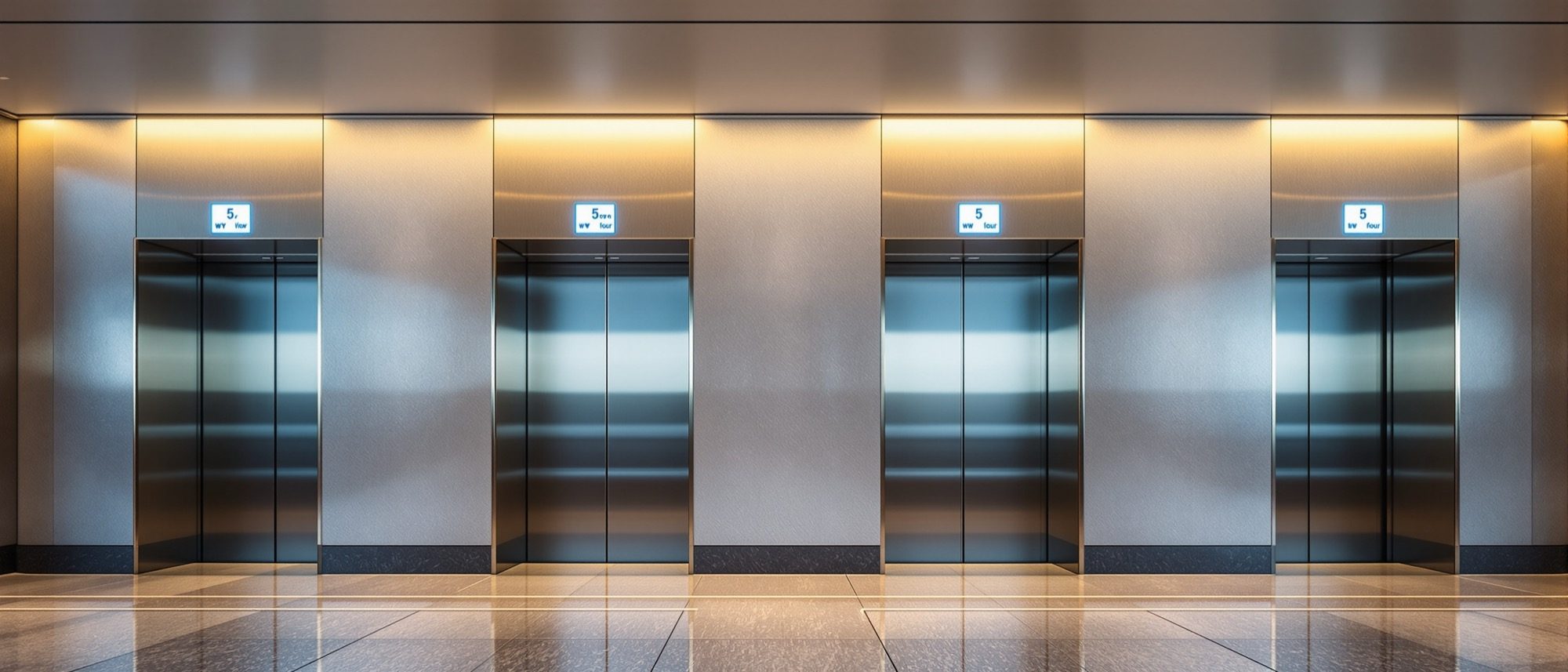
Electrical & Vertical Transport
Powering the tower — and moving thousands of people up it.
A tall building is a vertical city, and its two great circulatory systems are electricity and the lift. Learn the electrical supply chain — from high-tension intake to every floor — and then the defining service of the special building: vertical transportation. Lift types, speeds and capacities, the traffic analysis that decides how many lifts a tower needs, and the zoning of lift banks and sky lobbies.
Learning objectives
By the end of this lesson, you will be able to — mapped to the course outcomes for Building Services for Special Buildings:
Describe the electrical supply chain — HT/LT, substation, DG, distribution.
Compare lift types, speeds and capacities.
Apply traffic analysis and the zoning of lift banks.
Locate the substation, DG, lift cores and lobbies in the plan.
Electrical & the lift
Power flows HT → substation → LT panel → risers → floor boards (with a standby DG); and the lift — traction for high-rise — is what makes the tall building possible.[2, 3]
HT to the socket
A large building takes a HIGH-TENSION (HT, 11/33 kV) supply into an indoor SUBSTATION, where a TRANSFORMER steps it down to low-tension 415 V three-phase. From the main LT panel, BUS RISERS carry power up the building to floor distribution boards and final circuits. STANDBY DIESEL GENERATORS (DG) carry the essential load — lifts, pumps, fire systems, life-safety — when the mains fail, and a UPS protects critical IT loads. EARTHING and LIGHTNING PROTECTION are mandatory for a tall building.[2]
Vertical transportation
Traffic analysis (handling capacity, waiting time) decides the lift count; supertalls zone the lifts into banks with sky lobbies to save the core.[3]
How many lifts?
How many lifts a tower needs is decided by TRAFFIC ANALYSIS. The HANDLING CAPACITY is the percentage of the building's population a lift system can move in the 5 peak minutes — about 12–15% for a good office, 5–7% for residential. The INTERVAL or average WAITING TIME is the other measure — ~25–30 s for a prestige office, longer for a flat. Too few lifts and the lobby jams at 9 a.m.; too many and you waste valuable core area.[3]
At a glance
| Aspect | One | The other |
|---|---|---|
| Supply | HT intake → substation → transformer | → LT panel → risers → floor DBs |
| When mains fail | Standby DG: essential load | UPS: critical IT load |
| Lift type | Traction (rope): high-rise | Hydraulic: low-rise (≤ ~6 stops) |
| Traffic measures | Handling capacity: % in 5 min | Interval: average waiting time |
| Serving a supertall | Zone into low/mid/high banks | Sky lobbies + double-deck cars |
Key terms
High-tension (11/33 kV) intake stepped down by a transformer to low-tension 415 V.
The indoor room and transformer that bring utility power into the building.
Diesel generator carrying the essential load (lifts, pumps, fire) when the mains fail.
A rope-and-counterweight lift — the type used for high-rise (geared or gearless).
The % of a building's population a lift system moves in the 5 peak minutes (~12–15% office).
The average wait for a lift — ~25–30 s for a prestige office.
Grouping lifts into low/mid/high banks, with transfer floors in supertalls, to save core area.
A moving stair at a 30° incline (max 35°) for high continuous flow over short rises.
Studio task
For a 40-storey office tower, sketch a vertical-transport strategy — how many lift banks, which floors each serves, and whether you need a sky lobby — and mark the substation, DG room and lift cores in a typical-floor plan.
Self-assessment
1. When the mains fail, the essential load of a high-rise (lifts, pumps, fire systems) is carried by —
2. A lift system's 'handling capacity' is —
3. A supertall tower zones its lifts into low/mid/high banks (and adds sky lobbies) mainly to —
Recap
References & further reading
- [2]National Building Code of India 2016, Part 8 Section 2 — Electrical and Allied Installations. BIS.
- [3]IS 14665 — Electric Traction Lifts; and NBC 2016 Part 8 Section 5 — Installation of Lifts and Escalators. BIS. https://law.resource.org/pub/in/bis/S05/is.14665.1.2000.pdf
Further reading
- IS 14665 — Electric Traction Lifts. BIS.
- Gina Barney, Elevator Traffic Handbook. Routledge.
- NBC 2016 Part 8 — Building Services. BIS.
Sources gathered and fact-checked June 2026. Published values vary by source, sample and method — treat as indicative and confirm against the cited standard before structural use.
The author
Amogh N P
Architect, interior designer, and creative polymath. Studio Matrx began in his notebooks — his vision of design made honest, useful, and open to everyone. Its Academy is written and taught in his memory, and free, forever.
More about Amogh →