
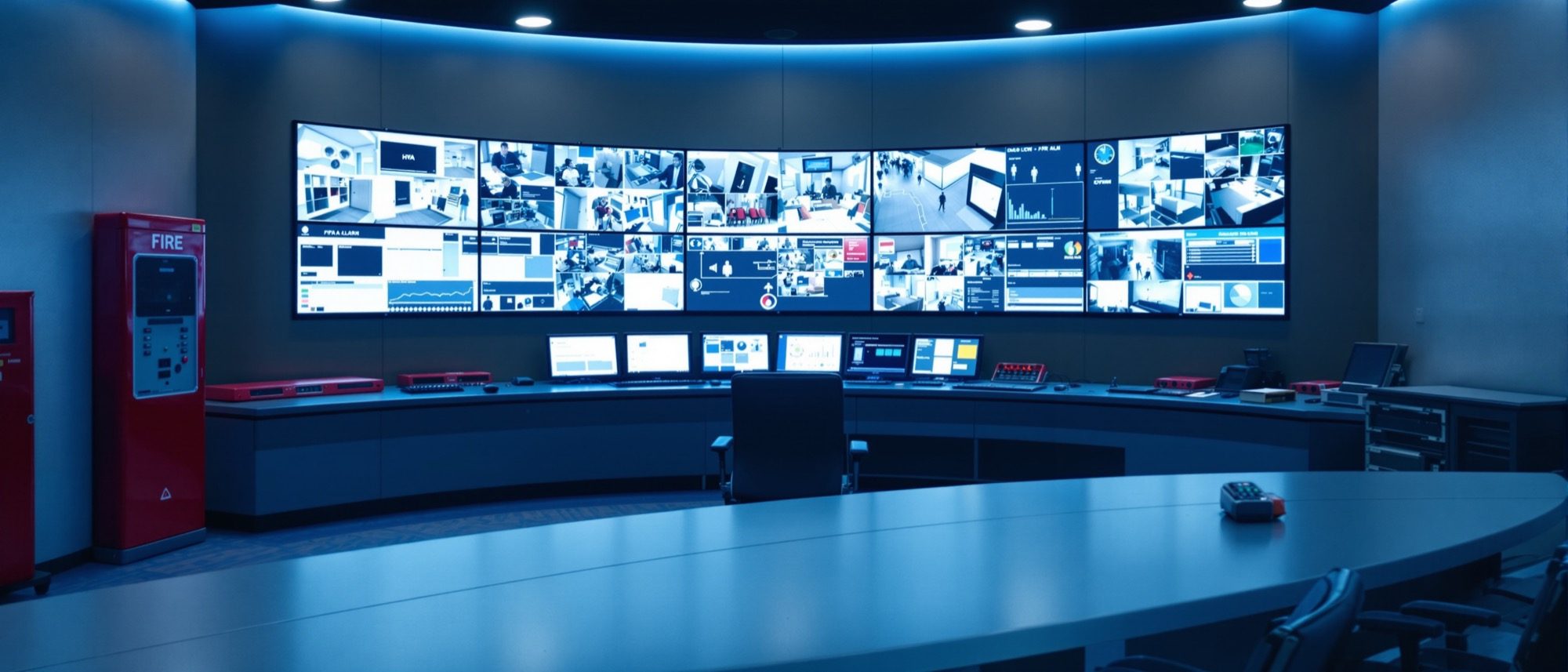
Fire Safety & Smart Buildings
Keeping everyone safe when it burns — and the brain that runs it all.
Of all a tall building's systems, fire safety is the one that must never fail — for a high-rise cannot be evacuated quickly, so it must be designed to protect people in place. Learn the firefighting systems of the NBC — the wet and dry risers and the down-comer (three different things), sprinklers, the refuge area and the pressurised stair — then the intelligent building management system that ties it all into one brain. Try the fire-system explorer below.
Learning objectives
By the end of this lesson, you will be able to — mapped to the course outcomes for Building Services for Special Buildings:
Distinguish the wet riser, dry riser and down-comer.
Apply sprinklers, hydrants, refuge areas and pressurisation (NBC).
Explain detection, alarm and the fire pumps and tank.
Integrate the systems through an intelligent building management system.
Firefighting systems
Know the three risers (wet, dry, down-comer), the individually-firing sprinkler, the mandated refuge area and the pressurised stair. Pick one in the explorer.[7]
Fire-safety systems · pick one
Wet riser
A vertical fire main kept PERMANENTLY charged with pressurised water by the building's own pumps, with a landing valve on each floor.
NBC trigger: Mandatory for every building over 15 m.
A high-rise (≥ 15 m) cannot be evacuated fast — so it is designed to protect people in place.
Wet, dry, down-comer
FLAG THE MYTH that conflates them — these are THREE different systems. A WET RISER is a fire main kept PERMANENTLY CHARGED with pressurised water by the building's own pumps (for buildings over 15 m). A DRY RISER is normally EMPTY, charged by the fire brigade pumping in at a ground inlet (for lower-rise). A DOWN-COMER is fed by GRAVITY from the roof tank down the building, boosted at the landing valves. Know which is which — it is a classic exam trap.[7]
The intelligent building
An intelligent building management system ties HVAC, fire, lighting, lifts, security and energy into one head-end — and acts as one on a fire alarm.[7, 6]
Sense, alarm, protect in place
A high-rise cannot be emptied quickly, so it is designed to PROTECT PEOPLE IN PLACE — which makes early DETECTION vital. Smoke and heat DETECTORS, manual call points and a PA/voice-evacuation system feed an integrated fire panel. Compartmentation (fire-rated walls), the pressurised stair, the refuge area and the FIREMAN'S LIFT together buy the time to evacuate or shelter. The high-rise threshold is 15 m; the major life-safety provisions step up above 24 m.[7]
At a glance
| Aspect | One | The other |
|---|---|---|
| Wet vs dry riser | Wet: always charged (own pumps) | Dry: empty, charged by the brigade |
| Down-comer | Gravity-fed from the roof tank | (distinct from both risers) |
| Sprinkler myth | Films: all heads fire at once | Reality: only heads over the fire open |
| Refuge area | Myth: a luxury balcony | Reality: mandated above 24 m, 0.3 m²/person |
| Smart building | Systems run separately by hand | IBMS: one brain, fire-safe interlocks |
Key terms
A fire main kept permanently charged with pressurised water by the building's pumps (over 15 m).
A normally-empty fire pipe charged by the fire brigade at a ground inlet (lower-rise).
A fire main fed by gravity from the roof tank, boosted at the landing valves.
A heat-triggered head — only the heads over the fire open, never all at once.
A code-mandated safe-wait area above 24 m (every 15 m; 0.3 m²/person) — not a luxury.
Fans holding the escape stair (~50 Pa) and lobby (~25–30 Pa) positive so smoke cannot enter.
A building 15 m or taller; major life-safety provisions step up above 24 m.
An intelligent building management system tying HVAC, fire, security and energy into one head-end.
Studio task
For a 25-storey tower, list the fire-safety systems the NBC requires (use the explorer above) — the riser type, sprinklers, hydrants, refuge areas (where?) and stair pressurisation — and describe one thing the IBMS should do automatically the moment the alarm sounds.
Self-assessment
1. A wet riser differs from a dry riser in that a wet riser is —
2. In a fire, automatic sprinkler heads —
3. A refuge area in a high-rise is —
Recap
References & further reading
- [6]ASHRAE Handbook; and BMS/IBMS practice (BACnet, Modbus controls).
- [7]National Building Code of India 2016, Part 4 — Fire and Life Safety (risers, sprinklers, refuge, pressurisation). BIS.
Further reading
- NBC 2016 Part 4 — Fire and Life Safety. BIS.
- V. K. Jain, Fire Safety in Buildings. New Age International.
- Reinhold A. Carlson / Don Di Pietro, Understanding Building Automation Systems.
Sources gathered and fact-checked June 2026. Published values vary by source, sample and method — treat as indicative and confirm against the cited standard before structural use.
The author
Amogh N P
Architect, interior designer, and creative polymath. Studio Matrx began in his notebooks — his vision of design made honest, useful, and open to everyone. Its Academy is written and taught in his memory, and free, forever.
More about Amogh →