
Sewage Treatment & Refuse Disposal
Carrying it away, and cleaning it up — the other half of water.
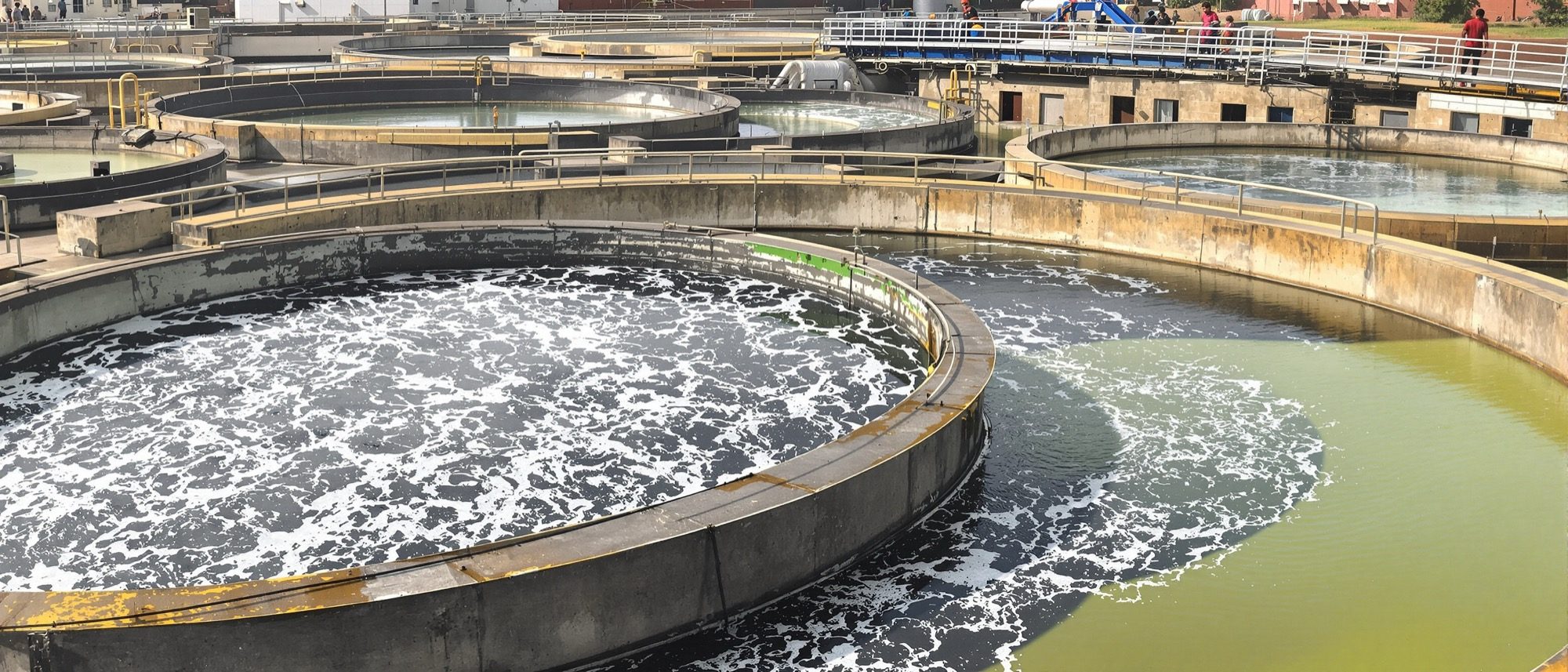
What comes in must go out. Sewage is treated in stages — primary treatment physically settles the solids, secondary treatment uses micro-organisms to consume the dissolved organics — measured by the BOD it removes. And the city's solid refuse must be collected, conveyed and disposed. Learn the two-stage treatment, suspended versus attached growth, and the refuse routes.
Learning objectives
By the end of this lesson, you will be able to — mapped to the course outcomes for Design of Structures I:
Distinguish primary (physical) from secondary (biological) sewage treatment.
Compare the activated sludge process with the trickling filter (suspended vs attached growth).
Explain BOD as the measure of organic load and the role of aeration.
Describe the collection, conveyance and disposal of town refuse.
Cleaning the sewage
Primary treatment is physical (settles solids); secondary is biological (microbes eat the dissolved organics). The activated sludge process is suspended growth (~90–95% BOD); the trickling filter is attached growth (~75–90%).[1, 2]
Physical — settle it
Primary treatment is physical: screening removes rags, a grit chamber drops sand, and primary sedimentation settles the suspended solids (~60% of SS, ~35% of BOD). It does NOT remove dissolved or colloidal organic matter — that needs the next stage.[1]
Disposing of refuse
Town refuse is segregated at source, collected and conveyed, then disposed by sanitary landfill (engineered burial), composting (organics → soil) or incineration (controlled burning).[6]
Collect, convey, dispose
Town refuse must be collected (segregated at source into wet, dry, sanitary and hazardous), conveyed (bins → transfer station → trucks), and disposed of by a chosen method. Segregation at source is required by the Solid Waste Management Rules.[6]
At a glance
| Aspect | One | The other |
|---|---|---|
| Two stages | Primary: physical, settleable solids | Secondary: biological, dissolved organics |
| Two biological processes | Activated sludge: suspended growth, ~90–95% BOD | Trickling filter: attached growth, ~75–90% BOD |
| Growth type | Suspended: biomass floats in the tank | Attached: biofilm grows on media |
| Two disposal routes | Landfill: engineered burial of residue | Composting: organics → soil conditioner |
| Composting method | Indore: aerobic, ~8–12 weeks | Bangalore: anaerobic, ~4–5 months |
Key terms
Physical removal of settleable suspended solids (screening, grit, sedimentation).
Biological removal of dissolved and colloidal organics by micro-organisms.
Suspended-growth treatment: aeration tank + clarifier + return sludge (~90–95% BOD).
Attached-growth treatment: sewage trickled over a media biofilm (~75–90% BOD).
Biochemical oxygen demand — the oxygen microbes need to degrade the organics; the load measure.
Supplying oxygen so aerobic microbes can oxidise the organic matter.
Engineered, lined burial of residual refuse with leachate and gas control.
Aerobic or anaerobic conversion of organic refuse into a soil conditioner.
Studio task
For a 200-flat residential complex, sketch the sewage path from the WC to the on-site STP and say which secondary process you would specify and why. Then propose how the treated water and the segregated wet refuse could be reused on site.
Self-assessment
1. Primary sewage treatment mainly removes —
2. The activated sludge process is a —
3. BOD is a measure of —
Recap
References & further reading
- [1]Primary vs secondary wastewater treatment (environmental engineering references).
- [2]Activated sludge process and trickling filter — suspended vs attached growth, BOD removal (Rao & Datta; standard texts).
- [6]Methods of solid-waste disposal — sanitary landfill, composting (Indore/Bangalore), incineration; SWM Rules 2016 (segregation).
Further reading
- M.N. Rao & A.K. Datta, Waste Water Treatment.
- S.C. Rangwala, Water Supply and Sanitary Engineering.
- B.C. Punmia et al., Waste Water Engineering.
Sources gathered and fact-checked June 2026. Published values vary by source, sample and method — treat as indicative and confirm against the cited standard before structural use.
The author
Amogh N P
Architect, interior designer, and creative polymath. Studio Matrx began in his notebooks — his vision of design made honest, useful, and open to everyone. Its Academy is written and taught in his memory, and free, forever.
More about Amogh →