
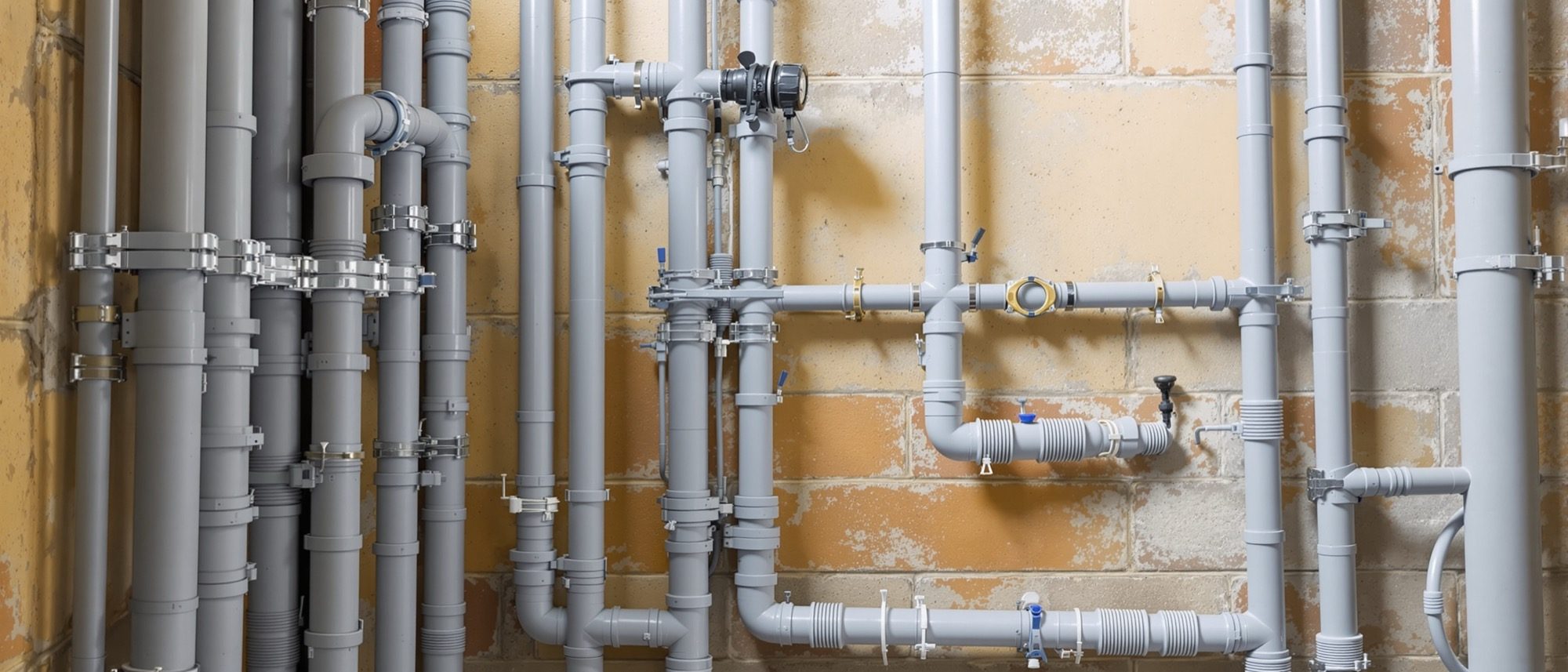
Plumbing Systems
Soil, waste and vents — the pipework, the trap, and the digital model.
Plumbing is the art of the trap and the stack. The drainage systems — single-stack, one-pipe and two-pipe — differ in how they carry soil and waste and whether they vent the traps. Every trap holds a ~50 mm water seal against foul gases, and venting exists because that seal can be siphoned away. Learn the systems, the traps, the codes — and how BIM coordinates a plumbing layout in 3D.
Learning objectives
By the end of this lesson, you will be able to — mapped to the course outcomes for Design of Structures I:
Distinguish the single-stack, one-pipe and two-pipe drainage systems.
Explain the trap seal, how it is lost, and why venting exists.
Select pipe materials and apply the relevant plumbing codes.
Describe how BIM coordinates plumbing layouts and detects clashes.
The drainage systems
The two-pipe system keeps soil and waste in separate stacks; the one-pipe combines them with a vent; the single-stack uses one stack with no separate vent. BIM models the lot in 3D and catches clashes before the site does.[3, 7]
Soil & waste apart
The two-pipe system keeps soil (WCs, urinals) and waste (basins, sinks, baths) in completely separate stacks, each with its own vent. It is the safest and most material-heavy — the conservative choice.[3]
Traps, fixtures & codes
Every fixture has a trap holding a ~50 mm seal against sewer gas; siphonage and back-pressure can lose it, which is why we vent. Fixtures are sized by fixture units; pipes are tested for water-tightness; the codes are NBC Part 9, SP 35 and UIPC-I.[3]
A water plug
Every fixture has a trap holding a ~50 mm water seal that blocks foul sewer gases from entering the building. P-traps exit horizontally (wall), S-traps vertically (floor); the gully and nahani traps drain floors; the intercepting trap isolates the property from the public sewer.[3]
At a glance
| Aspect | One | The other |
|---|---|---|
| Number of stacks | Two-pipe: soil and waste separate | One-pipe: combined, plus a vent |
| Venting | One-pipe: separate anti-siphonage pipe | Single-stack: no separate vent |
| Pipe duty | Soil pipe: WC/urinal (excreta) | Waste pipe: basin/sink/bath (used water) |
| Trap exit | P-trap: horizontal (wall) | S-trap: vertical (floor), prone to self-siphonage |
| Clash type (BIM) | Hard: physical overlap | Soft: clearance / access violation |
Key terms
Soil and waste carried in two separate, separately-vented stacks.
A single combined soil + waste stack with a separate anti-siphonage vent pipe.
One combined stack with no separate vent; seals protected by stack size and seal depth.
A water-filled bend (~50 mm seal) blocking sewer gases from entering the building.
Loss of a trap seal by suction — self (own discharge) or induced (a neighbour's).
A pipe admitting air to relieve pressure swings and protect trap seals.
Soil = WC/urinal discharge (excreta); waste = basin/sink/bath used water.
A relative load weighting per appliance, used to size stacks and drains.
A 3D coordinated model that finds pipe/beam/duct conflicts before construction.
Studio task
Sketch a single bathroom's plumbing, marking the soil pipe, waste pipe, vent and each trap. Then say which drainage system (single-stack / one-pipe / two-pipe) you would use for a 10-storey block, and one way BIM would help coordinate it.
Self-assessment
1. In a two-pipe drainage system —
2. A trap seal is lost by all of these EXCEPT —
3. Clash detection in BIM is used to —
Recap
References & further reading
- [3]National Building Code of India (NBC 2016) Part 9 — Plumbing Services; SP 35 (S&T):1987 — Handbook on Water Supply and Drainage; IS 1172.
- [7]Building Information Modelling (BIM) for MEP — federated models, clash detection, Revit MEP / Navisworks / IFC / LOD (industry practice).
Further reading
- S.C. Rangwala, Water Supply and Sanitary Engineering — plumbing systems and traps.
- B.C. Punmia et al., Building Construction — plumbing and drainage.
- NBC 2016 Part 9 and SP 35 — the plumbing codes.
Sources gathered and fact-checked June 2026. Published values vary by source, sample and method — treat as indicative and confirm against the cited standard before structural use.
The author
Amogh N P
Architect, interior designer, and creative polymath. Studio Matrx began in his notebooks — his vision of design made honest, useful, and open to everyone. Its Academy is written and taught in his memory, and free, forever.
More about Amogh →