
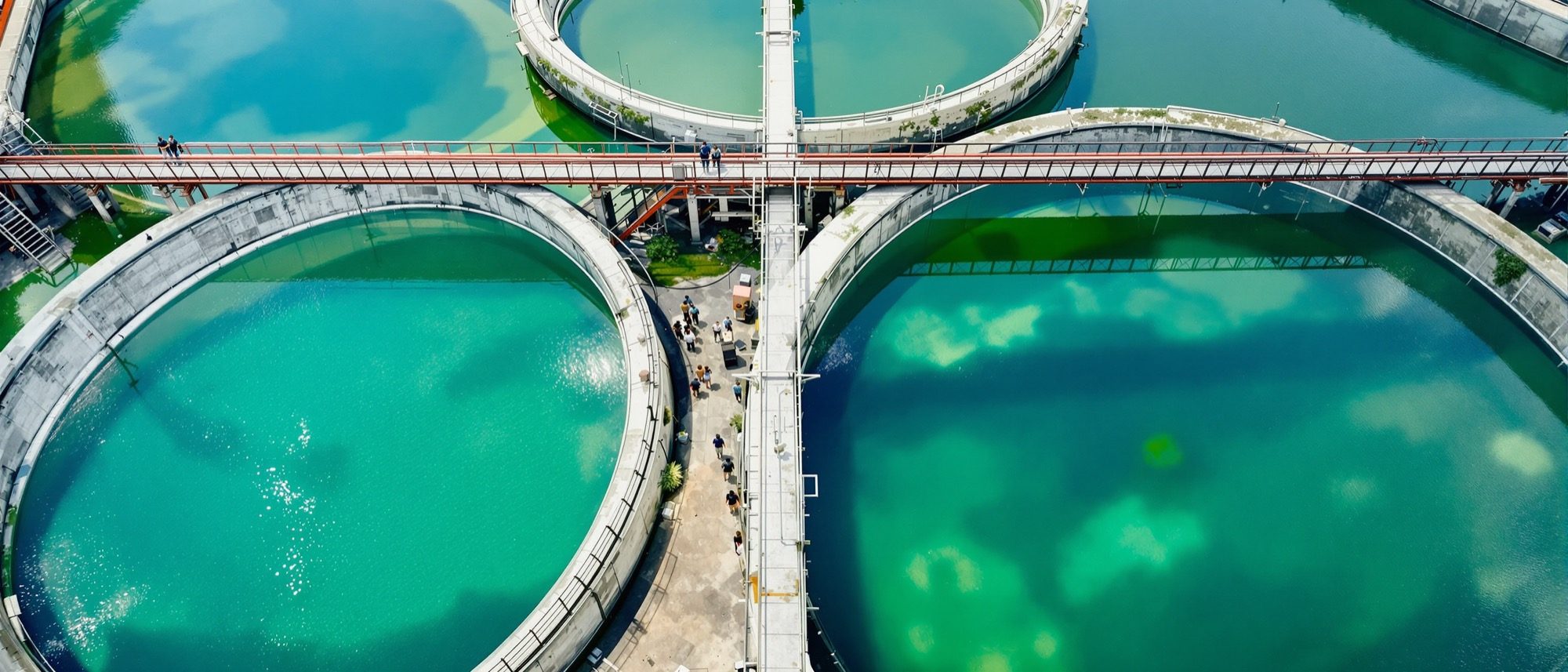
Water Treatment & Distribution
From the source to the tap — making water safe, and getting it there.
Raw water is rarely fit to drink. The treatment train makes it potable — sedimentation settles the solids, sand filters polish it, and chlorination kills the pathogens. Then it must reach the tap: stored, distributed by gravity from an overhead tank, piped, tested and conserved. Learn the train, the filters, and how to size a building's water demand from the LPCD figures of IS 1172.
Learning objectives
By the end of this lesson, you will be able to — mapped to the course outcomes for Design of Structures I:
Sequence the water treatment train and explain each stage.
Compare slow, rapid and pressure sand filters by their filtration rate and working.
Describe distribution in buildings — systems, pipes, testing and water reuse.
Compute a building's daily water demand and its storage from IS 1172 LPCD values.
Making water potable
Conventional treatment runs screening → coagulation → sedimentation → filtration → disinfection. Sand filters are the heart of it: slow (~100–200 L/m²/hr, biological) and rapid (~5,000, after coagulation).[4, 5]
Getting it to the tap
Buildings distribute water by direct supply, down-feed from an overhead tank, or a hydro-pneumatic set, through GI/PVC/CPVC/copper pipes, hydrostatically tested — and conserve it by reuse and rainwater harvesting.[3]
Direct, down-feed, pumped
Water reaches fixtures by direct supply (mains pressure), down-feed from an overhead tank (gravity — the common Indian multistorey method), or a hydro-pneumatic set (pressurised vessel + pumps). The overhead tank buffers peak demand when the pump is off.[3]
Water-demand calculator
Size a building's daily demand and storage from the IS 1172 LPCD values. 100 residents × 135 LPCD = 13,500 litres/day — split into an overhead tank (~1/3) and an underground sump (~2/3).[5]
Water demand & storage (IS 1172)
Daily demand = occupancy × 135 L (per person). Total storage ≈ one day; split overhead tank ~1/3 and underground sump ~2/3 (a common design convention).
0 L/day
Daily demand
0 L
Overhead tank (~1/3 day)
0 L
Underground sump (~2/3 day)
= 13.5 m³/day total. Hospitals/hotels are per bed; restaurants/cinemas per seat.
| Building type | Water supply (IS 1172) | Basis |
|---|---|---|
| Residences (full flushing) | 135 litres | per person/day |
| Hostels / nurses' homes | 135 litres | per person/day |
| Hotels | 180 litres | per bed/day |
| Hospitals (≤ 100 beds) | 340 litres | per bed/day |
| Hospitals (> 100 beds) | 450 litres | per bed/day |
| Offices | 45 litres | per person/day |
| Restaurants | 70 litres | per seat/day |
| Cinemas / theatres | 15 litres | per seat/day |
| Day schools | 45 litres | per person/day |
| Boarding schools | 135 litres | per person/day |
At a glance
| Aspect | One | The other |
|---|---|---|
| Filtration rate | Slow sand: ~100–200 L/m²/hr | Rapid sand: ~5,000 L/m²/hr |
| Pre-treatment | Slow: no coagulation needed | Rapid: needs coagulation first |
| Cleaning | Slow: scrape the top sand | Rapid: backwash (air + water) |
| Sedimentation | Plain: settleable solids only | With coagulant: colloids form flocs |
| Distribution | Direct: mains pressure | Down-feed: gravity from overhead tank |
Key terms
Gravity settling of suspended solids in a slow-moving tank.
Alum neutralises colloid charges, then gentle mixing grows settleable flocs.
A low-rate (~100–200 L/m²/hr) biological filter using a schmutzdecke; no coagulation.
A high-rate (~5,000 L/m²/hr) filter needing coagulation and backwashing.
A rapid sand filter housed in a closed pressure vessel.
The biological skin atop a slow sand filter that does the cleaning.
Disinfection with chlorine, leaving a free residual (~0.2 mg/l) in the network.
Litres per capita per day — the per-person water-demand design unit (IS 1172).
Supplying fixtures by gravity from an overhead tank.
Worked example
A residential building of 100 occupants at 135 LPCD: demand = 100 × 135 = 13,500 L/day = 13.5 m³. Overhead tank ≈ 1/3 day = 4,500 L; underground sump ≈ 2/3 day = 9,000 L. Re-run it in the calculator for an office (45 LPCD) or a hotel (180 L/bed) to see how the type changes everything.
Self-assessment
1. The filtration rate of a rapid sand filter is about —
2. Per IS 1172, the water supply for a hospital with more than 100 beds is —
3. Free residual chlorine recommended at the consumer's tap is about —
Recap
References & further reading
- [1]Conventional water treatment process — screening, coagulation, sedimentation, filtration, disinfection (public-health engineering references).
- [2]M.N. Rao & A.K. Datta, Waste Water Treatment. Oxford & IBH, 2007.
- [3]National Building Code of India (NBC 2016) Part 9 — Plumbing Services; SP 35 (S&T):1987 — Handbook on Water Supply and Drainage.
- [4]Sand filtration (slow ~100–200, rapid ~5,000 L/m²/hr) and chlorination (residual ~0.2 mg/l) — environmental engineering references.
- [5]IS 1172:1993 — Basic Requirements for Water Supply, Drainage and Sanitation (LPCD figures). Bureau of Indian Standards.
Further reading
- S.C. Rangwala, Water Supply and Sanitary Engineering. Charotar Publishing.
- B.C. Punmia, Ashok Kumar Jain & Arun Kumar Jain, Water Supply Engineering. Laxmi Publications.
- M.N. Rao & A.K. Datta, Waste Water Treatment.
Sources gathered and fact-checked June 2026. Published values vary by source, sample and method — treat as indicative and confirm against the cited standard before structural use.
The author
Amogh N P
Architect, interior designer, and creative polymath. Studio Matrx began in his notebooks — his vision of design made honest, useful, and open to everyone. Its Academy is written and taught in his memory, and free, forever.
More about Amogh →