
Electrical Systems & Lighting Design
Power down the wires, and light by the lumen.
Electricity arrives at high voltage, is stepped down by a transformer, split at the distribution boards and protected by switchgear — and the connected load, times a demand factor below one, gives the maximum demand. Then comes light: sources from the inefficient incandescent to the LED, described by colour temperature and rendering. Learn the supply chain, and the lumen method that turns a required lux level into a number of luminaires.
Learning objectives
By the end of this lesson, you will be able to — mapped to the course outcomes for Design of Structures I:
Trace the electrical supply chain from transformer to final circuit.
Calculate maximum demand from connected load and demand factor, and convert kW to kVA.
Classify light sources by efficacy, colour temperature and colour rendering.
Size the lighting for a room by the lumen method.
Power down the wires
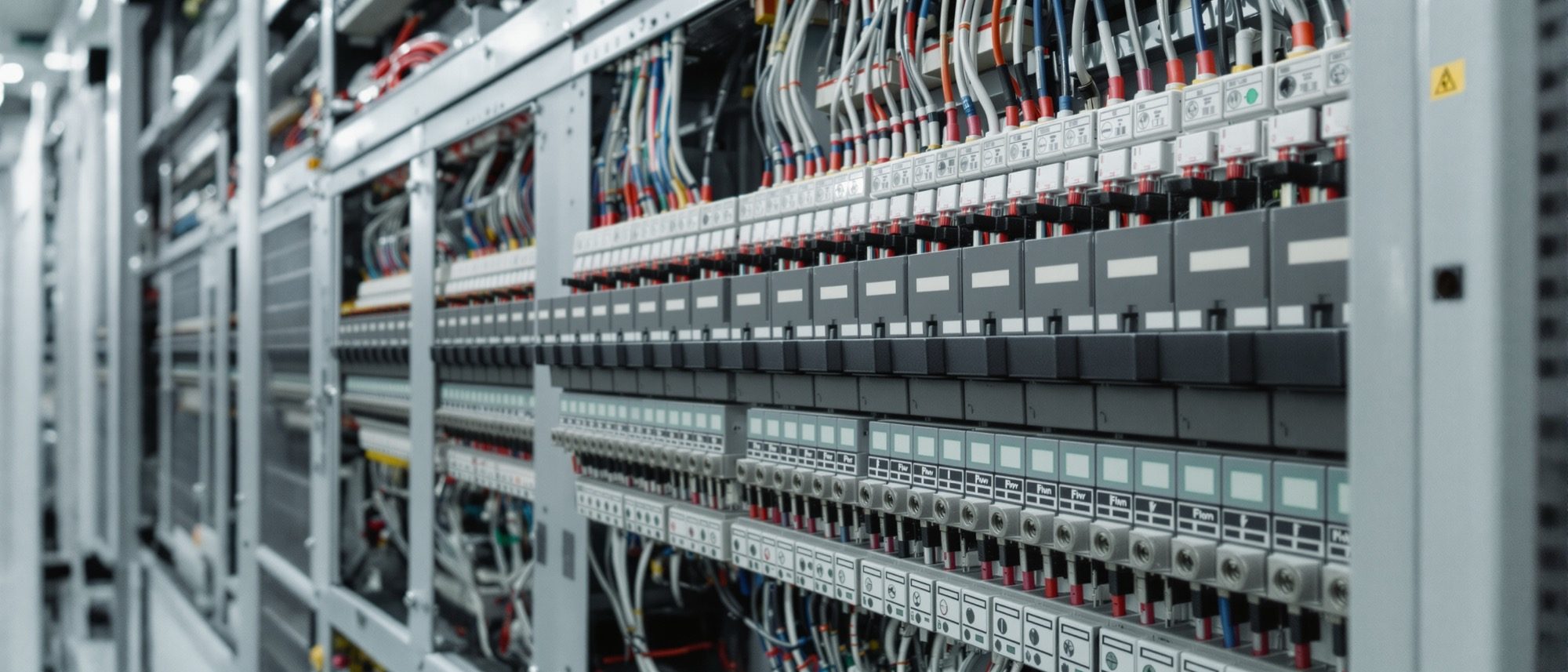
Power flows transformer → main panel → distribution boards → final circuits, protected by MCBs (equipment) and RCCBs (people). Maximum demand = connected load × demand factor (< 1); kVA = kW ÷ power factor.[8]
Transformer to circuit
Power arrives as HT/LT supply, a transformer steps it down (e.g. 11 kV → 415/240 V), the main LT panel feeds distribution boards (DBs), and each DB feeds the final sub-circuits. A standby DG set covers mains failure.[8]
Light by the lumen
Sources rank by luminous efficacy (LED ~100–150 lm/W beats incandescent ~15); colour temperature (K, higher = cooler) and CRI are independent. The lumen method sizes the lighting: N = (E·A)/(F·UF·MF).[9, 10]
Efficacy rising
Light sources differ hugely in luminous efficacy (lumens per watt): incandescent ~10–17, CFL ~50–70, fluorescent tube ~50–100, and LED ~80–150+ — which is why LED has displaced the rest. Spectral energy distribution sets a source's colour and rendering.[9]
| Light source | Luminous efficacy | Note |
|---|---|---|
| Incandescent | ≈ 10–17 lm/W | Cheap, warm, CRI ≈ 100, but very inefficient and short-lived. |
| Halogen | ≈ 16–24 lm/W | An improved incandescent; crisp white, still inefficient. |
| CFL | ≈ 50–70 lm/W | Compact fluorescent — efficient, contains mercury, now largely displaced by LED. |
| Fluorescent tube | ≈ 50–100 lm/W | Linear T8/T5 tubes — long the office workhorse. |
| LED | ≈ 80–150+ lm/W | The modern standard — efficient, long-lived, dimmable; efficacy still rising. |
Lumen-method calculator
Pick a room (which sets the required lux), set the area, lumens per fitting and the loss factors, and read off the number of luminaires. An office of 80 m² at 300 lux, 4000 lm fittings, UF 0.5, MF 0.8 needs 15.[10]
Lumen method · number of luminaires
N = (E·A) / (F·UF·MF) — required lux E = 300. UF and MF are losses, so they sit in the denominator.
0 fittings
Luminaires required
0.0
Exact N
0 lux
Required illuminance
Total flux needed = 24,000 lm on the working plane; round up to whole fittings.
| Room / task | Typical lux | Range (IS 3646 / NBC) |
|---|---|---|
| Corridors / stairs | 100 lux | 100–200 lux |
| Living room (general) | 150 lux | 100–200 lux |
| Kitchen | 200 lux | 200–300 lux |
| Reading / study | 300 lux | 150–300 lux |
| General office | 300 lux | 300–500 lux |
| Drawing office (boards) | 500 lux | 500–750 lux |
At a glance
| Aspect | One | The other |
|---|---|---|
| Two factors | Demand factor: max ÷ connected (< 1) | Diversity factor: Σ maxima ÷ system max (≥ 1) |
| kW vs kVA | kW: real (working) power | kVA: apparent power = kW ÷ power factor |
| Two protections | MCB: overload / short-circuit (equipment) | RCCB/ELCB: earth-leakage (people) |
| Colour | Colour temperature: the white's tone (K) | CRI: colour fidelity (0–100) — independent |
| Lumen-method losses | UF (~0.4–0.6): flux reaching the plane | MF (~0.7–0.8): derating for dirt/ageing |
Key terms
A board of MCBs feeding the final sub-circuits of a zone or floor.
Maximum demand ÷ connected load — always less than one.
Sum of individual maxima ÷ the coincident system maximum — always ≥ 1.
Miniature circuit breaker — trips on overload or short-circuit.
Earth-leakage breaker — trips on a live/neutral imbalance to prevent shock.
Light output per watt (lm/W) — incandescent ~15, LED ~100–150.
The white's tone in Kelvin; higher K is cooler/bluer (6500 K daylight).
How faithfully a source renders colour, 0–100; independent of colour temperature.
N = (E·A)/(F·UF·MF) — the calculation that sizes a room's lighting.
UF (~0.4–0.6) = flux reaching the plane; MF (~0.7–0.8) = derating for dirt/ageing.
Worked example
A residence with 10 kW connected load at a demand factor of 0.6 has a maximum demand of 6 kW; at 0.8 power factor that is 7.5 kVA. And a 10 × 8 m office at 300 lux, with 4000-lumen fittings, UF 0.5 and MF 0.8: N = (300 × 80)/(4000 × 0.5 × 0.8) = 24,000/1,600 = 15 luminaires.
Self-assessment
1. A residence has 10 kW connected load and a demand factor of 0.6. The maximum demand is —
2. Which colour temperature gives the coolest (bluest) light?
3. In the lumen method N = (E·A)/(F·UF·MF), the maintenance factor —
Recap
References & further reading
- [8]National Building Code of India (NBC 2016) Part 8 — Building Services (Electrical); National Electrical Code of India / IS 732; IS 3043 (Earthing).
- [9]Lighting — luminous efficacy, colour temperature and colour rendering index (lighting design references; CIE).
- [10]The lumen method of lighting design and recommended illuminance — IS 3646 (Part 1):1992 / NBC 2016 Part 8; CIBSE.
Further reading
- NBC 2016 Part 8 and the National Electrical Code of India — building electrical services.
- IS 3646 (Part 1) — Code of Practice for Interior Illumination.
- Standard texts on building electrical services and illumination engineering.
Sources gathered and fact-checked June 2026. Published values vary by source, sample and method — treat as indicative and confirm against the cited standard before structural use.
The author
Amogh N P
Architect, interior designer, and creative polymath. Studio Matrx began in his notebooks — his vision of design made honest, useful, and open to everyone. Its Academy is written and taught in his memory, and free, forever.
More about Amogh →