
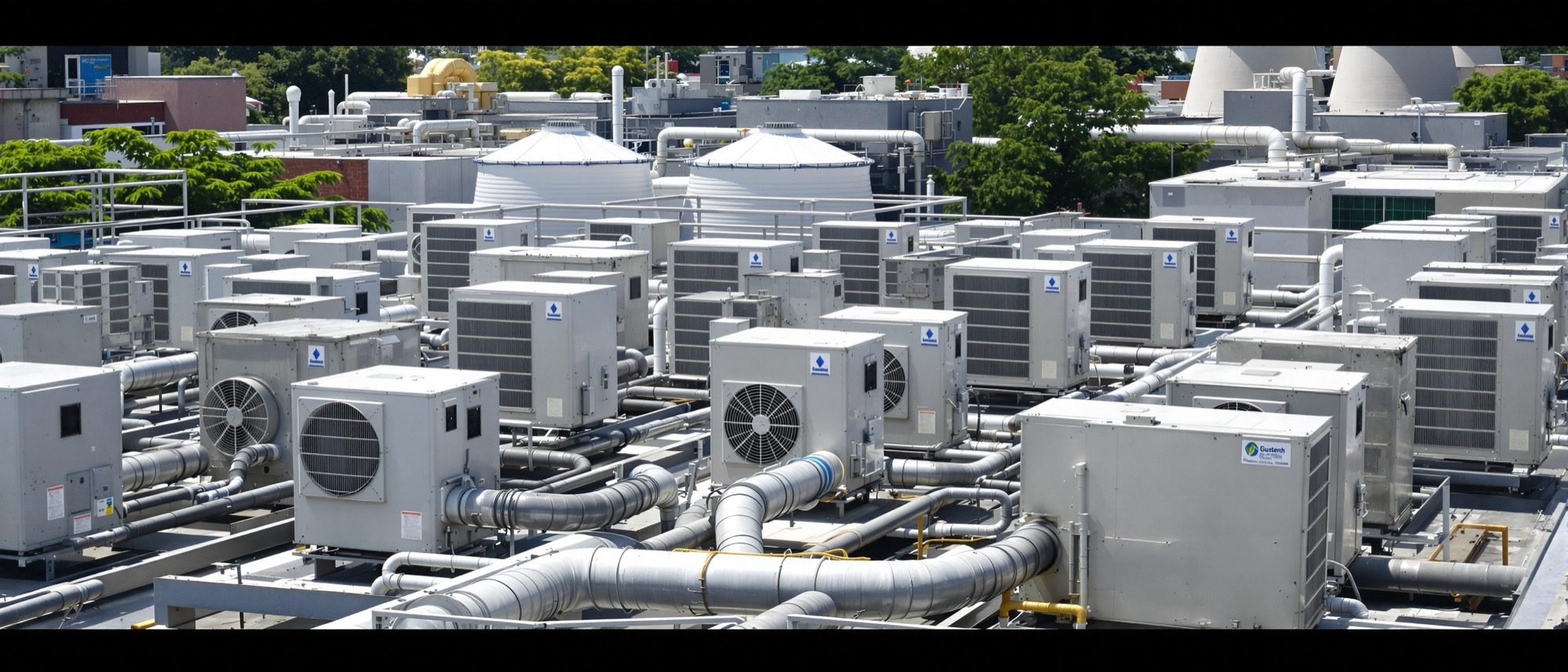
Air-Conditioning & Fire Protection
The cycle that cools — and the dampers that keep fire out of the ducts.
Air-conditioning controls four things — temperature, humidity, air movement and cleanliness — by running a refrigerant around the vapour compression cycle: the compressor squeezes it, the condenser rejects heat outdoors, the expansion valve drops its pressure, and the evaporator absorbs heat indoors. Learn the cycle, the system types, how to estimate cooling load in tons of refrigeration, and the fire protection an AC system demands.
Learning objectives
By the end of this lesson, you will be able to — mapped to the course outcomes for Design of Structures I:
Describe the vapour compression cycle and its four components in order.
Compare the types of AC system — window, split, packaged, central and VRF.
Estimate a space's cooling load in tons of refrigeration.
Explain the fire protection an AC system requires — fire and smoke dampers.
The cycle that cools
Compress → condense (reject heat outdoors) → expand (drop pressure) → evaporate (absorb heat indoors). The evaporator does the cooling; the condenser dumps the heat; the expansion valve drops pressure — it does not compress.[11]
Four steps, one loop
Air-conditioning controls temperature, humidity, air movement and cleanliness. It runs the vapour compression cycle: compress → condense (reject heat outdoors) → expand (drop pressure) → evaporate (absorb heat indoors) → repeat. Cooling happens at the evaporator (indoors); heat is dumped at the condenser (outdoors).[11]
From window unit to chilled-water plant
Systems scale from window/split/packaged (unitary, DX) to a central chilled-water plant and VRF. Capacity is in tons of refrigeration — 1 TR = 3.517 kW = 12,000 BTU/hr.[11, 12]
Window, split, packaged
Unitary systems are self-contained: a window unit (one box, one room), a split (indoor + outdoor unit, quieter), and a packaged unit (a larger DX unit, often rooftop, ducted to a few spaces). They are simple and cheap but less efficient at scale.[11]
| System | What it is | Best suited for |
|---|---|---|
| Window | A single self-contained unitary box, all components in one casing. | One small room — lowest cost; homes, small offices. |
| Split | An indoor unit (evaporator + fan) and an outdoor unit (compressor + condenser) joined by refrigerant pipes. | Single rooms where a window unit won't fit; quieter. |
| Packaged | A larger self-contained DX unit (often rooftop), ducted to several spaces. | Medium buildings — shops, restaurants, small floors. |
| Central chilled-water | Chillers make chilled water, pumped to AHUs/FCUs through piping; water-cooled with a cooling tower. | Large buildings — malls, hospitals, hotels, high-rises. |
| VRF / VRV | Variable refrigerant flow — one outdoor unit modulating refrigerant to many indoor units. | Modern multi-zone offices needing zoned control without a water plant. |
Cooling-load calculator
Estimate a space's cooling load in tons of refrigeration from its area and a use factor. A 50 m² office (~538 sqft) at ~120 sqft/TR ≈ 4.5 TR ≈ 15.8 kW — a first cut only; a real calc needs orientation, glazing, occupancy and ventilation.[12]
Cooling load · tons of refrigeration
A first-cut rule of thumb: TR ≈ area(sqft) ÷ (120 sqft/TR). 1 m² = 10.76 sqft; 1 TR = 3.517 kW. A real cooling-load calc needs orientation, glazing, occupancy and ventilation.
0.0 TR
Approx. cooling load
0.0 kW
In kW
0 sqft
Floor area
Rule-of-thumb estimate only — size the actual plant with a full load calculation.
Fire protection for AC
AC ducts can spread fire and smoke through a building. A fire damper closes on heat (a fusible link melts); a smoke damper closes on a smoke-detector signal; and the fans shut down on alarm.[13]
The hidden path
An AC system's ducts can carry fire and smoke from room to room and floor to floor — a hidden spread path. So where a duct crosses a fire-rated wall or floor, it must be protected, and on a fire alarm the air-moving fans serving the zone are shut down.[13]
At a glance
| Aspect | One | The other |
|---|---|---|
| Two unitary | Window: one box in an opening | Split: indoor + outdoor unit, quieter |
| Scale | Unitary: self-contained, per-room | Central: one chilled-water plant for the building |
| Carrying cooling | DX: refrigerant at the air coil | Chilled water: water carries cooling to AHUs/FCUs |
| Two heats | Sensible: changes temperature | Latent: removes moisture (humidity) |
| Two dampers | Fire damper: closes on heat (fusible link) | Smoke damper: closes on a smoke signal |
Key terms
Compressor → condenser → expansion → evaporator — the refrigeration cycle of nearly all AC.
Raises refrigerant vapour from low to high pressure; the work-input device.
Rejects heat outdoors, condensing high-pressure vapour to liquid.
Absorbs heat from the room (the cooling), boiling refrigerant to vapour.
Throttles the liquid — drops its pressure and temperature (it does not compress).
Air handling unit (fan+coil+filter, ducted) / fan coil unit (small per-room terminal).
Rejects condenser heat to atmosphere by evaporative cooling of water.
Cooling capacity unit; 1 TR = 3.517 kW = 12,000 BTU/hr.
The total heat (sensible + latent) to be removed from a space.
Duct devices closing on heat (fusible link) / on a smoke signal to block fire/smoke spread.
Worked example
A 50 m² office = 50 × 10.76 = 538 sqft. At ~120 sqft/TR, cooling load ≈ 538 ÷ 120 ≈ 4.5 TR; in kW, 4.5 × 3.517 ≈ 15.8 kW. Re-run it for a glassy top-floor space (~100 sqft/TR) and a shaded one (~150) to see the spread — then remember a real load calc needs far more than area.
Self-assessment
1. In the vapour compression cycle, heat is absorbed from the conditioned space at the —
2. One ton of refrigeration equals —
3. A fire damper in a duct typically closes because —
Recap
References & further reading
- [11]The vapour compression refrigeration cycle and AC systems (C.P. Arora; Severns & Fellows; ASHRAE Fundamentals).
- [12]Ton of refrigeration (1 TR = 3.517 kW = 12,000 BTU/hr) and area-based cooling-load estimation (HVAC references; rule-of-thumb).
- [13]Fire and smoke dampers, AHU shutdown and smoke management — NBC 2016 Part 4 (Fire & Life Safety).
Further reading
- C.P. Arora, Refrigeration and Air Conditioning. McGraw Hill.
- W.H. Severns & J.R. Fellows, Air Conditioning and Refrigeration. John Wiley.
- ASHRAE Handbook — Fundamentals; NBC 2016 Part 4.
Sources gathered and fact-checked June 2026. Published values vary by source, sample and method — treat as indicative and confirm against the cited standard before structural use.
The author
Amogh N P
Architect, interior designer, and creative polymath. Studio Matrx began in his notebooks — his vision of design made honest, useful, and open to everyone. Its Academy is written and taught in his memory, and free, forever.
More about Amogh →