
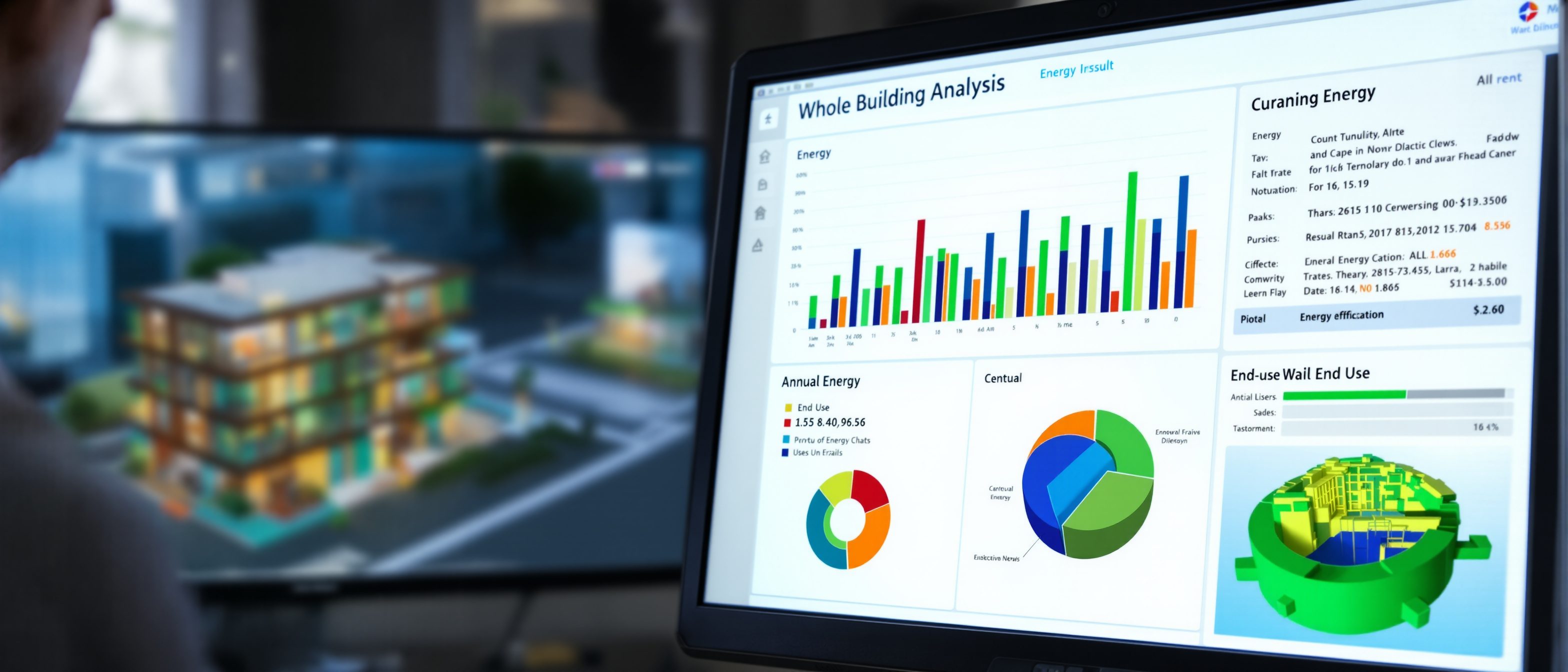
Whole-Building Energy Analysis
The energy balance — gains, losses and where the energy goes.
Whole-building energy analysis predicts how much energy a building uses over a year — and, more usefully, where it goes. Learn the energy balance the simulation solves — gains (solar, internal) and losses (envelope, ventilation), the loads, schedules and systems; how the result — annual energy and the Energy Performance Index — is read to find the biggest drains; and the difference between a fast early estimate and a detailed model.
Learning objectives
By the end of this lesson, you will be able to — mapped to the course outcomes for Building Performance Analysis:
Explain the energy balance — gains, losses, loads, schedules and systems.
Predict annual energy use and the Energy Performance Index.
Read an energy-use breakdown to find the biggest drains.
Distinguish an early-stage estimate from a detailed model.
The energy balance
Gains (solar, internal) warm the building and losses (envelope, ventilation) cool it; the mismatch is the load a system must meet, and the headline is the EPI in kWh/m²/year.[1]
Gains and losses
A building's energy use is the result of an ENERGY BALANCE that the simulation solves hour by hour. GAINS warm it: SOLAR gain (sun through glass), and INTERNAL gains from people, lights and equipment. LOSSES cool it: heat through the ENVELOPE (walls, roof, glazing), and by VENTILATION and INFILTRATION (air exchange). The mismatch between gains, losses and the comfort setpoint creates a heating or cooling LOAD, which a SYSTEM (HVAC) must meet, consuming energy. The simulation tracks all of this against the weather file to predict the year's use.[1]
Read where the energy goes
The end-use breakdown is where the design insight lives — find the biggest drain and test variants against it; and a fast early estimate and a detailed model serve two different moments.[1, 2]
Where to act
Energy analysis is a DIAGNOSTIC. Read the end-use breakdown to find the BIGGEST drain, then test design changes against it: a better envelope, a lower window-to-wall ratio, shading, a more efficient system, daylight-linked lighting. The value is in the COMPARISON — running a baseline and a variant and seeing which moves the number — not in the absolute figure. The architect's leverage is largest on the PASSIVE side (form, envelope, glazing, shading), which the early model captures; the systems engineer optimises the rest later.[1]
At a glance
| Aspect | Detail | Note |
|---|---|---|
| Gains | Solar + internal (people, lights, equipment) | Warm the building |
| Losses | Envelope + ventilation/infiltration | Cool it |
| Headline | Annual energy / EPI | kWh/m²/year |
| The insight | End-use breakdown | Where the energy goes |
| Early vs detailed | Fast estimate (form fluid) | Detailed model (later) |
Key terms
Gains (solar, internal) vs losses (envelope, ventilation) → loads → systems.
The heating or cooling a system must provide to hold comfort.
Energy Performance Index — annual energy use per m² (kWh/m²/year).
How energy splits across cooling, lighting, fans, plug loads — the design insight.
Fast, rough energy feedback while the form is still fluid.
A full systems-and-schedules model for code or design development.
Studio task
For an air-conditioned office in a hot Indian city, predict (in words) the likely end-use breakdown — which use dominates, and why? Then name three passive design changes an architect could make to cut the biggest drain, and explain why doing this early (when the form is fluid) matters more than a precise model later.
Self-assessment
1. The Energy Performance Index (EPI) is measured in —
2. The most USEFUL output of an energy analysis is usually —
3. A fast early-stage energy estimate is valuable because —
Recap
References & further reading
- [1]EnergyPlus / OpenStudio documentation + ASHRAE — the energy balance, loads, EPI, end-use breakdown.
- [2]Sefaira / early-stage energy-analysis guidance — fast feedback in early design.
- [3]Bureau of Energy Efficiency (BEE) — EPI benchmarks and the Indian context (cross-link Green Buildings).
Further reading
- Hensen & Lamberts (eds.) — Building Performance Simulation for Design and Operation.
- ASHRAE — Handbook of Fundamentals (loads and energy).
- EnergyPlus Engineering Reference.
Sources gathered and fact-checked June 2026. Published values vary by source, sample and method — treat as indicative and confirm against the cited standard before structural use.
The author
Amogh N P
Architect, interior designer, and creative polymath. Studio Matrx began in his notebooks — his vision of design made honest, useful, and open to everyone. Its Academy is written and taught in his memory, and free, forever.
More about Amogh →