
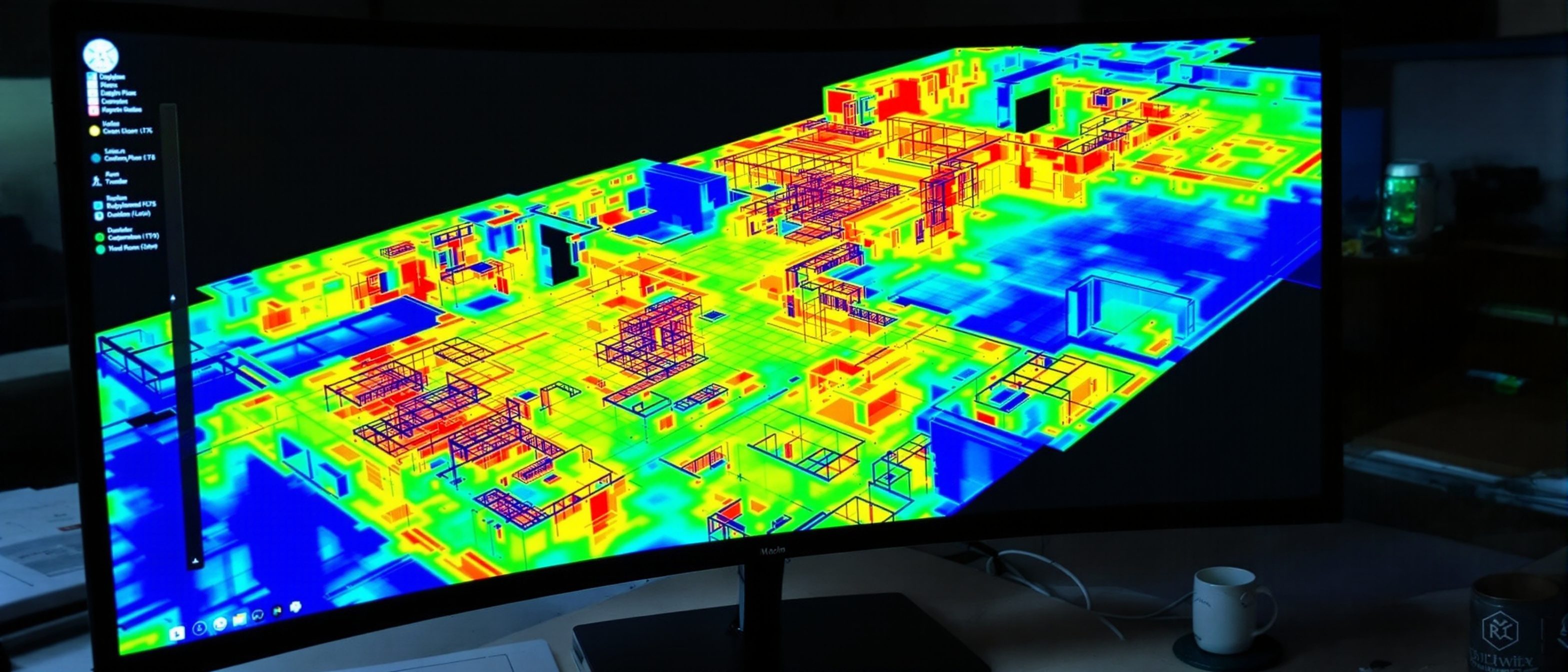
Daylight, Irradiation & Wind
The three analyses an architect runs most.
Three environmental analyses sit closest to the architect's hand. Daylight analysis — from the old static Daylight Factor to the climate-based spatial Daylight Autonomy (sDA), Annual Sunlight Exposure (ASE) and Useful Daylight Illuminance; solar irradiation and shading studies driven by the sun path; and wind / natural ventilation analysis with Computational Fluid Dynamics. Try the daylight-credit checker.
Learning objectives
By the end of this lesson, you will be able to — mapped to the course outcomes for Building Performance Analysis:
Explain daylight metrics — Daylight Factor, sDA, ASE and UDI.
Read a daylight result against a credit target (sDA/ASE).
Run solar-irradiation and shading studies from the sun path.
Explain wind and natural-ventilation analysis with CFD.
Daylight & irradiation
The old Daylight Factor is climate-blind; sDA and ASE are the modern measures — enough light AND not too much; and solar irradiation maps where the facade overheats and where shade is needed.[1, 2]
From factor to autonomy
Daylight is measured in ILLUMINANCE (lux on the working plane). The old DAYLIGHT FACTOR (DF) — daylight indoors as a % of outdoor light under a STANDARD OVERCAST sky — is simple but climate-blind (it ignores orientation and sun). Modern, climate-based metrics use the weather file: SPATIAL DAYLIGHT AUTONOMY (sDA) — the % of floor area that meets a target illuminance (typically 300 lux) for at least half the occupied hours; ANNUAL SUNLIGHT EXPOSURE (ASE) — the % of area getting too much direct sun (a glare proxy); and USEFUL DAYLIGHT ILLUMINANCE (UDI) — the % of time light is in a useful range. MISCONCEPTION→correct: 'the Daylight Factor tells you if a room is well daylit' — DF ignores climate and sun; sDA/ASE are the modern measures.[1, 2]
Check the daylight credit
Set the spatial Daylight Autonomy (sDA) and Annual Sunlight Exposure (ASE) and see whether the design meets the LEED v4 daylight option — a high sDA AND a low ASE.
Daylight credit · LEED v4 option
Enough daylight, and not too much glaring sun — both conditions met.
Good daylighting needs BOTH — a high sDA (enough light) and a low ASE (no glare).
Wind & ventilation
Wind and natural-ventilation analysis uses CFD to simulate airflow around and through the building; and every analysis yields a persuasive false-colour map — a model output, not a measurement.[1, 3]
How air moves
WIND and natural-ventilation analysis uses COMPUTATIONAL FLUID DYNAMICS (CFD) to simulate airflow — around the building (PEDESTRIAN WIND COMFORT: where gusts make a plaza unusable) and through it (NATURAL VENTILATION: whether openings actually drive enough air for cooling). CFD divides space into a mesh and solves the flow equations cell by cell. It is the most computationally costly and assumption-sensitive analysis, so it is used where airflow genuinely matters — a naturally-ventilated building, a windy tower base. MISCONCEPTION→correct: 'a window means natural ventilation' — air moves only with a pressure difference and a path; CFD shows whether the openings actually work together.[1, 3]
At a glance
| Aspect | Detail | Note |
|---|---|---|
| Daylight Factor | Static, overcast sky | Ignores orientation and sun |
| sDA / ASE | Climate-based (weather file) | Enough light AND not too much |
| Irradiation | kWh/m² per surface | Where it overheats / harvests |
| Wind (CFD) | Airflow around & through | Comfort and ventilation |
| The result | A false-colour map | A model output, not a measurement |
Key terms
Indoor daylight as a % of outdoor under an overcast sky — simple but climate-blind.
Spatial Daylight Autonomy — % of area reaching a target lux for ≥ half the hours.
Annual Sunlight Exposure — % of area getting too much direct sun (a glare proxy).
Solar energy (kWh/m²) falling on a surface, mapped from the sun path.
Computational Fluid Dynamics — simulates airflow around and through a building.
A simulation's colour result — a model output, not a measurement.
Studio task
Take a classroom and use the checker to test two glazing schemes: a small north window (try sDA 45%, ASE 4%) and a large west window (try sDA 70%, ASE 22%). Which passes, and why does the large window fail? Then describe, in two sentences, the overhang or fin you would add to the west window and why the low evening sun makes it hard.
Self-assessment
1. Spatial Daylight Autonomy (sDA) measures —
2. A room can pass sDA but fail ASE because —
3. Wind and natural-ventilation analysis is done with —
Recap
References & further reading
- [1]Reinhart, Daylighting Handbook; Ladybug Tools / Radiance documentation — daylight, irradiation and shading analysis.
- [2]IES LM-83 and LEED v4 — spatial Daylight Autonomy (sDA) and Annual Sunlight Exposure (ASE) metrics and thresholds.
- [3]CFD for the built environment (e.g. ANSYS / OpenFOAM, Autodesk CFD) — pedestrian wind comfort and ventilation.
Further reading
- Christoph Reinhart — Daylighting Handbook (I & II).
- Hensen & Lamberts (eds.) — Building Performance Simulation for Design and Operation.
- IES LM-83 — Approved Method for sDA and ASE.
Sources gathered and fact-checked June 2026. Published values vary by source, sample and method — treat as indicative and confirm against the cited standard before structural use.
The author
Amogh N P
Architect, interior designer, and creative polymath. Studio Matrx began in his notebooks — his vision of design made honest, useful, and open to everyone. Its Academy is written and taught in his memory, and free, forever.
More about Amogh →