
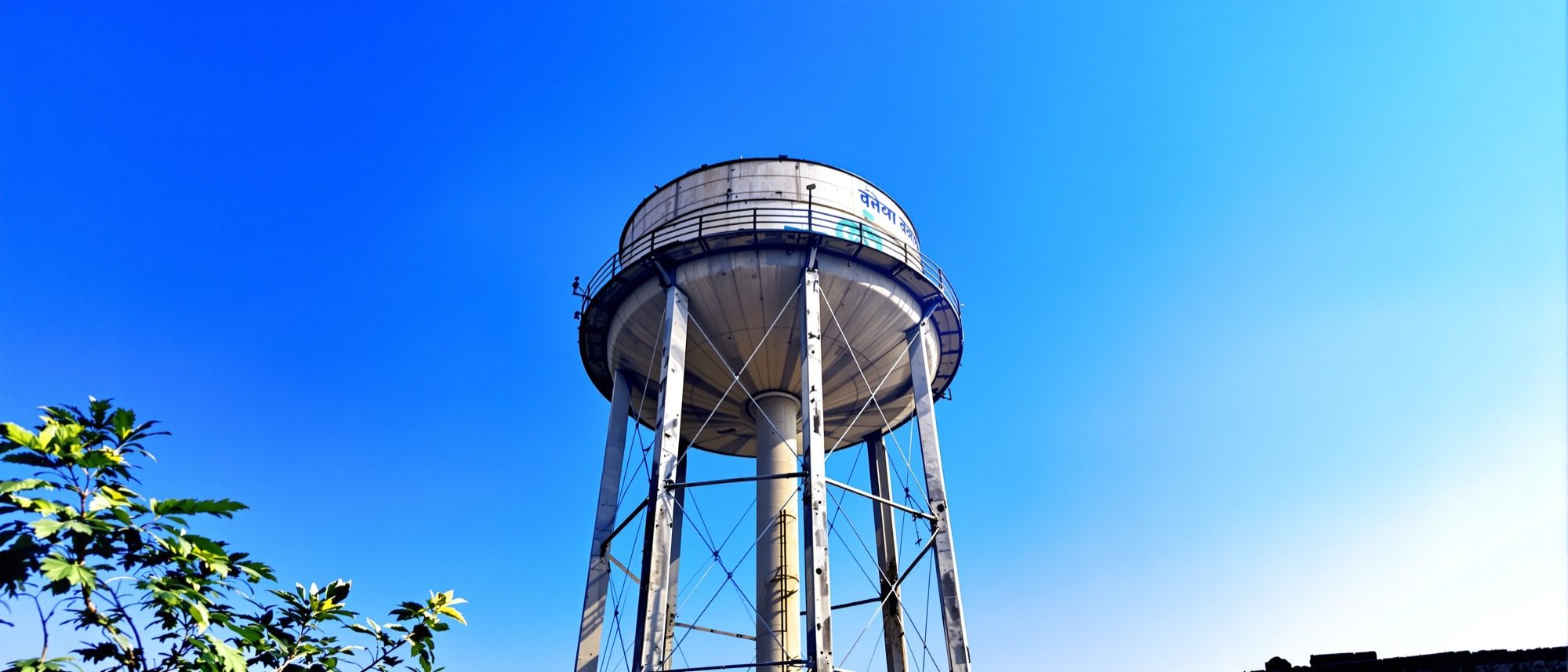
Liquid Storage Structures
A tank must not crack — water-tight RCC, designed to a stricter rule.
An ordinary RCC member may crack a little; a water tank must not — it would leak. That single requirement makes liquid-retaining design stricter than any other RCC: IS 3370 designs for no cracking (or cracks ≤ 0.2 mm), with low permissible stresses, M30 concrete and generous cover. Learn the families of tank, the hoop tension that governs a circular wall, and how to size a tank and its steel.
Learning objectives
By the end of this lesson, you will be able to — mapped to the course outcomes for Design of Structures I:
Classify water tanks by position (UG, on-ground, overhead) and shape (rectangular, circular, Intze).
Explain why liquid-retaining design is stricter than ordinary RCC — the no-crack philosophy of IS 3370.
Compute the capacity of a rectangular tank and the hoop tension in a circular tank wall.
Size the hoop steel from the tension and the IS 3370 permissible stress.
The families of tank
Tanks are grouped by position — underground, on-ground, overhead — and by shape — rectangular, circular, Intze. Each carries different loads, and all are designed water-tight to IS 3370.[1, 3]
UG, on-ground, overhead
Tanks are grouped as underground (below ground), resting on ground, and elevated/overhead on a staging of columns and braces. An underground tank must resist external earth pressure and uplift when empty, as well as water when full; an overhead tank carries water and self-weight onto a staging that also resists wind and earthquake.[1, 3]
Designing for no cracks
A circular wall works in hoop tension T = γHD/2 (max at base), carried by hoop steel sized at a low IS 3370 permissible stress (≈ 150 N/mm² for Fe415). A rectangular wall spans vertically or horizontally.[1, 4]
Why tanks are stricter
An ordinary RCC member may crack; a tank must not leak. IS 3370 designs for no cracking, or limits crack width to 0.2 mm on the liquid face (0.3 mm away from it), using low permissible stresses so the section stays largely uncracked. This is the whole reason liquid-retaining design differs from ordinary RCC.[1]
Water-tank calculator
Size a rectangular tank's capacity, or a circular tank's capacity, hoop tension and hoop steel. A 4 × 3 × 2.5 m tank holds 30,000 litres; an 8 m circular tank 4 m deep develops about 157 kN/m of hoop tension at its base.[1]
Water tank · capacity & hoop tension
Capacity = L × B × H (water depth, excluding freeboard).
0 litres
Capacity
0.0 m³
Volume
0.0 m²
Plan area
Leave ~150–300 mm freeboard above the water; design to IS 3370 for no cracking.
At a glance
| Aspect | One | The other |
|---|---|---|
| Position | Underground: earth pressure + uplift when empty | Overhead: water + self-weight on a wind/seismic staging |
| Shape | Rectangular: bending walls, small capacity | Circular: hoop tension, efficient for large capacity |
| Versus ordinary RCC | Ordinary: cracks tolerated, normal stresses | Tank: crack ≤ 0.2 mm, low stress (150), M30 min |
| Two methods | Working stress: elastic, low stresses, limits cracks | Limit state: ultimate strength + crack-width check |
| Wall action (circular) | Hoop tension T = γHD/2 | (Rectangular) bending + horizontal tension |
Key terms
RCC designed water-tight to IS 3370, with crack control as the governing criterion.
Circumferential pull in a circular tank wall from water pressure: T = γHD/2, max at base.
Designing so the section stays uncracked (or cracks ≤ 0.2 mm) to prevent leakage.
The low capped working stress (≈ 150 N/mm² steel, direct tension) used for water-tightness.
Clear height (≈ 150–300 mm) above the top water level — not counted in capacity.
The columns and braces carrying an overhead tank; resists gravity plus wind/seismic.
An economical overhead tank whose conical bottom thrust offsets the dome thrust.
Flotation pressure on an empty underground tank from the water table — a design case.
Worked example
A circular tank, diameter 8 m, water depth 4 m: capacity = (π/4)·8²·4 ≈ 201 m³. Hoop tension at base T = 9.81 × 4 × 8 / 2 = 156.96 kN/m; hoop steel Ast = 156.96 × 10³ / 150 ≈ 1046 mm²/m. Re-run it in the calculator and switch to a rectangular tank to compare.
Self-assessment
1. The maximum hoop tension per metre height in a circular tank wall is —
2. Liquid-retaining design differs from ordinary RCC mainly because it limits —
3. Freeboard in a water tank is —
Recap
References & further reading
- [1]IS 3370 — Concrete Structures for Storage of Liquids, Code of Practice (Parts 1, 2, 4). Bureau of Indian Standards.
- [2]IS 456:2000 — Plain and Reinforced Concrete, Code of Practice. Bureau of Indian Standards.
- [3]N. Krishna Raju, Advanced Reinforced Concrete Design. CBS Publishers.
- [4]B.C. Punmia, Ashok Kumar Jain & Arun Kumar Jain, Reinforced Concrete Structures (water tanks). Laxmi Publications.
Further reading
- N. Krishna Raju, Advanced Reinforced Concrete Design — the water-tank chapters.
- B.C. Punmia et al., Reinforced Concrete Structures.
- S. Ramamrutham, Design of Reinforced Concrete Structures.
Sources gathered and fact-checked June 2026. Published values vary by source, sample and method — treat as indicative and confirm against the cited standard before structural use.
The author
Amogh N P
Architect, interior designer, and creative polymath. Studio Matrx began in his notebooks — his vision of design made honest, useful, and open to everyone. Its Academy is written and taught in his memory, and free, forever.
More about Amogh →